

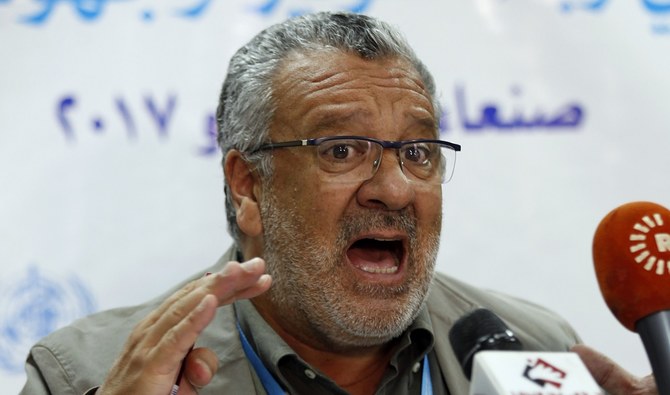
Italian WHO aid official under investigation for corruption in Yemen  

Nevio Zagaria, was a WHO country representative for Yemen. (File/AFP)
Updated 07 August 2019
Follow

Italian WHO aid official under investigation for corruption in Yemen  

  • WHO is investigating into its Yemen operations led by Italian doctor Nevio Zagaria
  • Workers said the WHO’s Yemen office under Zagaria was riddled with corruption and nepotism

An Associated Press investigation has found that more than a dozen United Nations aid workers deployed to deal with the humanitarian crisis caused by five years of conflict in Yemen are being accused of graft to enrich themselves from an international outpouring of donated food, medicine, fuel and money.

The AP obtained UN internal investigative documents, and interviewed eight aid workers and former government officials. The upshot: internal auditors from the World Health Organization are investigating allegations that unqualified people were placed in high-paying jobs, hundreds of thousands of dollars were deposited in staffers’ personal bank accounts, dozens of suspicious contracts were approved without the proper paperwork, and tons of donated medicine and fuel went missing.

Critics of such corruption say it threatens the international lifeline on which the majority of Yemen’s 30 million people rely. Last year, the UN said international donors pledged $2 billion for humanitarian efforts in Yemen.

The main focus of WHO’s investigation into its Yemen operations is Nevio Zagaria, an Italian doctor, who was chief of the agency’s Sanaa office from 2016 until September 2018, according to three individuals with direct knowledge of the investigation.


The only public announcement of the probe came in a sentence buried in the 37 pages of the internal auditor’s 2018 annual report of activities worldwide. The report did not mention Zagaria by name.

The report, released May 1, found that financial and administrative controls in the Yemen office were “unsatisfactory” — its lowest rating — and noted hiring irregularities, no-competition contracts and lack of monitoring over procurement.

WHO spokesman Tarik Jasarevic confirmed to the AP that the investigation is underway. He said Zagaria retired in September 2018, but he would not confirm or deny that Zagaria specifically was under investigation.

“The Office of Internal Oversight Services is currently investigating all concerns raised,” he said. “We must respect the confidentiality of this process and are unable go into details on specific concerns.”

Four current and former workers said the WHO’s Yemen office under Zagaria was riddled with corruption and nepotism.

Zagaria brought in junior staffers who worked with him in the Philippines and promoted them to high-salary posts though they were unqualified, three individuals said.

Two of them — a Filipino university student and a former intern — were given senior posts, but their only role was to take care of Zagaria’s dog, two of the officials said.

“Incompetent staff with heavy salaries” undermined the quality of work and monitoring of projects and created “many loopholes for corruption,” a former aid official said.

Zagaria also allegedly approved suspicious contracts signed by staffers with no competitive bidding or documentation for the spending. According to internal documents, local firms contracted to provide services at WHO’s Aden office were later found to have hired WHO staffers’ friends and family and overcharged for services. The owner of one firm was seen handing cash to one staffer, the documents show — an apparent kickback.

Under Zagaria, aid funds meant to be spent during emergencies were also used with little accountability or monitoring, according to internal documents.

Under WHO rules, aid money can be transferred directly into the accounts of staffers, a measure meant to speed up the purchasing of goods and services in a crisis. The WHO says the arrangement is needed to keep operations going in remote areas because Yemen’s banking sector is not fully functioning.

Because they are supposed to be restricted to emergencies, there is no requirement that spending of these direct transfers be itemized. Zagaria approved direct transfer of cash worth a total of $1 million for certain staffers, according to internal documents. But in many cases it was unclear how they spent the money.

Zagaria did not respond to emailed questions from the AP.


Kuwait airport targeted as Iran presses on with attacks on Gulf states

Updated 5 sec ago
Follow

Kuwait airport targeted as Iran presses on with attacks on Gulf states

KUWAIT CITY/DUBAI: Gulf nations on Sunday reported new missile and drone attacks, while Iran vowed to press on with strikes against neighboring countries as the war entered its second week.
Kuwait’s defense ministry and Kuwait's Public Authority for Civil Aviation said that the country’s forces were “responding to a wave of hostile drones” that penetrated the country’s airspace.
“The fuel tanks of Kuwait International Airport were attacked by drones in a direct targeting of vital infrastructure,” the defense ministry spokesman said, according to a post by the Kuwaiti military on X.

Saudi Arabia's Ministry of Defense was also reporting a wave of drone attacks, saying 21 unmanned aerial vehicles were intercepted and destroyed in the last four hours.

Major General Turki Al-Maliki, spokesman for the Defense Ministry, said in separate posts on X that 13 drones were intercepted and destroyed east of the national capital, Riyadh city, while eight drones were shot down just after entering Saudi air space.

Before midnight on Saturday, loud explosions were heard in Dubai, the Qatari capital Doha and Bahrain’s Manama, with attacks reported in the UAE, Saudi Arabia, Qatar and Kuwait, where the national oil company announced a “precautionary” cut to production.
The attacks came despite Iran’s president earlier apologizing to Gulf countries for earlier strikes. He had said they would no longer be targeted unless strikes were launched from their territory first.
Hours later, Iran said it would continue conducting strikes on sites in Gulf countries which were “at the disposal of the enemy.”
UAE President Mohammed bin Zayed Al Nahyan said in a rare televised address that the Emirates were in “a period of war” and “will emerge stronger” from it.
Dubai authorities said Saturday evening one person had been killed by debris from an “aerial interception,” adding they were a Pakistani national.

Dubai airport closed, reopens 

Earlier in the day, Dubai closed its main airport — the world’s busiest for international traffic — after authorities said an unidentified object was intercepted nearby.
The government said there had been “a minor incident resulting from the fall of debris after an interception,” without directly mentioning the airport. It said there were no injuries.
The Flightradar24 tracking website earlier showed planes circling above the airport in an apparent holding pattern.
In a statement since deleted from X, Emirates, the largest airline in the Middle East, had announced it was suspending all flights to and from Dubai until further notice, but later said it had resumed operations.
The UAE, a US ally and home to American military installations, has been the most heavily targeted nation in the Gulf during the war.
Earlier in the day, the Ministry of Defense said that of the 16 ballistic missiles fired at the country on Saturday, all but one had been intercepted, with that missile falling into the sea.
Of the 121 drones detected, 119 were brought down, while two fell within Emirati territory.
The barrage brings the number of ballistic missiles detected by the UAE since the start of the war last Saturday to 221, the defense ministry said, with the number of drones surpassing 1,300.
Flights from Dubai’s main airport had partially resumed on Monday despite daily drone attacks targeting sites in the UAE.
Last Saturday, four employees were injured and an airport terminal damaged as the war broke out following US-Israeli strikes on Iran.
Iranian attacks have also hit Abu Dhabi airport, the upmarket Palm Jumeirah development and the Burj Al Arab luxury hotel over the past week, while drone debris caused a fire at the US consulate in Dubai on Tuesday.

Relentless air threats

Elsewhere in the Gulf on Saturday, Qatar’s defense ministry said its military had intercepted two missile attacks targeting the country.

Kuwait said Saturday night it had intercepted seven drones since dawn, with the attacks resulting “only in material damage from falling debris.”
And Bahrain said it has intercepted and 92 missiles and 151 drones since the start of the “brutal Iranian aggression.”
AFP journalists heard an explosion Saturday night in Manama, Bahrain’s capital, as authorities said one person was injured after rocket shrapnel fell in a public street.
In Saudi Arabia, the defense ministry said it had destroyed three ballistic missiles heading toward Prince Sultan Air Base, which hosts American troops, as well as 17 drones over the Shaybah oil field in the southeast.
Kuwait also reported intercepting a drone, while the country’s national oil company announced a “precautionary” cut to its production of crude due to Iranian attacks and threats to the Strait of Hormuz, a key transit point for Gulf hydrocarbons.
Further north, Jordan accused Iran of directly targeting sites in the kingdom, saying Tehran had fired 119 missiles and drones in the past week.
“These missiles and drones were targeting vital installations inside Jordan and were not passing through our territories,” said military spokesman Brig. Gen. Mustafa Hayari.

(With AFP)