



KARACHI: Pakistan’s federal minister for maritime affairs, Ali Haider Zaidi kicked off the ‘Clean Karachi’ campaign in a ceremony with the mayor present on Sunday, but provincial authorities said they were not invited, highlighting existing rivalries between the federal, provincial and local governments in Pakistan’s largest city.
However, Sunday’s kick-off ceremony for the ambitious clean-up campaign did little in the way of revealing any on-ground details about the initiative itself.
“No one invites me but we are doing our work much before this drive & will continue,” provincial minister for local bodies, Saeed Ghani, tweeted hours before the ceremony began at Karachi’s Port Trust (KPT) head office.
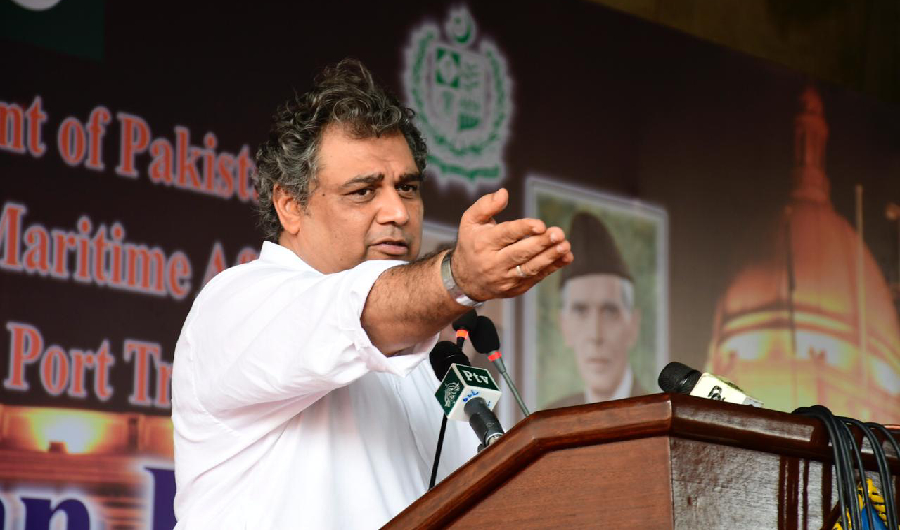
Federal minister of Maritime Affairs, Ali Haider Zaidi, addresses an audience at the launching ceremony of “Clean Karachi” drive in Karachi on August 4, 2019. The largest and most densely populated city of Pakistan, Karachi produces 12,000 metric tons of trash on a daily basis. (Photo courtesy: PTI)
The largest and most densely populated city of Pakistan, Karachi produces 12,000 metric tons of trash every day. 70 percent of it is disposed of through proper channels, but whatever remains creates a staggering backlog that grows with each passing day.
“All the work will be done by the mayor, we are here to support you,” Zaidi told Mayor Wasim Akhter and added that he wanted to register at least 15,000 volunteers by the end of the day to get to work in six districts.
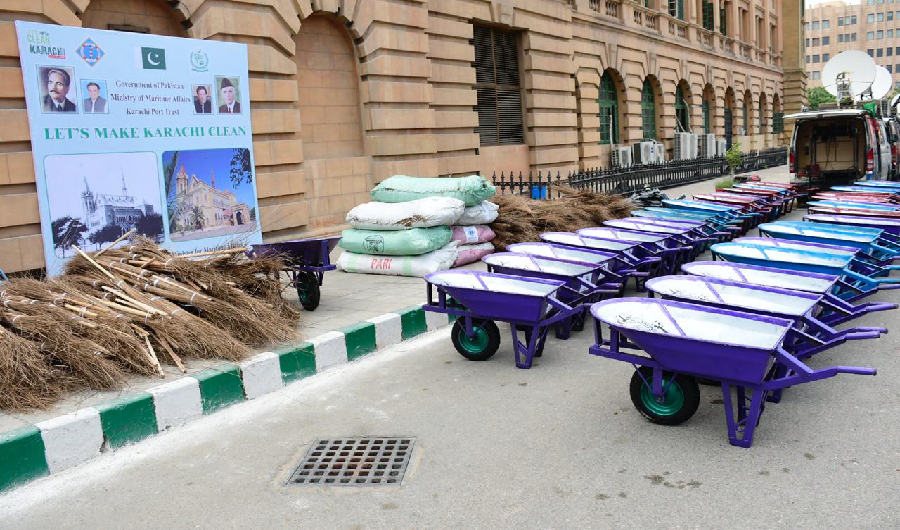
Handcarts, brooms and other items required for cleaning and lifting garbage have been brought to Karachi Port Trust headquarters, from where the drive officially started on Sunday, August 4, 2019. (Photo by PTI media)
No details were shared about how that plan would be executed, manned, or how such massive amounts of garbage would be transported to dumping sites.
On Friday, Ghani had told Arab News that he welcomed the cleanup campaign but that Zaidi had “not contacted us yet for any logistical support or other help.”
Karachi’s political structure means even the most basic governance issues are a challenge to address.
In the national assembly, 14 out of 21 national assembly members and in the provincial assembly, 22 out of 42 provincial assembly members belong to the Pakistan Tehreek-e-Insaf party that rules at the federal level.
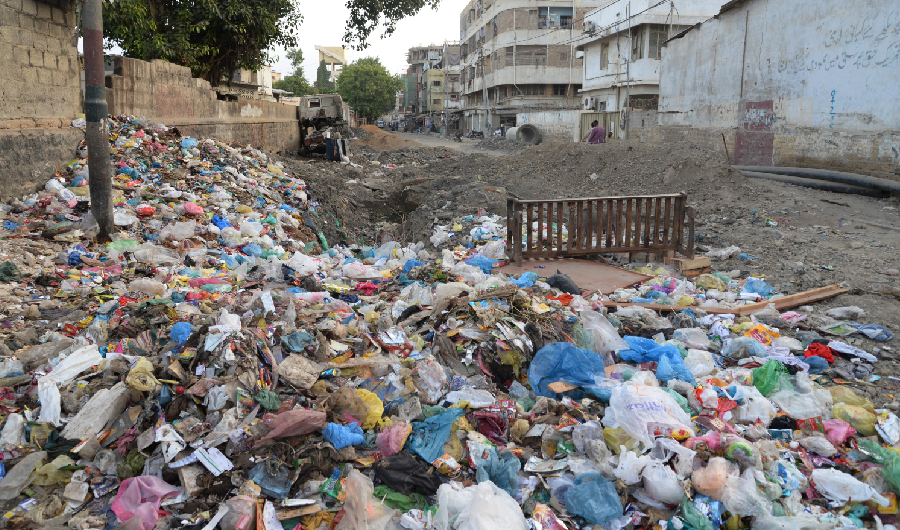
Garbage piles in Karachi on August 3, 2019. The largest and most densely populated city of Pakistan, Karachi produces 12,000 metric tons of trash on a daily basis. Only 70 percent of it is properly disposed of. (AN Photo by SA Babar)
But the local government belongs to the Muttahida Qaumi Movement party, and it is Sindh province’s ruling Pakistan People’s Party that controls most of the district management through its local bodies’ minister.
At the campaign ceremony, federal minister Zaidi said Karachi’s town planning had been ill-thought-out, and that the provincial government should spend more of its money on the city, with a veiled reference to corruption.
“We will complete the task before Eid,” Zaidi said but did not share any details about how the drive would be carried out.

Brooms, wipers and other items required for cleaning and lifting garbage have been brought to Karachi Port Trust headquarters, from where the drive officially started on Sunday, August 4, 2019. (Photo by PTI media)
The Joint Director of a non-profit organization, Urban Resource Center, Zahid Farooq, told Arab News that the entire campaign was an effort aimed at “political gain,” and that the issue of garbage collection would have to be resolved through the joint workings of federal, provincial and local governments.
“The federal government, especially KPT which generates funds from the port in Karachi, should contribute by providing machineries to the district municipal corporation (DMC’s), whose major responsibility includes the collection of garbage,” Farooq said.
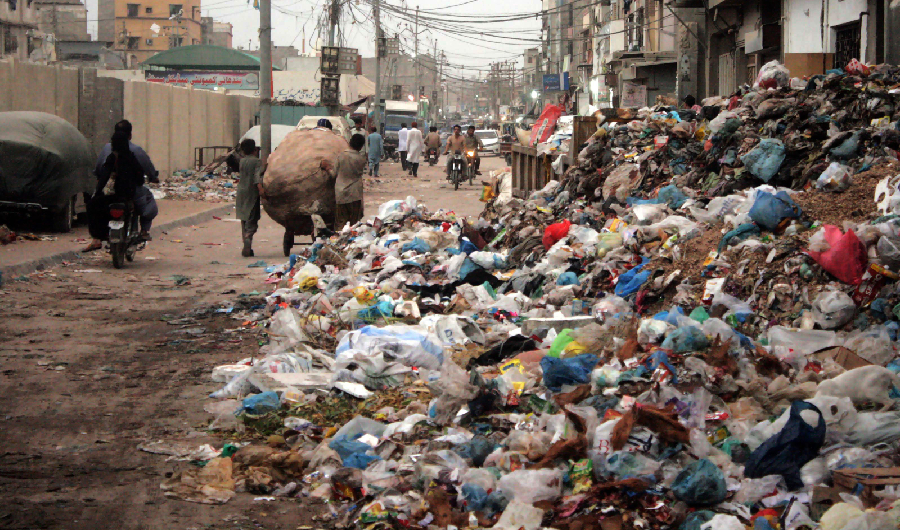
Garbage collectors scavenging through garbage piles in a street of Liaquatabad area of Karachi on August 3, 2019. The scavengers, mostly children and teenagers, collect recyclable material from parts of the city and transport it for dispatch to factories and mills in Karachi, Hyderabad, Thatta and Lahore (AN Photo by SA Babar)
“Drains for rainwaters must be separated from the ones for sewage water, a complete ban should be placed on plastic, and permanent sanitary workers should be hired,” Farooq said and added that the last time permanent sanitary workers were hired was in 1996 after which they have been working purely on a contractual basis.
Farooq also said DMC workers were not given increments in their salaries and did not get salaries on time.
“All three tiers of government, run by three different parties, who strive for their own personal political gains are responsible for the garbage problem,” he said.


