

Officials say KP’s model coalmine to serve as training institute for workers

1 / 2
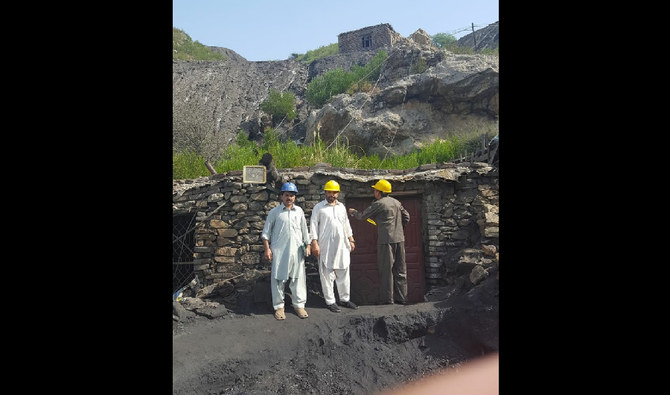
Mineworkers ready for work on a coal mine in Orakzai tribal district on July 31, 2019. The Khyber Pakhtunkhwa (KP) approves the establishment of model coalmine at Dara Adam Khel, a rugged town in the newly-merged Khyber district, leading to construction of service roads to mining areas, training of mining workers to ensure risk-free and scientific extraction, a top official said. (Photo courtesy KP mineral department)
2 / 2
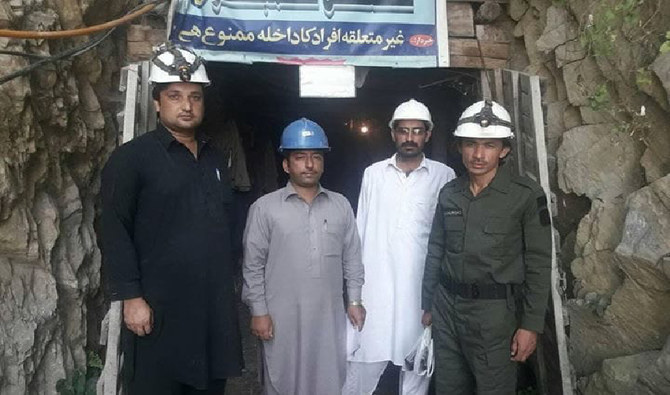
Workers pose for a photo outside a coalmine in Orakzai tribal district on July 30, 2019. The provincial administration of Khyber Pakhtunkhwa decided to establish a model coalmine in Dara Adamkhel, a rugged town in Khyber district, which will help train coalminers. (Photo Courtesy: KP mineral department)
Updated 04 August 2019
Follow

Officials say KP’s model coalmine to serve as training institute for workers

  • KP has ‘474 mines in different parts of the province where 5,000 poorly trained and ill-equipped workers extract minerals’
  • The provincial administration wants to maximize revenue from the mining sector

PESHAWAR: The government of northwestern Khyber Pakhtunkhwa (KP) province has approved the establishment of a model coal mine at Dara Adamkhel, a rugged town in Khyber district, said a top official of the mineral department on Saturday.
The project will also involve the construction of service roads to the mining area and training of workers to ensure “risk-free and scientific extraction” of coal.
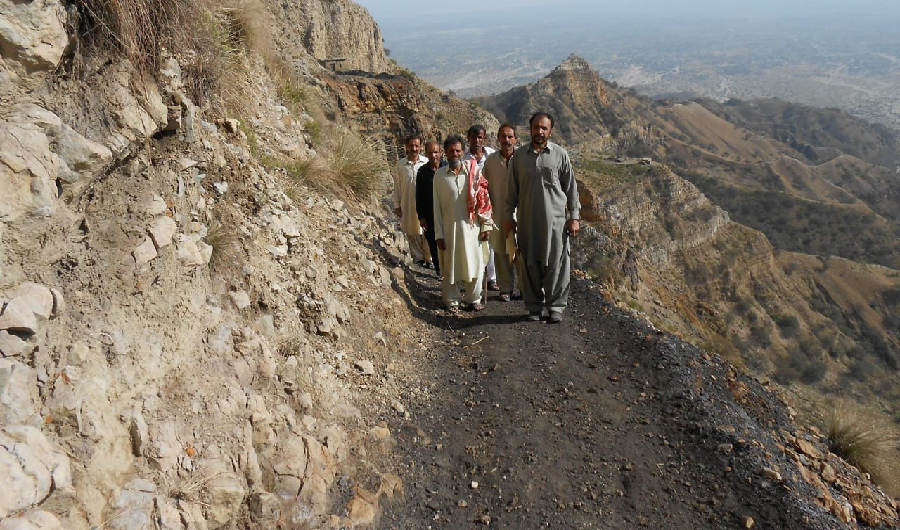


Mineworkers head for work in Orakzai tribal district on July 31, 2019. The Khyber Pakhtunkhwa (KP) approves the establishment of model coalmine at Dara Adam Khel, a rugged town in the newly-merged Khyber district, leading to the construction of service roads to mining areas, training of mining workers to ensure risk-free and scientific extraction, a top official said. (Photo courtesy KP mineral department)

“We have included the new mines and minerals policy in the Annual Development Program (ADP) which will be approved by the KP assembly in the next four to six months,” Secretary Mineral Development Nazar Hussain Shah told Arab News. “That is also the time when we will initiate work on the establishment of the model coalmine in Dara Adamkhel.”
He added that the provincial administration would also take another initiative, worth Rs. 500 million, to develop and build a major cluster of roads to ensure easy access between the mine and mineral markets.
Shah recalled that KP’s Chief Minister Mahmood Khan had approved the development of the model coal mine on Friday, instructing everyone to take precautionary measures in the mines to avoid incidents that were taking workers’ lives.

According to the deputy director mineral concession, Shahadat Khan, about seven to eight miners died annually, mostly because they lack knowledge of mineral extraction and take little precautionary measures.
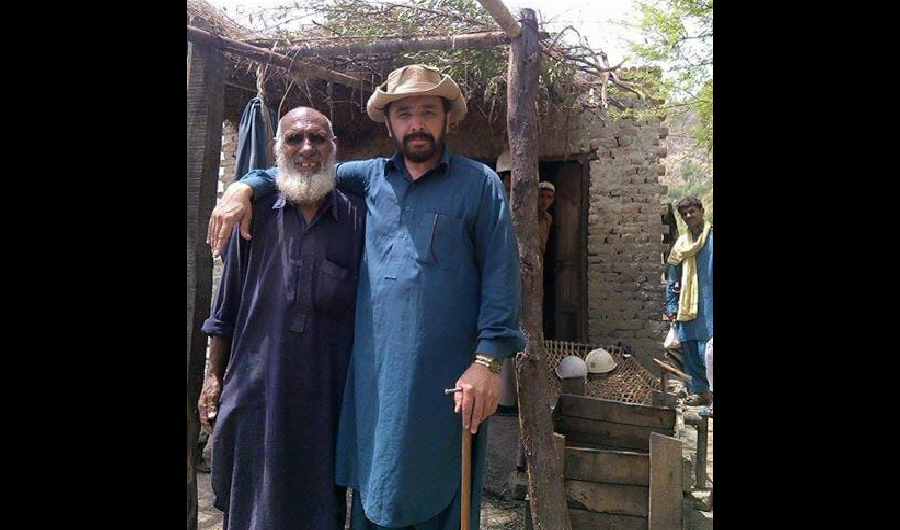


A senior official (right) of the Khyber Pakhtunkhwa (KP) mineral department poses for a photo with a mine worker in Orakzai tribal district on July 30, 2019.  (Photo courtesy KP mineral department)

“We have 474 mines in different parts of the province where 5,000 poorly trained and ill-equipped workers extract minerals,” he added.
Sharing the details of Friday’s meeting, Shah informed that the chief minister had also expressed satisfaction over measures to control illegal mining in the province.
“The establishment of the model coalmine will serve as a training institute,” Shah continued. “It will lead to the extraction of minerals in a sophisticated way, maintain international standards and train workers to use modern equipment while performing their job.”

The chief minister, he said, had directed to adopt effective measures to maximize revenue from the mining sector and create greater incentives to entice national and international investors.
Shah recalled that the province had generated a revenue of Rs. 2.1 billion from mining activity last year, adding that the administration was optimistic to secure Rs. 4 billion during this fiscal year.
He also added that preferential treatment and maximum incentives would be offered to miners and local and multinational investors.
“Modern technology will be introduced to produce material in finished rather than raw shape. This will also benefit the national economy,” Shah said.


Pakistani fodder exporters target $1 billion in five years but need Saudi, China market access

Updated 10 sec ago
Follow

Pakistani fodder exporters target $1 billion in five years but need Saudi, China market access

  • Pakistan exported $112.2 million in animal feed last fiscal year, industry targets nine-fold increase
  • Heavy dependence on UAE market raises risk of oversupply as Pakistan’s fodder production expands

KARACHI: Pakistan’s fast-growing fodder industry is targeting up to $1 billion in annual exports within five years, but growers say reaching that goal depends on Islamabad securing market access to major buyers such as Saudi Arabia and China.

The country exported 930,802 tons of “feeding stuff for animals” worth $112.2 million in the fiscal year ending June, according to the Pakistan Bureau of Statistics (PBS) data shared with Arab News. The United Arab Emirates accounted for the largest share at $33.2 million, leaving exporters heavily reliant on a single market.

Industry representatives say expanding cultivation without opening new destinations risks a supply glut that could depress farm prices and undermine a rapidly emerging export niche.

“We have mainly one country, the UAE, which is a purchaser,” said Sarfaraz Ali Janjua, chief executive of GRJ Agriculture and Livestock Farms and head of the Pakistan Hay Association.

He urged authorities to engage major importing countries “at the government-to-government level.”

The appeal reflects the growing importance of a specific export crop driving the sector’s expansion.

Rhodes grass — a high-protein tropical fodder crop used to feed dairy cattle, horses and camels — has gained commercial value as water-scarce Gulf states rely on imports rather than domestic cultivation.

“There is no agricultural land there (Gulf region). There is mostly desert due to shortage of water,” said Irfan Mahmood, an animal feed expert managing GRJ farms in Sindh province.

“In Saudi Arabia, agriculture is limited. In Dubai, there is no agriculture. Sometimes, if it rains once or twice a year, then grass grows. There are big animal farms, such as horses, camels, goats and sheep. They have to import fodder from other countries. Pakistan is one of them.”

Pakistan’s exports to Saudi Arabia remain minimal at $307,000 annually, compared with much larger imports from Sudan, while China has yet to approve the product for import.

“China could be a big buyer if the government takes initiative because the product is not registered there,” Janjua said.

“Saudi Arabia imports [more] Rhodes grass from Sudan, not from Pakistan. If there is an agreement at the government level, then definitely Saudi Arabia is a bigger market than the UAE, and our Rhodes grass can go there as well.”

RAPID EXPANSION AT HOME

Farmers have rapidly expanded acreage in response to Gulf demand. Rhodes grass cultivation has increased more than 60 percent in three to four years to roughly 120,000 acres nationwide.

On GRJ’s farms in Mirpurkhas district, workers harvest up to 60 tons daily.

“Sometimes they earn Rs1,000 ($3.6) a day, sometimes Rs1,500 ($5.4) a day. It depends on the amount of work,” said labor supervisor Muhammad Soomar.

“If they harvest fewer acres, they earn less.”

GRJ plans to boost exports 36 percent to 30,000 tons this year but may pause expansion due to oversupply fears.

“If Pakistan’s agricultural setup exceeds 100,000 acres, naturally the market will not be local. People will be worried,” Janjua said.

“If no other country comes in, then there will be problems. Farmers will suffer and will not get proper market rates.”

The shift toward export crops is partly policy-driven rather than purely market-led.

The growth comes as Pakistan reduces crop subsidies under a $7 billion IMF stabilization program approved in September 2024, pushing farmers toward export-oriented agriculture instead of state-supported staples.

“There is no rate support for other crops. There is no government policy, no government subsidy, no cover,” Janjua said.

He said Pakistan’s Trade Development Authority should actively negotiate access abroad.

“There is a Trade Development Authority (of Pakistan). They should engage at the government level and send delegations,” he said.

“Buyers should be briefed. Our products should be sampled.”

Pakistan enjoys “very good relations” with China but must complete regulatory registration before exports can begin, according to Janjua.

“We should talk at the government level and get it registered. To China, we can also export animal feed by road, which would be a breakthrough,” he said

POTENTIAL AND OBSTACLES

Beyond regulatory approval, exporters cite taxation on imported machinery, foreign exchange conversion losses and customs duties as barriers to scaling production.

“Exporting is very difficult. When we bring in foreign exchange, we do not get favorable rates. We face customs and regulatory issues,” Janjua said.

“There should be zero taxes on machinery. Heavy machinery and tractors are not made locally, so we have to import them, and taxes are high.”

Despite the challenges, industry participants say Pakistan’s fodder quality now rivals established suppliers.

“There is also alfalfa and other animal feed products going from Pakistan, but not on a large scale,” Janjua said.

“We need to work on expanding other products as well. If these matters are addressed at the government level, exports can grow.”

Agriculture accounts for about 24 percent of Pakistan’s economy and employs roughly 38 percent of the labor force. Growers believe opening major markets could transform fodder into a major non-traditional export sector.

“If China and Saudi Arabia start importing from us, it (exports) can increase tenfold because there is a strong need for fodder,” Janjua said.

“They have a culture of keeping animals, and dairy products are needed everywhere.”

He identified Saudi Arabia and China as the two decisive markets:

“If our product goes to Europe, that would be very good. But the two big markets that can be worked on are China and Saudi Arabia.”