


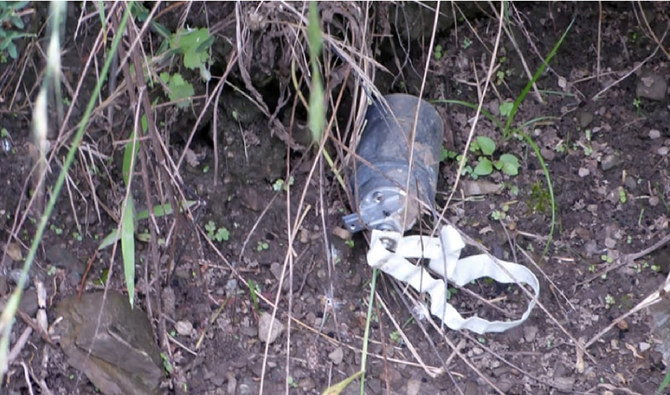

ISLAMABAD: The Pakistan Army on Saturday accused India of using cluster bombs to deliberately target civilian population along the Line of Control in the disputed Kashmir region.
Banned under the United Nations’ Convention on Cluster Munition (CCM), the said military ammo releases a number of projectiles on the impact that is designed to kill personnel and destroy vehicles.
“Indian Army on the night [between] July 30th and 31st targeted innocent citizens, including women and children, in Neelum Valley through artillery using cluster ammunition,” the military’s media wing, Inter-Services Public Relations (ISPR), said in a statement on Saturday.
“This is a violation of the Geneva Convention and international humanitarian law. Because of severe impact on non-combatants, use of cluster ammunition is prohibited under [the] Convention on Cluster Ammunition,” the ISPR said, adding that Indian shelling had killed two civilians, including a 4-year-old boy, and critically injured 11 people.
The CCM, under the United Nations Office of Disarmament Affairs (UNODA), prohibits all use, stockpiling, production and transfer of cluster munitions.
The convention was adopted in Dublin on May 30, 2008 and has 108 signatories. It became a binding international law when it entered into force on August 1, 2010, after 30 states ratified it. India and Pakistan are not listed among the signatory states, according to the UNODA.
Talking to Arab News, the country’s leading international law expert, Ahmer Bilal Soofi, noted that the use of cluster munition was not allowed even against non-civilian population under international humanitarian law.
“Cluster bombs are viewed as prohibited because they disregard the principle of distinction,” he said. “They fail to distinguish between military and non-military target, and a movement for prohibition led to the international convention against the use of cluster bombs for the same reason.”
Pakistan’s Ministry of Foreign Affairs shared gruesome images of civilian casualties along with the pictures of Indian cluster bombs with the media. However, officials did not say how many bombs were used by the Indian forces.
“Pakistan condemns the atrocious attacks by the Indian Army in occupied Jammu and Kashmir,” Foreign Office Spokesman Dr. Mohammad Faisal said, warning New Delhi that “a befitting reply” would be given to such attacks. He also added that India should not “forget February 27,” the day Pakistan shot down an Indian fighter jet and captured its pilot.
The disputed territory of Kashmir is divided into two halves, one administered by Pakistan and other by India, though both countries claim the region in full. Both nations have fought wars over the disputed territory since gaining independence from the British Raj in 1947 and continue to have border skirmishes in the area.
Asked about Pakistan’s legal options, Soofi said Islamabad could take its complaint to the United Nations Security Council and also bring it to the notice of the International Committee of Red Cross.
“It can also consider taking the matter to the International Criminal Court,” he added.
“Pakistan needs to take a position and this blatant violation needs to be flagged and brought to the notice of the international community,” Soofi continued. “The more momentum Pakistan finds in support of this position, the stronger its legal case will become. It will also make disregarding the law difficult for any other country in the future,” he added.


