

Honor to serve: Saudi boy scouts are always there to help during Hajj

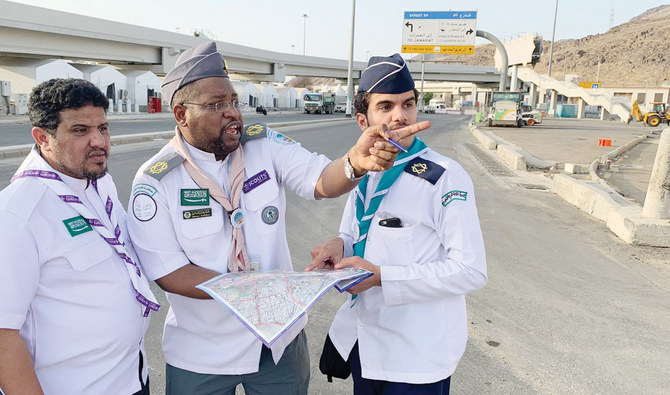
More than 4,000 Saudi boy scouts volunteer for service during Hajj. (Photo/Supplied)
Updated 02 August 2019
Follow

Honor to serve: Saudi boy scouts are always there to help during Hajj

  • The main duty of each Saudi scout is to assist in leading people to the correct sites
  • Scouts can communicate with pilgrims in numerous languages including Arabic, English and Urdu

JEDDAH: Each Hajj season more than 4,000 Saudi boy scouts volunteer for service, as up to 2 million pilgrims gather to perform Hajj.

Saudi scouts are always there at the camps of Mina and Arafat to help those in need and guide them if they need help.

The main duty of each Saudi scout is to assist in leading people to the correct sites, especially older people who find it hard to follow their groups or are not able to cope with the new mapping technologies.

Scouts can communicate with pilgrims in numerous languages including Arabic, English and Urdu. 

Pioneer Scout Mubarak Al-Dosari talked to Arab News about the number of scouts assisting during Hajj 2019 in Makkah and Madinah: “This year we have 4,500 Saudi boy scouts and team leaders, as well as about 1,500 members working in the ports and holy cities who were chosen by the Ministry of Education and are supervised by the Saudi Arabian Boy Scouts Association (SABSA) to assist nearly 400.000 pilgrims.’’

He added that scouts are divided to join specific teams according to their age. “The advanced boy scouts are from 15 to 17 years old, while the rover scouts are from 18 to 22.”

Waleed Felemban, one of the pioneer scouts in Saudi Arabia, who has been leading new scouts with SABSA for more than 30 years, is the commander of the Committee on Cartographic Guidance in Camps.

“SABSA qualifies its employees to provide better service to the pilgrims, and help in smoothing the process of guidance,” said Felemban.

Saudi Boy Scouts training 

“To train the beginners, we introduce them to the important sites of the Two Holy Cities, and teach them how to find all the streets of Mina and Arafat. The team leaders’ mission is to keep boy scouts updated on the changes and developments,” Felemban said.

The groups come from the first day of Dul Hijjah and train for six days, where they perform a complete survey of the Mina and Arafat camps. They ensure that all civil institutions and Tawafa offices have set up their positions so that they are mapped.

Decoder

Title

Content...

Felemban talked about what the scouts do and how they are being prepared to receive pilgrims.

“Boy scouts and rover scouts make field surveys and record the sites of camps and field service offices, and they register the names and nationalities of the pilgrims to identify them through wrist bracelets of different colors.”  During these six days, two surveys are conducted every morning and evening, in which all the changes are recorded, including all the services provided by the Saudi Arabian government, such as police stations, health centers, the Red Crescent, and bus stops.

Hajj mapmaking and updating

Waleed Felemban explained the strategy they follow in making Hajj maps, how these are created from scratch and updated.

“The committee starts working from the middle of Shawwal, collecting data through government agencies, including any changes in street numbers or new bridges — including housing.”

“These are put on maps and modified by Google Earth, assisted by the King Abdul Aziz City for Science and Technology (KACST). Images are processed, and features and services are presented in a simplified form that everyone can read through the AutoCAD program.”

More than 1 million maps are printed in different sizes and distributed to all Tawafa offices and charity guidance centers to identify sites.

These maps can also be downloaded from the SABSA website (www.scouts.org.sa), which determines the direction and location desired by the user.


Decoder

Arafat

After sunrise on the 9th of Dul Hijjah, pilgrims go to where Mount Arafat is located.


Jeddah and Taif earn World Region of Gastronomy 2027 title

Updated 6 sec ago
Follow

Jeddah and Taif earn World Region of Gastronomy 2027 title

  • Recognition opens new avenues for international collaboration in food culture, research and tourism, says culinary commission CEO

RIYADH: Jeddah and Taif have been awarded the World Region of Gastronomy 2027 title according to the criteria set by the International Institute of Gastronomy, Culture, Arts and Tourism.

A recent report issued by the institute highlighted efforts to “preserve culinary heritage, support local biodiversity, empower youth and entrepreneurs in the food sector, and promote sustainable environmental practices.”

Mayada Badr, CEO of Culinary Arts Commission, said: “The award also reflects the ongoing legacy of excellence initiated by the Asir region, which held the same title in 2024.”

The two Saudi cities received the prestigious title following a comprehensive field visit by an international jury of IGCAT experts, who met key local stakeholders and assessed the region’s commitment to holistic sustainable development standards linking gastronomy, culture, responsible tourism, and economic and social development.

The commission led a broad national coalition to achieve the milestone, with participation from strategic partners including King Abdulaziz University, Dar Al-Hekma University, Jeddah Development Authority, Al-Balad Development Co., Azka Foods, Queen Taste, Aysh Academy, the Tour Guides Cooperative and the Abdullah Al-Thagafi Cultural Center.

“These efforts converged to support education, innovation and skills development, strengthen cultural identity and link gastronomy with responsible tourism,” she said.

By receiving the title, Jeddah and Taif join an exclusive global network of leading World Regions of Gastronomy, opening new opportunities for international collaboration in food research and development, cultural exchange and attracting responsible tourism that values authentic heritage.

The recognition will also serve as a catalyst for developing long-term plans that place culinary arts at the heart of the creative economy, contribute to income diversification and promote intercultural dialogue.

Badr told Arab News that the designation represents a high-level international acknowledgment of the richness of Saudi Arabia’s culinary heritage and its commitment to holistic sustainable development across economic, social, cultural and environmental sectors.

The achievement is part of a continuous journey building on the success of the Asir region in 2024, reflecting a national strategic vision to strengthen Saudi Arabia’s presence on the global gastronomy map and highlighting the role of cuisine as a bridge for preserving identity and empowering communities, Badr said.

She also highlighted that the international jury observed firsthand the efforts to support food and biodiversity, protect heritage, and empower youth to contribute to innovations advancing the creative economy and sustainable tourism development.

“Through this inclusion in the global platform, Jeddah and Taif will collaborate with their counterparts worldwide to promote sustainable food practices, support local food systems, advance food research and education, and establish gastronomy as an effective means of cultural exchange,” she added.

The title will act as a strong catalyst for developing long-term plans that position culinary arts as a core pillar for preserving intangible cultural heritage, diversifying economic sources, and promoting dialogue and understanding among cultures and peoples, Badr said.