Taliban, US hit stalemate over troop withdrawal time frame

1 / 2
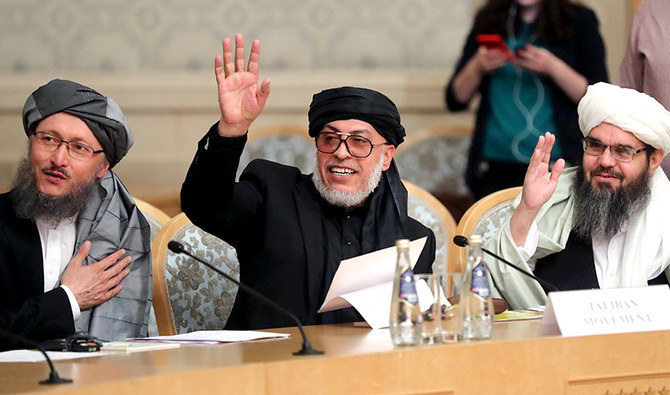
Members of a Taliban delegation, led by chief negotiator Mullah Abdul Ghani Baradar (C, front), walk before a meeting with Afghan senior politicians in Moscow, Russia May 30, 2019. REUTERS/Evgenia Novozhenina
2 / 2
Taliban representatives during the peace talks on Afghanistan held in Moscow on November 9, 2018. (TASS)
Updated 31 July 2019
Follow

Taliban, US hit stalemate over troop withdrawal time frame

  • Washington seeks 18 months for a complete troop pullout while Taliban stress on 9.
  • The negotiating sides have taken a break to hold discussions with their respective leadership

ISLAMABAD: Taliban on Wednesday said its hopeful to reach an understanding with the United States over the time-frame for the complete withdrawal of foreign troops from Afghanistan.
The decision — one of the several taken during a meeting between the two sides when they resumed talks in Qatar on Monday — follows months of negotiations for the peace process.
The Taliban leadership has endorsed suggestions by its political office to reach an understanding with Washington on ways to end the conflict which has now entered its 18th year.
The Taliban demand the US to agree exiting Afghanistan within a span of nine months, a Taliban official privy to the discussions told Arab News requesting anonymity. 
The US, for its part, has asked for 18 months instead, a condition rejected by the Taliban, he said.
During the talks on Monday, the two sides also reached a prisoner swap deal where the Taliban agreed to release two professors — American Kevin King, 60, and Australian Timothy Weeks, 48 – who were associated with the American University of Afghanistan in Kabul and had been kidnapped near the campus in August 2016.
The Taliban had released two videos of the hostages since they were kidnapped in which they had urged US President Donald Trump to negotiate the conditions for their release.
Taliban officials say that negotiations had been held in Qatar for the prisoner swap, following Pakistan’s intervention in the matter.
The deal could pave way for the release of Anas Haqqani, brother of Taliban deputy chief Siraj Haqqani, and 10 other Taliban members, the source added.
During their meeting on July 22, Prime Minister Imran Khan had told US President Donald Trump that they would “be giving you good news about the two hostages.”
Meanwhile, Taliban’s spokesperson Zabihullah Mujahid told Arab News on Tuesday that no date has yet been fixed for the upcoming meeting after the two sides took a break from negotiations on July 9.
Taliban’s political spokesman, Suhail Shaheen, had earlier announced that both sides will resume their seventh round of negotiations following a break which they had taken for consultations with their respective leaders.
Meanwhile, a delegation of the Taliban’s political office is currently in Indonesia for a conference with religious scholars in Jakarta, a statement issued by the group said on Tuesday.
During the talks, Mullah Abdul Ghani Baradar, who is the head of the group’s political office and is leading the delegation in Indonesia, highlighted the “current situation of Afghanistan, policy and achievements,” it added. 
The US Special Representative for Afghanistan Reconciliation, Zalmay Khalilzad, who had been in Kabul since July 23, also held talks with government leaders, politicians, members of the peace council and civil society, women activists, and diplomats to brief them about their talks with the Taliban.
On July 22, the US State Department had said that Khalilzad would also visit Doha to resume talks with the Taliban.


Pakistan, Qatar resolve to boost strategic, economic cooperation at Doha talks

Updated 8 sec ago
Follow

Pakistan, Qatar resolve to boost strategic, economic cooperation at Doha talks

  • Both countries urge dialogue on Afghanistan amid renewed border tensions between Islamabad and Kabul
  • Discussions focus on bilateral trade and investment, energy, defense, manpower and labor and culture

ISLAMABAD: Pakistan and Qatar on Tuesday agreed to deepen their strategic and economic cooperation during high-level talks between Prime Minister Shehbaz Sharif and his Qatari counterpart Sheikh Mohammed bin Abdulrahman bin Jassim Al Thani, Sharif’s office said.

Sharif visited Qatar along with a high-level delegation on the invitation of Qatari emir Sheikh Tamim bin Hamad Al Thani. The Pakistan premier also held meetings with Qatar’s trade and defense minister to discuss cooperation in various domains.

The visit came at a time when Pakistan is seeking closer economic engagement with Gulf partners amid its broader push to stabilize the economy and attract investment, while maintaining security and defense cooperation with key regional states.

During their meeting in Doha, PM Sharif and Qatar’s Sheikh Mohammed discussed bilateral relations and exchanged views on regional and international developments, according to the Pakistan prime minister’s office.

“They reaffirmed the strong brotherly relations between Pakistan and Qatar and expressed satisfaction at the growing momentum in political, economic and institutional ties,” Sharif’s office said.

“Discussions focused on enhancing cooperation in the fields of trade and investment, energy, defense, manpower and labor and culture, with both sides stressing the importance of their task force to accelerate cooperation in all these areas.”

Pakistan and Qatar maintain strong trade and investment ties. In 2022, the office of Qatar’s emir said the Qatar Investment Authority planned to invest $3 billion in Pakistan, targeting sectors including transport, aviation, education, health, media, technology and labor.

Nearly 300,000 Pakistanis live and work in Qatar, according to Pakistan’s foreign office, with many employed in health, education, engineering and public services, as well as construction and transport. The two countries engage through forums such as the Bilateral Political Consultations and the Joint Ministerial Commission.

Sharif and his Qatari counterpart also discussed regional issues, including developments in Gaza and broader Gulf security. PM Sharif appreciated Qatar’s constructive diplomatic efforts to promote dialogue and de-escalate tensions in the region, according to Sharif’s office.

The meeting reaffirmed the shared commitment to further strengthen the strategic partnership between Pakistan and Qatar and to remain in touch on current bilateral, regional and international issues.

DIALOGUE WITH AFGHANISTAN

Earlier, Sharif and Qatar’s Deputy PM Sheikh Saoud Al-Thani discussed the situation in Afghanistan and called for dialogue to support regional stability.

The meeting took place amid renewed tensions after Islamabad carried out airstrikes last week on what it described as Tehreek-e-Taliban Pakistan (TTP) targets inside Afghanistan. Kabul said the strikes killed civilians and vowed to respond to what it called a violation of its sovereignty.

“Regional developments were also discussed, in particular the situation in Iran and Afghanistan,” Sharif’s office said in a statement. “Both sides emphasized the importance of dialogue, de-escalation and collective efforts to promote peace and stability in the region.”

This was the second time in less than six months that Pakistan conducted airstrikes in Afghanistan. The last strikes triggered heavy, weeklong clashes between the neighbors along their border before Qatar and Turkiye mediated a ceasefire between them in Oct. last year.

Separately, Sharif held meetings with Qatar’s State Minister for Trade Dr. Ahmed bin Mohammed Al-Sayed and a delegation of the Qatar Businessmen Association (QBA), highlighting Pakistan’s investment-friendly reforms.

He invited QBA members to explore opportunities in infrastructure, logistics, energy, agriculture, technology and export-oriented manufacturing, his office said.