



DUBAI: Until now few people outside Saudi Arabia had heard of Dumat Al-Jandal.
But with construction due to begin there on the Middle East’s largest — and Saudi Arabia’s first — wind farm, the historical capital of the Kingdom’s northwestern Al-Jouf region will soon be firmly on the world’s renewable-energy map.
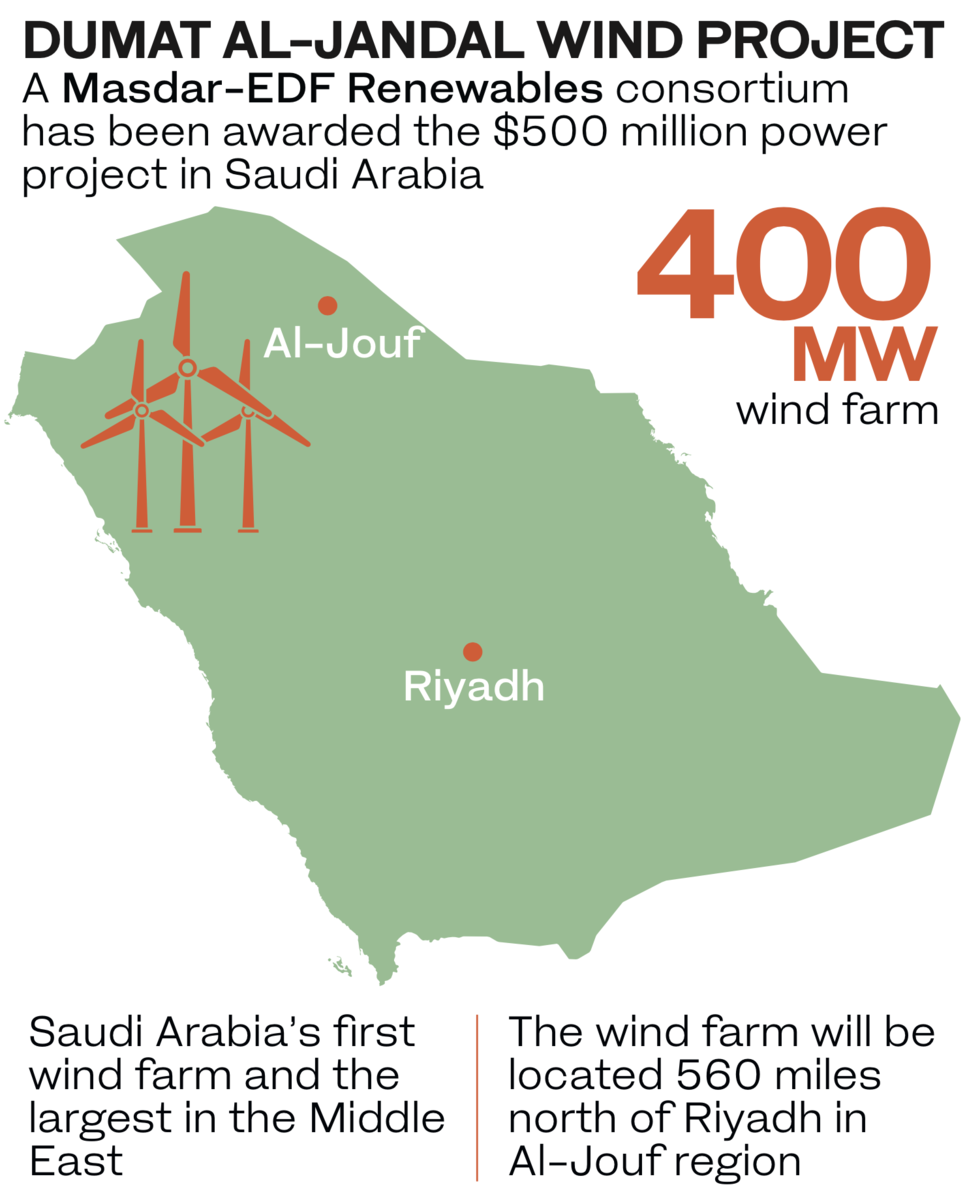
Launched as a part of Saudi Arabia’s planned shift away from fossil fuels as a source of electricity, the $500 million wind farm will have an installed capacity of 400 megawatts (MW), enough to power 70,000 homes in the Kingdom and reduce carbon emissions by up to 880,000 tons every year. Commercial operations are due to start in the first quarter of 2022.
Last week, a consortium led by EDF Renewables and Masdar reached a deal with Saudi and international banks to finance the utility-scale wind project, which will be located 560 miles north of Riyadh.
“We are delighted to see the project progress to the construction stage,” said Osama bin Abdul Wahab Khawandanah, CEO of the Saudi Power Procurement Co., a subsidiary of the Saudi Electricity Co. (SEC).
In line with the Kingdom’s Vision 2030 strategy, the Saudi government is planning to develop 30 solar and wind projects over the next nine years as part of a $50 billion program to boost power generation and cut oil consumption. It is seeking to use more natural gas and renewable energy for power generation so that the nearly 600,000 barrels of oil that are currently burnt each day for the purpose can be freed up for export.
As part of an effort to reduce economic dependence on sales of crude, Saudi Arabia’s sovereign wealth fund is investing in industrial units to manufacture components for solar and wind farms and in renewable-energy facilities.
To this end, the Renewable Energy Project Development Office of the Saudi Ministry of Energy, Industry and Mineral Resources had awarded the Dumat Al-Jandal wind-farm project in January following a call for tenders in August 2017.
EDF Renewables and Masdar — which are, respectively, the renewable-energy units of Electricite de France SA and Abu Dhabi’s Mubadala Investment Co. — had submitted the most cost-competitive bid of $21.3 per MW hour.
“Saudi Arabia is a large country that has different atmospheres from north to south,” Yousif Al-Ali, acting executive director of clean energy at Masdar, told Arab News.
“Particularly in the north- western side, they have very high wind resources, so you can build wind projects at an attractive cost. That area, close to Egypt and north of the Red Sea, has a lot of wind resources.”
Al-Ali said the UAE, Kuwait and Bahrain lacked Saudi Arabia’s advantages when it comes to viable wind projects.
FASTFACTS
• Wind power involves the conversion of kinetic (wind) energy into electrical energy.
• Wind makes a wind turbine’s rotor spin; the rotor blades’ movement drives a generator that produces electricity.
• Average wind speeds must be above 18 km per hour to make installing a wind turbine worthwhile.
• Ideal locations for wind turbines are the countryside, farms and coastline.
Nevertheless, in the rest of the Arabian Peninsula, the northwestern and southern parts of Oman have good wind resources.
“In the Gulf region, the potential for wind is specifically in the northwestern side of Saudi Arabia and the southern side of Oman,” Al-Ali said.
“The area on the Egyptian side opposite the Dumat Al-Jandal project location has a lot of wind resources. There is also very good wind potential in Tunisia and Morocco,” he added. “I foresee more wind projects in Saudi Arabia, especially as they have a plan to have 27.3 gigawatts (GW) of renewable energy in their total energy mix by 2024. A large portion of this amount will be coming from wind.”
As for the Dumat Al-Jandal project, the contracted wind- turbine technology provider Vestas will be responsible for the engineering, procurement and construction contract.
Spanish industrial group TSK will be in charge of the rest of the plant, while Belgian company CG Holdings will provide substations and high-voltage solutions.
The wind farm is expected to supply electricity according to a 20-year power purchase agreement with the Saudi Power Procurement Co.
“The plant will be connected to the Kingdom’s grid, generating 400 MW of clean power,” Al-Ali said. “We had a world record with the pricing of $21.3 per kilowatt hour.”
During construction, the wind farm will employ 1,000 people, which will drop to between 30 and 50 when the site becomes fully operational.
“We are delighted to take part in the first wind project in (Saudi Arabia), which is set to be the most powerful wind farm in the Middle East,” said Bruno Bensasson, EDF Group senior executive president responsible for renewable energies, and chairman and CEO of EDF Renewables.
“This new step reflects the quality of our partnership with Masdar, which enabled us to jointly submit the most competitive bid. Wind power is now representing a renewable and economical solution in the energy mix.”
He said that Dumat Al-Jandal represents another step forward under the EDF Group’s Cap 2030 strategy, which aims to double its renewable energy capacity by 2030 — both in France and worldwide — to 50 GW.
Masdar CEO Mohamed Jameel Al-Ramahi said that winning the contract for Saudi Arabia’s first wind farm during Abu Dhabi Sustainability Week in January was a momentous event in the history of the company.
“It illustrated the depth of Saudi Arabia’s commitment to realizing its bold strategy to substantially increase the contribution of renewables in its total energy mix to 27.3 GW by 2024, from wind as well as solar energy,” he added.
“The oversubscribed financing of the Dumat Al-Jandal project further illustrates the confidence of local and international lenders, and the investment community, in the economy of the Kingdom, and its potential as a hub for highly cost-effective renewable energy development.”


