Egypt fears decline in Nile water levels this year, say experts

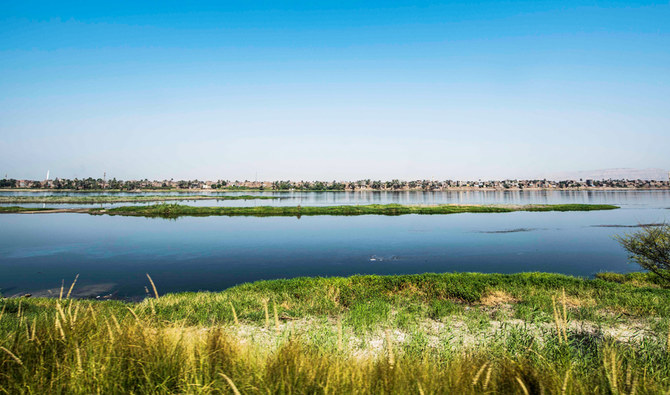
A picture taken on September 9, 2017 shows a view of the Nile river in the southern Egyptian city of Luxor. (AFP)
Updated 29 July 2019
Follow

Egypt fears decline in Nile water levels this year, say experts

  • A report issued by the ministry said that the High Dam was prepared to receive the rise in water levels that marks the start of the 2019-2020 water year, which begins in August

CAIRO: The Egyptian Irrigation Ministry announced the decline in the Nile water by about 5 billion cubic meters from last year, according to an official statement.
The government declared a state of maximum emergency in all governorates during the coming period to ensure the country’s water needs, especially drinking water, to meet the demand for household uses and periodic monitoring of agricultural land irrigation.
According to the Ministry of Irrigation, the flood season runs from Aug. 1 until mid-November, and all the agencies of the ministry took major measures, from the High Dam Unit to the irrigation sector.
Abdullatif Khalid, head of the irrigation sector in the ministry, confirmed that the current level of water in the Nile River is 55.5 billion cubic meters. He said that this quantity is low because drinking water is consuming 11 billion cubic meters, as against 7 billion last year. Industrial usage consumes 8 billion cubic meters and the rest is distributed to agriculture.
“Egypt will certainly be affected by this decline, so we call for rationalization and austerity in water consumption,” he said, pointing out that population growth and climate change are factors that increase the demand for more water.
A report issued by the ministry said that the High Dam was prepared to receive the rise in water levels that marks the start of the 2019-2020 water year, which begins in August.

The necessary maintenance works were carried out for its installations, emergency floods and gates.
The water levels start to rise as flood waters arrive from Ethiopia via the blue Nile, passing through Khartoum before arriving at Lake Nasser in Aswan Governorate. The water comes partly from rains on the Ethiopian hills, and partly from the opening of dams by the Khartoum authorities (Al-Roussiris, Sennar-Merwi, Upper Atbara, Sitit-Khashm Al-Qurba) in preparation for the start of the new floodwater storage, which begins in August every year. The season ends in October-November.
Dr. Iman Al-Sayyid, head of the irrigation ministry, said that the ministry has monitoring devices for the indicators of the rainy season in the Nile basin, pointing out that the rate of rainfall is expected to be lower than previous years.
She added that the low rainfall rates on the Nile Basin countries — specifically Ethiopia — is behind the decline in water levels of the Nile, confirming that the low rate of rainfall is a natural phenomenon for Egypt, Sudan and the rest of the Nile Basin countries.
She said that the ministry has an early-warning system to monitor the water situation on a continuous basis, and has a strategy to deal with emergencies.


UN humanitarian chief’s fresh funding call as Sudan crisis passes 1,000 days amid famine, mass displacement

Updated 6 sec ago
Follow

UN humanitarian chief’s fresh funding call as Sudan crisis passes 1,000 days amid famine, mass displacement

  • ‘Today we are signaling that the international community will work together to bring this suffering to an end,’ Tom Fletcher tells fundraising event in Washington
  • Sudan is a central pillar of the UN’s global humanitarian plan for 2026, which aims to save 87m lives worldwide, he adds

NEW YORK CITY: The UN on Tuesday launched a renewed appeal for funding and the political backing to address what it described as the catastrophic humanitarian crisis in Sudan, which has now been locked in civil war for more than 1,000 days.

Speaking at a fundraising event for Sudan in Washington, organized by the US Institute for Peace, the UN under-secretary-general for humanitarian affairs, Tom Fletcher, said the scale of the suffering in Sudan had reached intolerable levels marked by famine, mass displacement and widespread sexual violence against women and girls.

“The horrific humanitarian crisis in Sudan has endured more than 1,000 days — too long,” he said. “Too many days of famine, of brutal atrocities, of lives uprooted and destroyed.”

The global community was now united in its desire to halt the suffering and ensure life-saving aid reaches those most in need, Fletcher said.

“Today we are signaling that the international community will work together to bring this suffering to an end,” he added.

Sudan is a central pillar of the UN’s global humanitarian plan for 2026, which aims to save 87 million lives worldwide, Fletcher explained as he thanked donors, including the US, the EU and the UAE, for stepping forward.

“Sudan is the most important component of that plan,” he said, noting that humanitarian operations there have been chronically underfunded and plagued by danger. “We have lost hundreds of colleagues in Sudan, colleagues of incredible courage.”

The UN plans to provide food, medicine, water and sanitation services to more than 14 million people across Sudan this year, as well as protection for vulnerable groups, Fletcher said.

He stressed that funding alone would not be sufficient, however, and called for stronger measures to protect civilians and aid workers, secure humanitarian access and support a temporary truce between the warring factions.

“The money is not enough,” he said. “We need the air assets, the security, the medical support for our teams, and the mediation work that has to underpin the access.”

The UN will work, through the Sudan Humanitarian Initiative, with the so-called “Quad” group of international partners (the US, Egypt, Saudi Arabia and the UAE) and others to identify priority areas for urgent action and remove obstacles to the delivery of aid, Fletcher said.

He added that the UN seeks visible progress toward a humanitarian truce in Sudan within the next few weeks, and called for those guilty of any violations in the country to be held accountable.

“We have set a target date of the beginning of Ramadan to make visible progress on this work,” Fletcher said. Ramadan is expected to begin on or around Feb. 17 this year.

Quoting UN Secretary-General Antonio Guterres, he added that the urgency of ending the conflict was growing as the third anniversary of its outbreak on April 15, 2023, approaches.

“The guns must fall silent and a path to peace must be charted,” Fletcher said, adding that the UN fully supports efforts to secure a humanitarian truce and rapidly scale up aid across Sudan.

“Today, we’re saying, ‘Enough.’ Let today be the signal that the world is uniting in solidarity for practical impact.”