

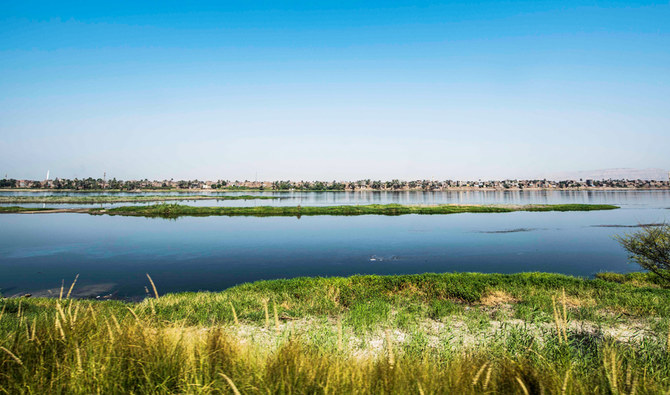

CAIRO: The Egyptian Irrigation Ministry announced the decline in the Nile water by about 5 billion cubic meters from last year, according to an official statement.
The government declared a state of maximum emergency in all governorates during the coming period to ensure the country’s water needs, especially drinking water, to meet the demand for household uses and periodic monitoring of agricultural land irrigation.
According to the Ministry of Irrigation, the flood season runs from Aug. 1 until mid-November, and all the agencies of the ministry took major measures, from the High Dam Unit to the irrigation sector.
Abdullatif Khalid, head of the irrigation sector in the ministry, confirmed that the current level of water in the Nile River is 55.5 billion cubic meters. He said that this quantity is low because drinking water is consuming 11 billion cubic meters, as against 7 billion last year. Industrial usage consumes 8 billion cubic meters and the rest is distributed to agriculture.
“Egypt will certainly be affected by this decline, so we call for rationalization and austerity in water consumption,” he said, pointing out that population growth and climate change are factors that increase the demand for more water.
A report issued by the ministry said that the High Dam was prepared to receive the rise in water levels that marks the start of the 2019-2020 water year, which begins in August.
The necessary maintenance works were carried out for its installations, emergency floods and gates.
The water levels start to rise as flood waters arrive from Ethiopia via the blue Nile, passing through Khartoum before arriving at Lake Nasser in Aswan Governorate. The water comes partly from rains on the Ethiopian hills, and partly from the opening of dams by the Khartoum authorities (Al-Roussiris, Sennar-Merwi, Upper Atbara, Sitit-Khashm Al-Qurba) in preparation for the start of the new floodwater storage, which begins in August every year. The season ends in October-November.
Dr. Iman Al-Sayyid, head of the irrigation ministry, said that the ministry has monitoring devices for the indicators of the rainy season in the Nile basin, pointing out that the rate of rainfall is expected to be lower than previous years.
She added that the low rainfall rates on the Nile Basin countries — specifically Ethiopia — is behind the decline in water levels of the Nile, confirming that the low rate of rainfall is a natural phenomenon for Egypt, Sudan and the rest of the Nile Basin countries.
She said that the ministry has an early-warning system to monitor the water situation on a continuous basis, and has a strategy to deal with emergencies.


