

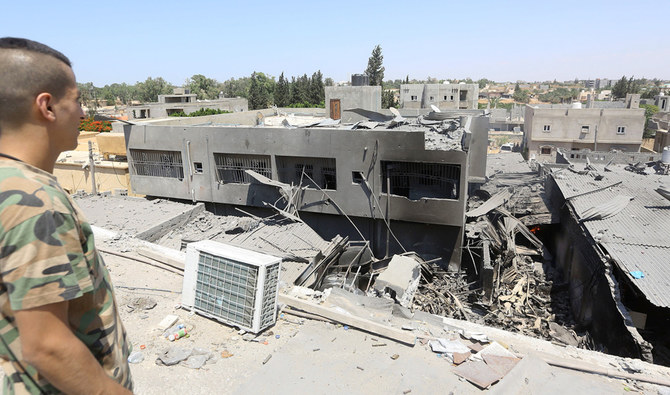

CAIRO: Libyan health authorities say an airstrike hit a field hospital south of the capital, Tripoli, killing at least four doctors and a paramedic.
Malek Merset, a spokesman for the Health Ministry of the Tripoli-based Government of National Accord (GNA) says the attack took place late on Saturday in the Zawya district.
Forces based in the country’s east are currently fighting for control of the capital’s southern outskirts against militias allied with the Tripoli-based government.
Health authorities did not say which side was behind the airstrike, which wounded eight health workers.
The GNA blamed the airstrike on Libyan National Army (LNA), led by eastern commander Khalifa Haftar. The LNA could not immediately be reached for comment.
Haftar’s LNA began its offensive on Tripoli in early April. In past weeks, the battle lines have changed little.
The battle for control of the Libyan capital raged amid increased fighting over the past 24 hours, officials said on Saturday, with both sides relying heavily on airpower to make progress in the stalemated conflict.
LNA has been advancing into the city’s southern outskirts, clashing with an array of militias loosely affiliated with the GNA.
Libyan officials, who spoke on condition of anonymity because they were not authorized to brief reporters, said Haftar’s LNA launched airstrikes overnight against an air base in the western city of Misrata.
The officials said the LNA also took control of the Al-Naqliyah military camp in the south of Tripoli.
They said Haftar’s forces were also fighting to cut off a major route linking Mistrata to Tripoli, which, if they succeeded, would be a major blow to the UN-supported government.
In past weeks, the battle lines have changed little, with both sides dug in and shelling one another in the southern reaches of the capital.
The LNA is the largest and best organized of the country’s many militias, and enjoys the support of Egypt, the UAE and Russia. But it has faced stiff resistance from fighters aligned with the UN-recognized government, which is aided by Turkey and Qatar.
HIGHLIGHT
Khalifa Haftar’s LNA is the largest and best organized of the country’s many militias, and enjoys the support of Egypt, the UAE and Russia.
The Libyan officials said the LNA airstrikes on the Air Force Academy in Misrata came after armed groups allied with Tripoli launched an air attack a day earlier against Al-Jufra air base, the LNA’s main forward airfield in the Tripoli offensive.
The officials also said heavy fighting was underway in Abu Salim district, about 7 kilometers (4 miles) from Tripoli’s center, and in Salah Al-Deen, an area that saw previous clashes between rival militias in September.
The LNA’s media office said in a statement that over 10 airstrikes had targeted a control room for Turkish-made drones, along with other targets in Misrata and the western coastal city of Sirte.
A spokesman for the Tripoli-based militias confirmed they had launched an air attack Friday against Al-Jufra air base.
The LNA released a statement saying its forces had taken control of the Al-Naqliyah military camp and advanced in different parts of southern Tripoli.
Fighting for the capital has emptied entire neighborhoods of civilians. Thousands of African migrants captured by Libyan forces supported by the European Union are trapped in detention centers near the front lines. An airstrike on one facility earlier this month killed more than 50 people, mainly migrants held in a hangar that collapsed on top of them.
On Saturday, Libya’s coast guard said it had intercepted 89 Europe-bound migrants in a rubber boat the previous day. The coast guard is continuing its search for the bodies of up to 150 people, including women and children, whose boats capsized Thursday in the Mediterranean Sea while attempting to cross to Europe.
Libya slid into chaos after the 2011 uprising that toppled and killed long-ruling dictator Muammar Qaddafi. Armed groups have proliferated, and the country has emerged as a major transit point for migrants fleeing war and poverty for a better life in Europe.


