KARACHI: Pakistan’s net addition to its external public debt for FY2018-19 was its lowest in three years at less than $2.3 billion, according to a press statement released by the country’s Economic Affairs Division (EAD) on Friday, which has caused some confusion among experts.
Total external inflow in the outgoing fiscal year was $10.186 billion, including grants of $330 million and loans of $9.85 billion, the EAD further said, and added that the government spent $8.94 billion on debt servicing.
This brought the total addition to the public debt to $2.29 billion, it said.
But Hammad Azhar, the federal minister for the EAD, said the net increase in Pakistan’s external public debt stock was approximately $2.5 billion against last year’s $8.6 billion. The net increase in total external debt and liabilities was $10 billion against $13 billion of the previous year.
The data updated on the EAD’s own website and titled “Disbursements against budget estimates of foreign economic assistance 2018-19,” shows that the government received $10.81 billion, which does not include inflows from Saudi Arabia, the UAE and Qatar.
The EAD’s press release added that the Asian Development Bank and the World Bank disbursed $541.17 million and $652.75 million respectively during FY2018-19, as compared to $945.69 million and $817.54 million during FY2017-18. It explained the slowdown in disbursement from political partners was due to “a period of political transition in the country.”
“With the restoration of confidence of international financial institutions and good prospects of budgetary support, the government is expecting very strong inflows from its development partners this year,” the statement said.
But economic experts told Arab News on Saturday that the press release had caused confusion about official figures.
“There is confusion about the data. Net debt stock was $96 billion by the end of June 2018. The net addition would be $10-12 billion,” Dr. Ashfaque Hassan Khan, a senior economist and member of the Economic Advisory Council, told Arab News.
The government had failed to factor in deposits from the Gulf countries and China, “even though we are paying interest on the loans extended to us,” he said.
According to the International Monetary Fund, Pakistan’s total external debt stock in FY 2018-19 was $104.16 billion which is projected to increase to $112.5 billion in the current fiscal year.
“See, they are saying two things,” Muzzamil Aslam, a senior economist, told Arab News. “They are saying that they have raised $16 billion, and our loans have increased by $10 billion. But they are also saying that our net loan has increased by $2.2 billion,” he said.
But EAD chief Hammad Azhar said the data was showing a clear trajectory of decreasing debt accumulation.
“Each measure, categorization of external debt [has been] listed separately,” Azhar said and added, “In all measures, external debt accumulation is less than preceding year.”
Though dates for the announcement are yet unconfirmed, Pakistan’s central bank will have the final word on official figures of external debt.


Amid data ambiguity, government claims lowest external public debt in three years
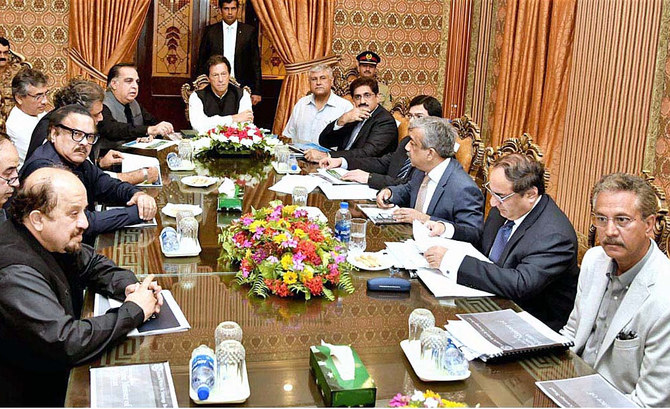
Amid data ambiguity, government claims lowest external public debt in three years

- Statement says external inflows during outgoing fiscal year were $10.186 billion, including grants of $330 million
- In all measures, external debt accumulation in FY19 is less than in preceding year: Hammad Azhar

Rating firm S&P says it won’t rush Iran war downgrades, sees risks for countries like Pakistan
- Agency says it is monitoring indebted energy importers as higher oil prices strain finances
- Gulf economies seen better placed to weather shock, though Bahrain flagged as vulnerable
LONDON: S&P Global said it would not make any knee-jerk sovereign rating cuts following the outbreak of war in the Middle East, but warned on Thursday that soaring oil and gas prices were putting a number of already cash-strapped countries at risk.
The firm’s top analysts said in a webinar that the conflict, which has involved US and Israeli strikes against Iran and Iranian strikes against Israel, US bases and Gulf states, was now moving from a low- to moderate-risk scenario.
Most Gulf countries had enough fiscal buffers, however, to weather the crisis for a while, with more lowly rated Bahrain the only clear exception.
Qatar’s banking sector could also struggle if there were significant deposit outflows in reaction to the conflict, although there was no evidence of such strains at the moment, they said.
“We don’t want to jump the gun and just say things are bad,” S&P’s head global sovereign analyst, Roberto Sifon-Arevalo, said.
The longer the crisis was prolonged, though, “the more difficult it is going to be,” he added.
Sifon-Arevalo said Asia was the second-most exposed region, due to many of its countries being significant Gulf oil and gas importers.
India, Thailand and Indonesia have relatively lower reserves of oil, while the region also had already heavily indebted countries such as Pakistan, Bangladesh and Sri Lanka whose finances would be further hurt by rising energy prices.
“We are closely monitoring these (countries) to see how the credit stories evolve,” Sifon-Arevalo said.


