

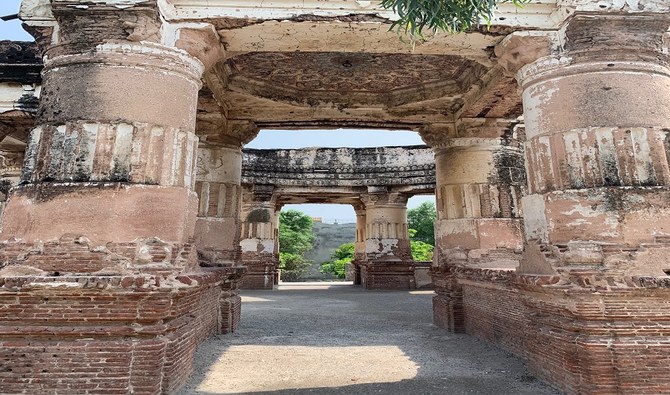


SIALKOT, Pakistan: In April this year, Pakistani Hindu community leader Surinder Kumar got the phone call he had been waiting almost two decades to receive.
On the line, an official from the state-run Evacuee Trust Property Board (ETPB) offered good news: the government had decided that a 1,000-year-old temple in Kumar’s hometown of Sialkot, sealed for 72 years, would be reopened.
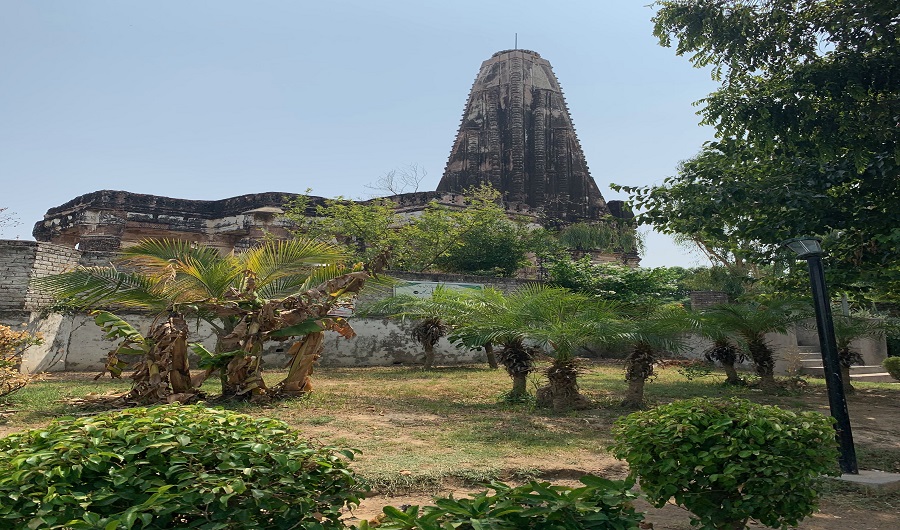
The inner structure of the Teja Singh Temple, attacked by a mob in 1992, stands delipidated after 72 years of neglect. July 5, 2019 (Photo by Benazir Shah)
The ancient Shawala Teja Singh temple was closed to worshippers after thousands of Hindus fled to India when Britain divided its Indian empire into Muslim Pakistan and mainly Hindu India in 1947. The structure has since been governed by the ETPB in Pakistan, a body responsible for the maintenance of properties abandoned by people who left the newly created Pakistan at Partition.
Kumar says he has written hundreds of letters to Pakistani presidents and prime ministers since 2002, pleading that the temple be reopened. In each letter, he penned the same line: “There are close to 100 Hindu families in Sialkot, and only one temple, and that too is closed.”
But no one ever responded to Kumar’s supplications and he had all but given up when he heard from the Board earlier this year, igniting hope that the temple dedicated to the Hindu god of recreation would once again come alive with chants of “Hail Lord Shiva!”
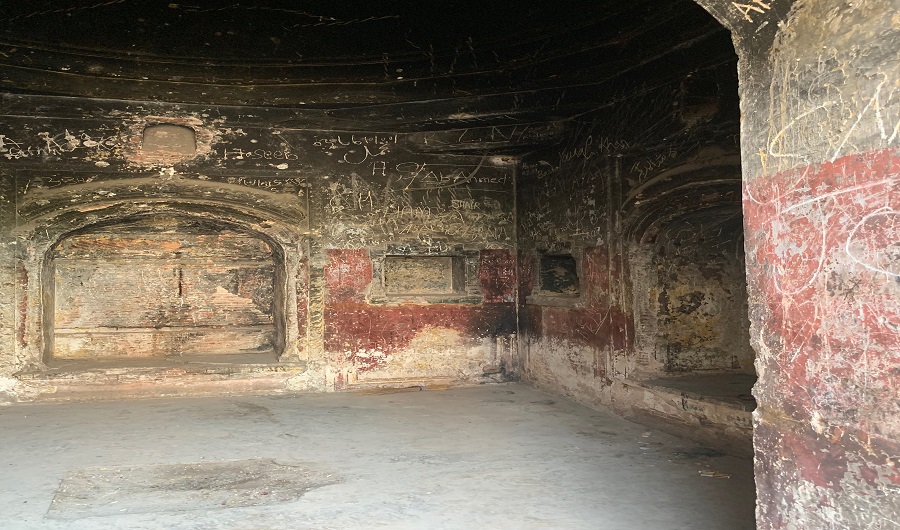
Slogans and graffiti etched into the inner walls of the Teja Singh Temple, over-run for decades by drug addicts. July 5, 2019 (Photo by Benazir Shah)
On Saturday, the temple finally got a mini launch. Sialkot Deputy Commissioner Bilal Haider told local reporters that officials had collaborated with the Evacuee Trust Property Board to reopen the temple and “people are now free to visit anytime.”
On August 5, officials of the Board said, a formal opening ceremony would be held to mark the day Hindus celebrate the snake festival of Nag Panchami.
Minority communities in Pakistan are often targeted by right-wing groups and successive governments have in the past been reluctant to embrace the country’s non-Muslim heritage. But recent attempts to improve Pakistan’s image have included overtures to minority communities by the last government of the Pakistan Muslim League-Nawaz party, and now by the ruling Pakistan Tehreek-e-Insaf of Prime Minister Imran Khan.
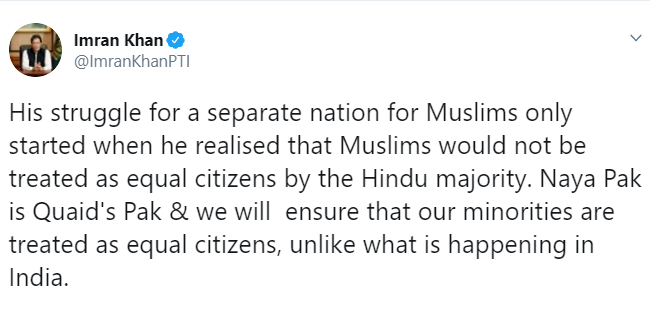
On December 25, just a few months after being elected to office in July polls, Khan said in a Twitter post that his government would “ensure that our minorities are treated as equal citizens.”
Considered a conservative figure, Khan has in the past stressed dialogue with hard-liners including the Taliban, but in recent months has spoken about promoting religious tourism.
Last year, his government announced it would allow Indian Sikh pilgrims to visit an ancient gurdwara in Sialkot. In a rare instance of cooperation, Pakistan also said last year it would work with India to construct a corridor which will give Sikh pilgrims from India single-day, visa-free access to visit a temple in the small Pakistani commune of Kartarpur where the founder of Sikhism is buried.
The moves are all part of an official initiative to encourage tourism and project religious harmony in a region long marked by religious violence, senior officials said.
“I can’t thank this government enough for supporting the Hindu community,” Kumar told Arab News in a phone interview this month.
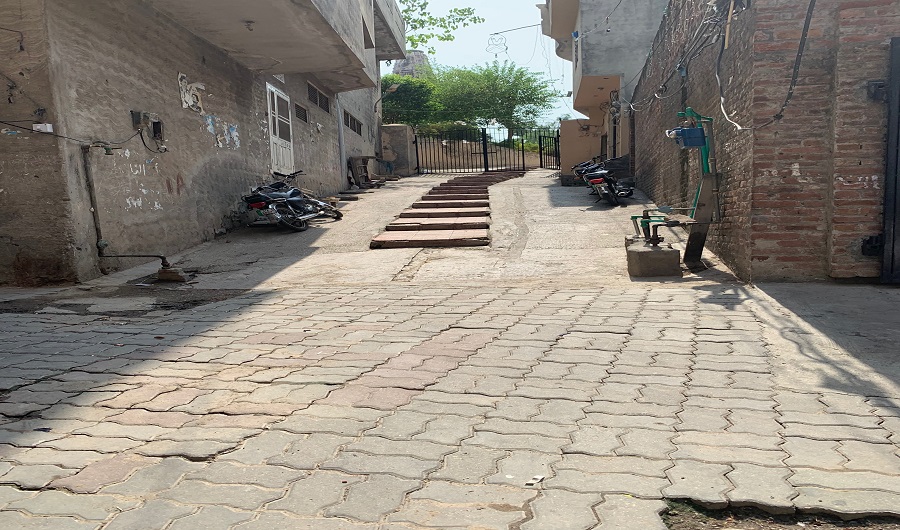
Steps leading up to the ancient Shawala Teja Singh temple in a residential neighborhood of Sialkot. July 5, 2019 (Photo by Benazir Shah)
Dr. Aamer Ahmed, the new chairman of the Evacuee Trust Property Board, said the decision to open the Sialkot temple was communicated to him by the prime minister soon after Ahmed took office in May. The PM Office and information ministry did not respond to repeated calls seeking comment on whether PM Khan has directly ordered the temple’s relaunch.
But Ahmed said the decision was born from a realization for the need for a Hindu temple in Pakistan’s 13th largest city.
“We noticed how big the Hindu community was here,” Ahmed told Arab News in an interview. Restoration work was ordered soon after.
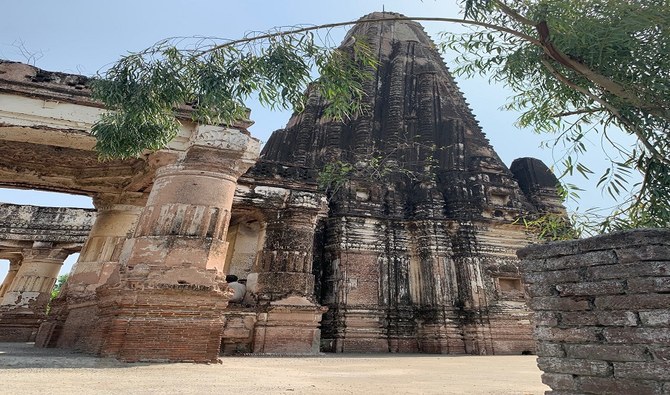
The sun shines in through the majestic open ceiling of the ancient Hindu temple. July 5, 2019 (Photo by Benazir Shah)
Once a marvel of granite and sandstone, the temple, which sits high on a sand dune in a congested, residential neighborhood, has fallen into profound disrepair over the last many years. The intricate carvings on the thick outside pillars have long faded or been scrubbed off by drug addicts and roving bandits taking refuge in the temple, and the tall, imposing idols of Lord Shiva stolen or destroyed.
Now, under the supervision of Sumera Rizvi, a deputy administrator at the ETPB, basic repair work is underway, she said. A boundary wall has been constructed to mark the perimeters of the building and doors refitted near the prayer room. The monument’s exterior and interior have been scrubbed clean and the graffiti on its exterior walls scraped off to make it ready for August 5.
“For the August ceremony, idols of Hindu deities are being transported to the temple from other temples in Pakistan and India,” Rizvi said.
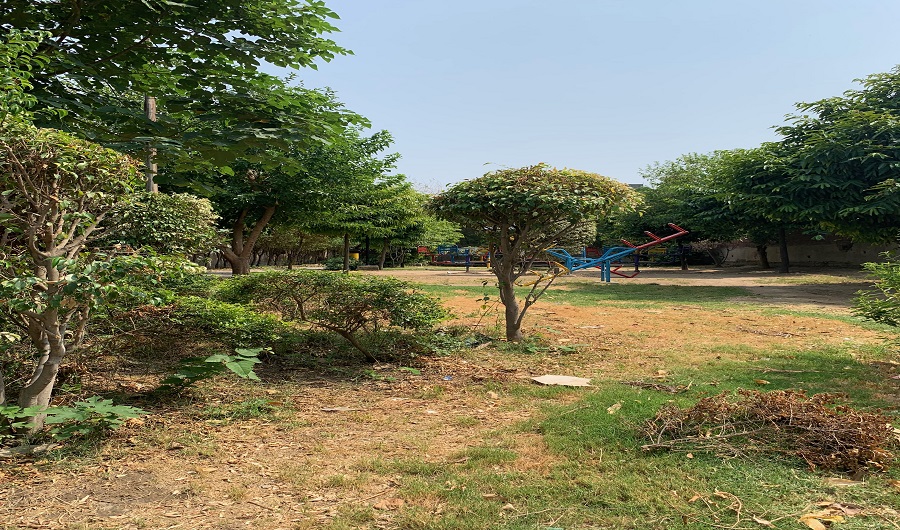
The exterior walls of the Teja Singh Temple in Sialkot, where complete restoration work is estimated to take five years. July 5, 2019 (Photo by Benazir Shah)
Officials said complete restoration would take up to five years, for which UNESCO and the Karachi-based Aga Khan Foundation had been taken on board.
“We don’t want to renovate it in a rushed manner... build a wall here and white-wash there and be done,” EPTB’s Ahmed said. “We want to restore it to its past dignity and grandeur, which will take time.”
For Ravi Dawan, general secretary of the Pakistan Hindu Panchayat, the Shawala Teja Singh temple’s restoration and opening is a huge victory for Pakistani Hindus.
“Of the 10,000 (Hindu temples) in Pakistan, only 4,000 are functional,” Dawan told Arab News. “Majority of the temples have either been lost to encroachments or converted into shops, scrap yards and homes.”
Syed Saeed ul Hassan Shah, Punjab’s minister for religious affairs, said restoring and reopening abandoned places of worship for Sikhs, Hindus and Buddhists was part of the government’s agenda to boost religious tourism and reap its economic benefits.
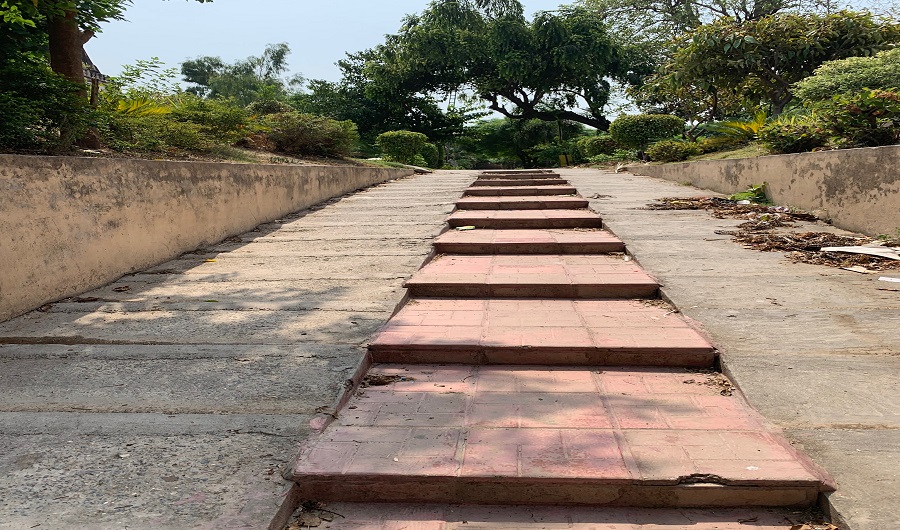
The serene, 1,000-year-old Teja Singh Temple, built of sandstone and granite, has fallen into profound disrepair over the years. July 5, 2019 (Photo by Benazir Shah)
“When these religious tourists visit Pakistan, it will give a boost to our economy,” Shah said.
But most importantly, Rizvi added, it would foster interfaith harmony in a country long roiled by religious violence and hate.
“I get cards, letters and sometimes personal visits from Hindus on a daily basis these days,” she said with a smile, speaking about the love she had received from the minority community since she started supervising restoration of the temple. “This is how we should live: like brothers and sisters, respecting each others’ space.”


