

21 migrants found in North Macedonia near Serbian border

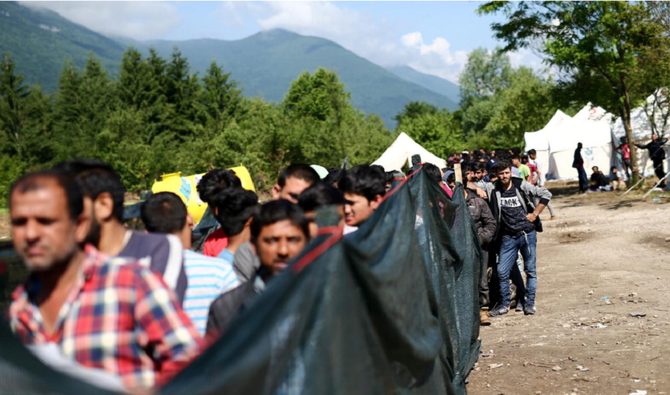
Migrants wait for food at the camp Vucjak, in Bihac area, Bosnia and Herzegovina, June 19, 2019. REUTERS
Updated 28 July 2019
Follow

21 migrants found in North Macedonia near Serbian border

  • Migrants include Pakistani nationals
  • They have been transferred to a migrants' transit center and will be deported to Greece

SKOPJE, North Macedonia: Police in North Macedonia say they have discovered 21 migrants from Pakistan, Iraq and Syria left in the woods after the driver abandoned the vehicle carrying them near the border with Serbia.
Police said in a statement late Friday that a patrol had tried to stop a jeep near the border crossing of Tabanovce, but the driver had run away. Police are still searching for the driver.
Police then searched the area and discovered the migrants hidden in the woods almost 24 hours later.
They have been transferred to a migrants’ transit center and will be deported to Greece. Officially closed since 2015, the so-called Balkan route is still used by migrants traveling from Greece to wealthier European Union countries.


Pakistan launches double-decker buses in Karachi after 65 years to tackle transport woes

Updated 31 December 2025
Follow

Pakistan launches double-decker buses in Karachi after 65 years to tackle transport woes

  • Karachi citizens will be able to travel in double-decker buses from Jan. 1, says Sindh government
  • City faces mounting transport challenges such as lack of buses, traffic congestion, poorly built roads

ISLAMABAD: The government in Sindh province on Wednesday launched double-decker buses in the provincial capital of Karachi after a gap of 65 years, vowing to improve public transport facilities in the metropolis. 

Double-decker buses are designed to carry more passengers than single-deck vehicles without taking up extra road space. The development takes place amid increasing criticism against the Sindh government regarding Karachi’s mounting public transport challenges and poor infrastructural problems. 

Pakistan’s largest city by population faces severe transportation challenges due to overcrowding in buses, traffic congestion and limited bus options. Commuters, as a result, rely on private vehicles or unregulated transport options that are often unsafe and expensive.

“Double-decker buses have once again been introduced for the people of Karachi after 65 years,” a statement issued by the Sindh information ministry said. 

Sindh Transportation Minister Sharjeel Inam Memon and Local Government Minister Syed Nasir Hussain Shah inaugurated the bus service. The ministry said the facility will be available to the public starting Jan. 1. 

The statement highlighted that new electric bus routes will also be launched across the entire province starting next week. It added that the aim of introducing air-conditioned buses, low-fare services, and fare subsidies is to make public transport more accessible to the people.

The ministry noted that approximately 1.5 million people travel daily in Karachi using the People’s Bus Service, while around 75,000 passengers use the Orange Line and Green Line BRT services.

“With the integration of these routes, efforts are being made to benefit up to 100,000 additional people,” the ministry said.