

’Shop window’ Caracas angers rest of Venezuela

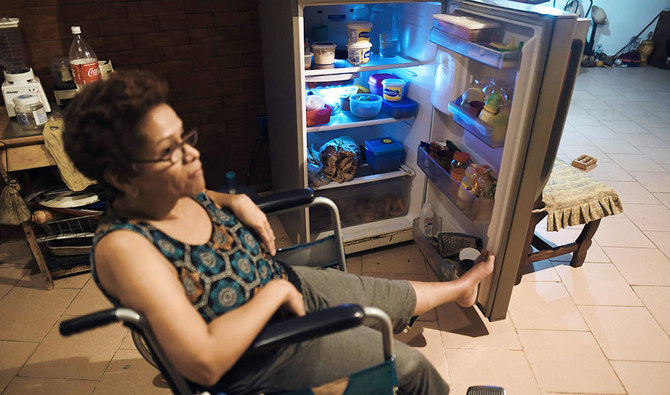
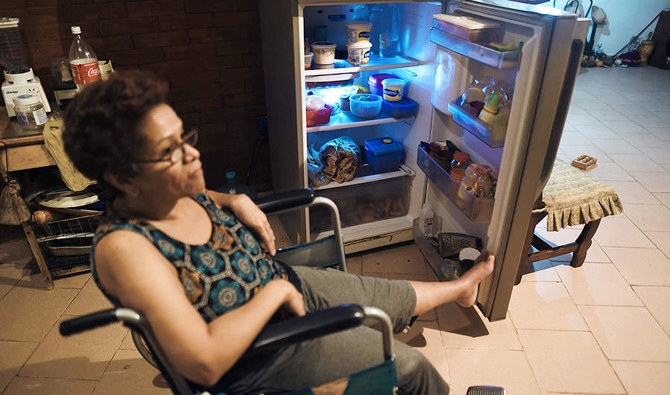
A resident, who remains in a wheelchair due to a broken leg, shows groceries and vegetables in her fridge, in Petare slum, Caracas on July 25, 2019. (AFP)
Updated 28 July 2019
Follow

’Shop window’ Caracas angers rest of Venezuela

  • Fuel is heavily subsidized in Venezuela to keep the price absurdly low

CARACAS/MARACAIBO: While authorities concentrate on presenting an image of normality in Caracas, Venezuelans elsewhere in the country who are suffering from severe shortages amid a political and economic crisis are livid.
The capital is a “shop window” for ambassadors and foreigners as well as a “propaganda operation,” said Andres Canizalez, an expert in political communication.
It’s an outlook shared by many Venezuelans, who see a harsh reality play out in places like the grocery store and gas station.
Gendry Parra fumed recently as he watched a video of a man in Caracas taking just five minutes to fill his vehicle with fuel.
The 44-year-old shopkeeper had spent three days queuing for fuel in Maracaibo, a city in the country’s far west close to the border with Colombia.
“It disgusts me that we’re in the same country and it’s one thing there and another here,” he said.
Parra doesn’t have running water, fuel or cash, and blackouts can last days in his hometown of Maracaibo even though it was the first city in Venezuela to have electricity.
It’s also the capital of Zulia state, which used to be an important source of Venezuelan oil and gas.
Alberto Arriechi, the man pumping gas in the video, said he recognizes the privilege he has over millions of Venezuelans who live in the country’s interior and are hit harder by Venezuela’s declining oil production and lack of cash for imports.
Like other people in Caracas, the 29-year-old engineer does not suffer as severely from electricity rationing carried out by the government ever since a massive blackout in March.
The latest rationing came Monday: Caracas was without power for seven hours, other parts of the country suffered for two days.
When it comes to fuel, customers in places like Maracaibo complain that some unscrupulous gas stations illegally ask for payment in dollars.
Fuel is heavily subsidized in Venezuela to keep the price absurdly low. Arriechi bought his for a handful of bolivars.

On the shores of Lake Maracaibo, Johannis Semprun, a victim of the country’s economic crisis, sighs.
“Right now we have electricity. And I mean ‘right now.’ Don’t be surprised if it goes in a moment,” said the 37-year-old, who has six children and a handicapped wife. Due to financial troubles, he had to take his children out of school and they now eat at an evangelical church.
“Everything has got worse,” he said.
Maracaibo was once booming thanks to oil but Venezuela’s production has plummeted from 3.2 million barrels a day 10 years ago to just one million.
The disparities between life in Caracas and elsewhere have left some feeling envious.
Warin Guerrero, a livestock industry leader in the western state of Barinas, has implored cattle ranchers not to send food to the capital.
“Over there, they don’t have any problems ... we’re treated like second class citizens,” he said.
While Caracas’ special status has historical roots in centralization, nowadays it’s about government bias, said Canizalez, the political communication expert.
“There’s a belief that if there were a social disruption in Caracas, it would spread throughout the rest of the country,” he said.
“If Caracas is kept relatively well, if it doesn’t rebel, everything else will work.”
The apparent normality of Caracas includes a greater choice of products. There’s also a proliferation of imported goods, with prices in dollars.
But few can afford them as salaries and savings have been rendered almost worthless by hyperinflation which the International Monetary Fund says will reach 10 million percent this year.
At the Las Pulgas market in Maracaibo, it’s normal for poor people to buy bones and entrails to eat.
Cleaning lady Josefina Galindo, 49, feels “outrage, impotence” when hearing the price of coffee in a store: $15 for 250 grams. She earns only $9 a month.
She hasn’t bought meat in a year. On her way home she goes through a street market.
“All I do is look at meat and the prices,” she says.


Disaster losses drop in 2025, picture still ‘alarming’: Munich Re

Updated 5 sec ago
Follow

Disaster losses drop in 2025, picture still ‘alarming’: Munich Re

  • Costliest disaster came in the form of the Los Angeles wildfires in January, with total losses of $53bn

FRANKFURT: Natural disaster losses worldwide dropped sharply to $224 billion in 2025, reinsurer Munich Re said Tuesday, but warned of a still “alarming” picture of extreme weather events likely driven by climate change.

The figure was down nearly 40 percent from a year earlier, in part because no hurricane struck the US mainland for the first time in several years.
Nevertheless, “the big picture was alarming with regard to floods, severe ... storms and wildfires in 2025,” said Munich Re, a Germany-based provider of insurance for the insurance industry.

HIGHLIGHT

Around 17,200 lives were lost in natural disasters worldwide, significantly higher than about 11,000 in 2024, but below the 10-year average of of 17,800.

The costliest disaster of the year came in the form of Los Angeles wildfires in January, with total losses of $53 billion and insured losses of around $40 billion, Munich Re said in its annual disaster report.
It was striking how many extreme events were likely influenced by climate change in 2025 and it was just chance that the world was spared potentially higher losses, according to the group.
“The planet has a fever, and as a result we are seeing a cluster of severe and intense weather events,” Tobias Grimm, Munich Re’s chief climate scientist, told AFP.
Last month Swiss Re, another top player in the reinsurance industry, also reported a hefty drop for 2025, putting total losses at $220 billion.
According to Munich Re’s report, insured losses for 2025 came in at $108 billion, also sharply down on last year.
Around 17,200 lives were lost in natural disasters worldwide, significantly higher than about 11,000 in 2024, but below the 10-year average of of 17,800, it said.
Grimm said 2025 was a year with “two faces.”
“The first half of the year was the costliest loss period the insurance industry has ever experienced,” he said — but the second half saw the lowest losses in a decade.
It is now the cumulative costs of smaller-scale disasters — like local floods and forest fires — that are having the greatest impact.
Losses from these events amounted to $166 billion last year, according to Munich Re.
After the LA wildfires, the costliest disaster of the year was a devastating earthquake that hit Myanmar in March, which is estimated to have caused $12 billion in losses, only a small share of which was insured.
Tropical cyclones caused around $37 billion in losses.
Jamaica was battered by Hurricane Melissa, one of the strongest hurricanes ever to make landfall, generating losses of around $9.8 billion.
By region, the US’ total losses amounted to $118 billion, $88 billion of which was insured — around the same as an estimate of $115 billion total losses from US nonprofit Climate Central.
The Asia-Pacific region had losses of about $73 billion — but only $9 billion was insured, according to the report.
Australia had its second most expensive year in terms of overall losses from natural disasters since 1980 due to a series of severe storms and flooding.
Europe saw losses of $11 billion. Natural disasters in Africa led to losses of $3 billion, less than a fifth of which was insured.
The report comes at a time when skepticism toward green policies is growing, particularly since the return to power of US President Donald Trump, who derides climate science as a “hoax.”
But Grimm warned that the Earth “continues to warm.”
“More heat means more humidity, stronger rainfall, and higher wind speeds — climate change is already contributing to extreme weather,” he said.