RIYADH: The Secretariat of the Holy Capital has implemented a project to apply a heat-blocking coating to pavement surfaces in pedestrian pathways at holy sites.
The first phase of the project included coating the pedestrian pathway in Mina all the way to the Jamarat facilities, a total area of about 3,500 square meters.
The director general of the holy sites and seasons, Ahmed Manshi, pointed out that the project is being implemented in cooperation with the Japanese corporation Sumitomo.
“The project aims to reduce the temperature of the pavement surface in Shaiben area, and there is a possibility to include the Jamarat facilities, and coat several pedestrian pathways at holy sites,” he said.
Manshi added that the project will help reduce the temperature by 15-20 degrees celsius, highlighting that the temperature will be recorded every 10 seconds during the season using sensors installed under the asphalt.
He explained that to measure the success of this project, surveys will be distributed to pilgrims during this year’s Hajj season.
“We have also coordinated with the Custodian of the Two Holy Mosques Institute for Hajj and Umrah Research to conduct a study on this experiment, recommend the possibility of expanding to other locations, and learn the most convenient sites for the secretariat to provide the service,” he said.
The project came after the completion of a network of pedestrian pathways extending from the Mount of Mercy (Jabal Al-Rahma) in Arafat to Mina, passing through Muzdalifah.
It aims to ensure the comfort, safety and security of pilgrims while they move between holy sites. The pathway has been paved using interlocking tiles, and benches are placed on both sides for pilgrims to rest.
Sunshades have also been installed to protect pilgrims from the sun, and concrete barriers have been placed to prevent vehicles from entering the pedestrian pathway. The pathway is lit using high-tech poles and LED beams, which are bright, cost-efficient when compared to ordinary lighting, and have low emissions.


Makkah successfully reduces heat in pedestrian pathways at holy sites




Makkah successfully reduces heat in pedestrian pathways at holy sites

- The first phase of the project included coating the pedestrian pathway in Mina all the way to the Jamarat facilities, a total area of about 3,500 square meters
- The director general of the holy sites and seasons, Ahmed Manshi, pointed out that the project is being implemented in cooperation with the Japanese corporation Sumitomo

Qatar, Pakistan resolve to boost strategic, economic cooperation at Doha talks
- Both countries urge dialogue on Afghanistan amid renewed border tensions between Islamabad and Kabul
- Discussions focus on bilateral trade and investment, energy, defense, manpower and labor and culture
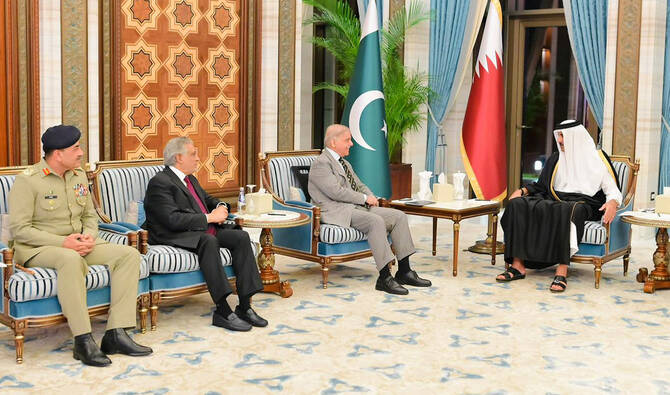
ISLAMABAD: Pakistan and Qatar on Tuesday agreed to deepen their strategic and economic cooperation during high-level talks between Prime Minister Shehbaz Sharif and his Qatari counterpart Sheikh Mohammed bin Abdulrahman bin Jassim Al Thani, Sharif’s office said.
Sharif visited Qatar along with a high-level delegation on the invitation of Qatari emir Sheikh Tamim bin Hamad Al Thani. The Pakistani premier also held meetings with Qatar’s trade and defense ministers to discuss cooperation in various domains.
The visit came at a time when Pakistan is seeking closer economic engagement with Gulf partners amid its broader push to stabilize the economy and attract investment, while maintaining security and defense cooperation with key regional states.
During their meeting in Doha, PM Sharif and Qatar’s Sheikh Mohammed discussed bilateral relations and exchanged views on regional and international developments, according to the Pakistan prime minister’s office.
“They reaffirmed the strong brotherly relations between Pakistan and Qatar and expressed satisfaction at the growing momentum in political, economic and institutional ties,” Sharif’s office said.
“Discussions focused on enhancing cooperation in the fields of trade and investment, energy, defense, manpower and labor and culture, with both sides stressing the importance of their task force to accelerate cooperation in all these areas.”
Pakistan and Qatar maintain strong trade and investment ties. In 2022, the office of Qatar’s emir said the Qatar Investment Authority planned to invest $3 billion in Pakistan, targeting sectors including transport, aviation, education, health, media, technology and labor.
Nearly 300,000 Pakistanis live and work in Qatar, according to Pakistan’s foreign office, with many employed in health, education, engineering and public services, as well as construction and transport. The two countries engage through forums such as the Bilateral Political Consultations and the Joint Ministerial Commission.
Sharif said he had productive discussions with Qatar’s emir, Sheikh Tamim bin Hamad Al Thani, on how the two sides could transform their brotherly ties into mutually beneficial economic relationships.
“We also took stock of the regional situation,” he said on X. “Pakistan and Qatar will continue to work together for peace and stability in the region and beyond.”
DIALOGUE WITH AFGHANISTAN
Earlier, Sharif and Qatar’s Deputy PM Sheikh Saoud Al-Thani discussed the situation in Afghanistan and called for dialogue to support regional stability.
The meeting took place amid renewed tensions after Islamabad carried out airstrikes last week on what it described as Tehreek-e-Taliban Pakistan (TTP) targets inside Afghanistan. Kabul said the strikes killed civilians and vowed to respond to what it called a violation of its sovereignty.
“Regional developments were also discussed, in particular the situation in Iran and Afghanistan,” Sharif’s office said in a statement. “Both sides emphasized the importance of dialogue, de-escalation and collective efforts to promote peace and stability in the region.”
This was the second time in less than six months that Pakistan conducted airstrikes in Afghanistan. The last strikes triggered heavy, weeklong clashes between the neighbors along their border before Qatar and Turkiye mediated a ceasefire between them in Oct. last year.
Separately, Sharif held meetings with Qatar’s State Minister for Trade Dr. Ahmed bin Mohammed Al-Sayed and a delegation of the Qatar Businessmen Association (QBA), highlighting Pakistan’s investment-friendly reforms.
He invited QBA members to explore opportunities in infrastructure, logistics, energy, agriculture, technology and export-oriented manufacturing, his office said.