


Pakistan opposition parties hold protest rallies against PM Khan

A supporter of Pakistan Peoples Party (PPP) attends an anti-government protest in Karachi on July 25, 2019. Thousands of supporters of Pakistan’s opposition parties on July 25, took to the streets as they observed “Black Day,” one year after the election that brought cricket-turned politician Imran Khan into power. (AFP)
Updated 26 July 2019
Follow

Pakistan opposition parties hold protest rallies against PM Khan

  • Rallies, dubbed the "Black Day," marked the first anniversary of the parliamentary elections
  • Rallies came less than two weeks after Pakistani businesses observed a daylong strike against taxes

QUETTA: Pakistan’s main opposition parties held protest rallies in cities across the country on Thursday, accusing Prime Minister Imran Khan’s government of ruining the economy and seeking to intimidate and silence its opponents.
The so-called “Black Day” protests, a year after Khan’s PTI party swept to power following a bitterly contested election, come amid mounting economic problems for Pakistan and a political climate that has grown increasingly angry.
Surging prices of fuel and everyday staples, a plunging currency that has lost a quarter of its value since the election and allegations of media censorship and stifling opposition voices has fueled the protests.
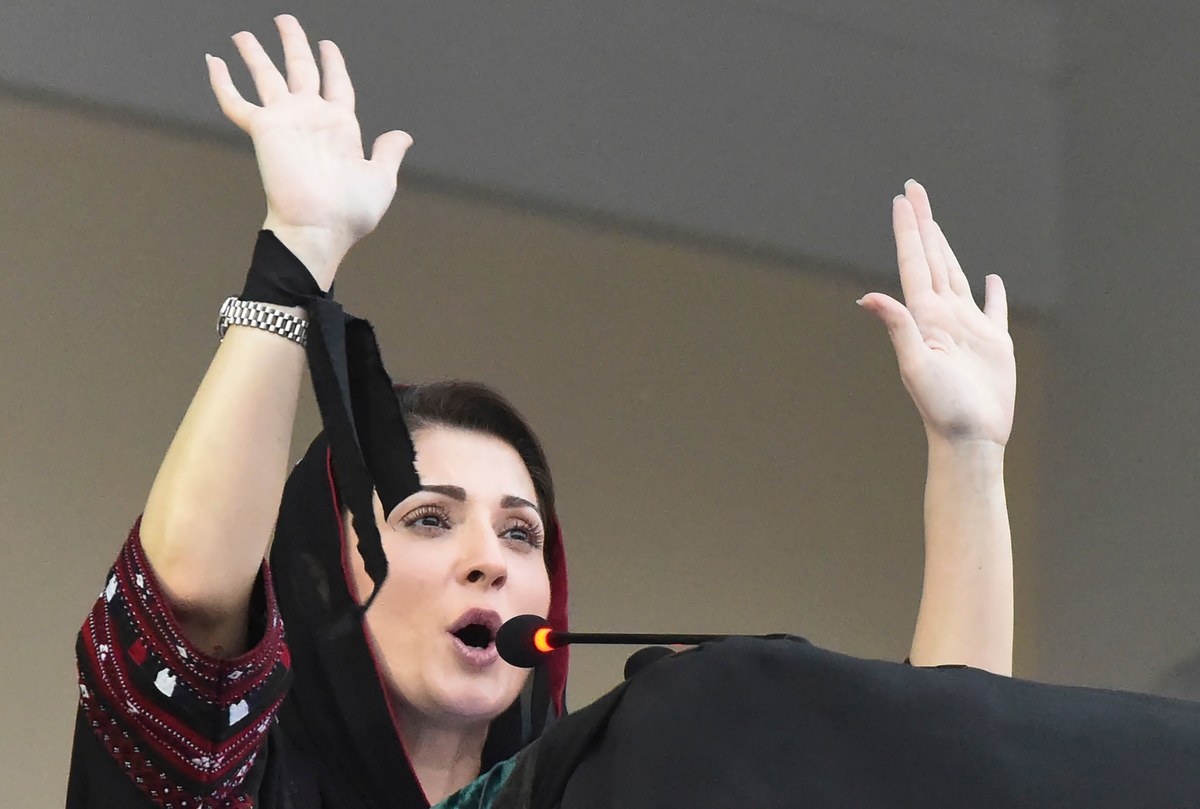


Maryam Nawaz, daughter of jailed former Pakistani prime minister Nawaz Sharif, addresses the gathering during an anti-Imran Khan protest rally in Quetta on July 25, 2019. (AFP)

“Every day in the presence of Imran Khan is a black day,” Maryam Nawaz, leader of the PML-N party that was ousted from power in last year’s election told a crowd of thousands of supporters in a football stadium in the western city of Quetta.
She accused Khan of accepting “dictation” from US President Donald Trump during his visit to Washington and proposed a march on the capital Islamabad but did not name a date.
In Karachi, Pakistan’s commercial capital, thousands of supporters of the PPP, Pakistan’s other main opposition party, gathered to hear party leader Bilawal Bhutto, son of the murdered former prime minister Benazir Bhutto.
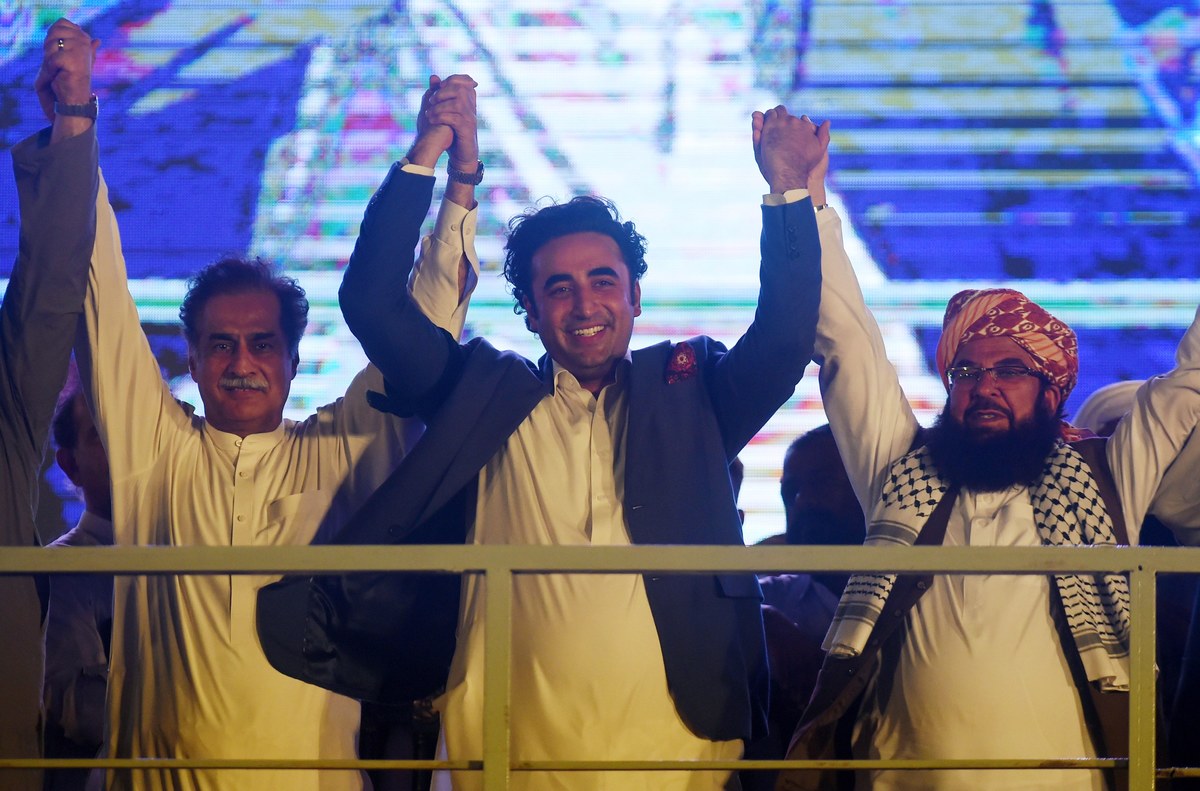


Chairman of Pakistan Peoples Party (PPP), Bilawal Bhutto Zardari (C), join hands with other opposition parties leaders during an anti-Imran Khan protest in Karachi on July 25, 2019. (AFP)

Banners reading “PTI brought price hikes, PTI brought joblessness, PTI brought economic terrorism” hung over the main stage. There were similar protests in other cities including Lahore and Peshawar.
Khan’s government came to power with Pakistan already nearing a balance of payments crisis, and this month agreed a $6 billion bailout with the International Monetary Fund that came with tough austerity conditions including more taxes and an agreement to let the rupee currency fall sharply.
It has dismissed the opposition protests and blamed the economic turmoil on massive corruption and economic mismanagement by previous governments, accusing their leaders of shifting millions of dollars out of the country illegally.
PML-N founder and former Prime Minister Nawaz Sharif, Maryam Nawaz’s father, is currently serving a 7-year sentence on corruption charges. His successor, Shahid Khaqan Abbasi, has also been arrested on corruption charges. He denies wrongdoing.
The arrests have fed the anger of opposition parties, who say the government has manipulated the justice system to crush its adversaries.
Earlier this month, PML-N officials produced video evidence they said showed the judge responsible for sentencing Nawaz Sharif had been blackmailed into convicting him. The judge, who said the PML-N had also attempted to blackmail him, has since been sacked from the court that decided the Nawaz case.


Pakistan, Japan discuss boosting trade, investment and cooperation in key sectors

Updated 8 sec ago
Follow

Pakistan, Japan discuss boosting trade, investment and cooperation in key sectors

  • The Pakistani side highlighted various opportunities in sectors minerals and mining, agricultural and agri-food products, and IT sectors
  • The development comes as Pakistan steps up economic diplomacy to expand trade, investment ties after emerging from a financial crisis

ISLAMABAD: Pakistan and Japan have held talks on improving bilateral trade and investment and expanding cooperation in key sectors, Pakistan’s Press Information Department said on Saturday.

Both countries held the 8th Pakistan–Japan Government–Business Joint Dialogue and the Pakistan Business Forum in Tokyo on Friday, marking the first convening of the dialogue in the Japanese capital since Dec. 2018.

The dialogue was co-chaired by Prime Minister Shehbaz Sharif’s aide on commerce Rana Ihsaan Afzal Khan and Takuo Komori, Japan’s parliamentary vice-minister of economy, trade and industry, according to the PID.

The two sides exchanged views on strengthening bilateral economic relations, with a focus on improving the trade and investment environment and advancing practical cooperation.

“The Pakistani side outlined Pakistan’s economic priorities and highlighted opportunities for collaboration in sectors such as minerals and mining, agricultural and agri-food products, and information technology,” the PID said in a statement.

“The Japanese side shared perspectives on the operating environment for Japanese companies in Pakistan and discussed areas where continued engagement and follow-up could further facilitate business activity.”

Pakistan steps up economic diplomacy to expand trade ties and attract foreign capital after emerging from a prolonged financial crisis that nearly pushed it into default in mid-2023. Islamabad has since set up the Special Investment Facilitation Council (SIFC), a civil-military body designed to cut red tape and provide a one-window operation for businesses, as it navigates a long path to economic recovery under a $7 billion International Monetary Fund (IMF) program.

Pakistan and Japan established diplomatic and economic relations in 1952. Since then, Japan has been a major development partner, financing infrastructure such as roads, power plants and water systems, while extending technical assistance and yen loans.

The Pakistan–Japan Government–Business Joint Dialogue brought together senior officials and private-sector representatives from both countries, including members of the Pakistan–Japan Business Forum (PJBF) and the Japan–Pakistan Business Co-operation Committee (JPBCC).

Participants reaffirmed the importance of sustained government-to-government engagement, supported by close coordination with the private sector, to advance mutually beneficial economic cooperation between Pakistan and Japan, according to the statement.

Following the Joint Dialogue, the Pakistan Business Forum, co-organized by the Embassy of Pakistan in Tokyo and the Japan External Trade Organization (JETRO), was held in Tokyo that was attended by Japanese and Pakistani business leaders.

The Forum featured selected sectoral presentations highlighting practical cooperation between Japanese and Pakistani partners. It included a presentation by the Trade and Investment Counsellor of the Embassy of Pakistan in Tokyo on “From Trade to Investment: Building Japan–Pakistan Joint Value Chains.”

“The Forum concluded with closing remarks by Mr. Abdul Hameed, Ambassador of Pakistan to Japan, who highlighted the importance of sustained engagement, trust-building, and long-term partnership in advancing Pakistan–Japan economic cooperation,” the PID added.