

Iran threatens new ‘confrontation’ in Gulf

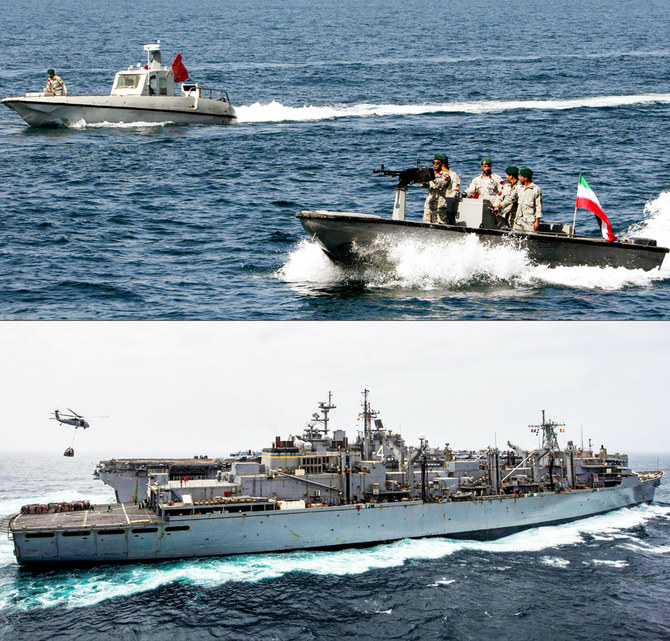
This combination of file pictures created on July 22, 2019, shows Iranian soldiers taking part in the "National Persian Gulf day" in the Strait of Hormuz, on April 30, 2019 (up) and the amphibious assault ship USS Boxer (LHD 4) receiving a vertical replenishment-at-sea in the Arabian Sea on July 14, 2019. (US Navy photo via AFP)
Updated 25 July 2019
Follow

Iran threatens new ‘confrontation’ in Gulf

  • If we can’t export oil no one can, Islamic Revolutionary Guard Corps chief vows
  • The maritime crisis in the Gulf began when IRCG forces boarded a British tanker last week and diverted it to an Iranian port

JEDDAH: Tehran on Wednesday threatened a “dangerous confrontation” in the Strait of Hormuz amid escalating tension over Iranian state piracy in the Arabian Gulf.

All countries should be able to export their oil through the strait or else no one could, said  Hossein Dehghan, a commander of Islamic Revolutionary Guard Corps (IRGC) and military adviser to Iran’s supreme leader Ayatollah Ali Khamenei.

Tehran would not negotiate with the US under any circumstances and if Washington decided to go to war then all American bases in the region would be targeted, Dehghan said.

He accused Abu Dhabi, the capital of the UAE, of becoming a US center to strike Iran’s national security.

The maritime crisis in the Gulf began when IRCG forces boarded a British tanker last week and diverted it to an Iranian port, in retaliation for the British seizure in the Mediterranean of an Iranian tanker carrying oil to Syria in breach of EU sanctions.

Iran’s President Hassan Rouhani hinted on Wednesday that the two vessels could be swapped. “We don’t want tensions with some European countries,” Rouhani said.

BACKGROUND

Japanese Prime Minister Shinzo Abe and top French diplomatic adviser Emmanuel Bonne have visited Tehran in the past month.

If such countries were to “cease the incorrect acts that they have done, including that of Gibraltar, Iran’s response would be appropriate.”

Rouhani also said Iran would be open to talks should there be a “cease-fire” in US economic sanctions that are crippling the Iranian economy.

“In this regard some countries are intermediaries, though they themselves say they are not mediators and are just expressing their own views,” he said. Japanese Prime Minister Shinzo Abe and top French diplomatic adviser Emmanuel Bonne have visited Tehran in the past month.

Meanwhile, the Israeli spy agency Shin Bet said security forces had uncovered Iranian intelligence efforts to recruit Israeli Arabs and Palestinians.

“The network was based in Syria under Iranian guidance and was led by a Syrian operative nicknamed Abu Jihad,” it said. 

“It attempted to recruit people via fictitious Facebook profiles and messaging apps.”

The recruits were asked to gather data on sites such as military bases and police stations with a view to providing Iran with potential Israeli targets. Most refused to cooperate, Shin Bet said.

Algeria inaugurates strategic railway to giant Sahara mine

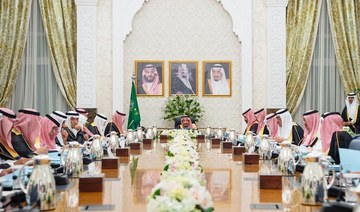
President Tebboune attended an inauguration ceremony in Bechar. (AFP file photo)
Updated 4 sec ago
Follow

Algeria inaugurates strategic railway to giant Sahara mine

  • The mine is expected to produce 4 million tons per year during the initial phase, with production projected to triple to 12 million tons per year by 2030, according to estimates by the state-owned Feraal Group, which manages the site
  • The project is financed by the Algerian state and partly built by a Chinese consortium

ALGEIRS: Algerian President Abdelmadjid Tebboune on Sunday inaugurated a nearly 1,000-kilometer (621-mile) desert railway to transport iron ore from a giant mine, a project he called one of the biggest in the country’s history.
The line will bring iron ore from the Gara Djebilet deposit in the south to the city of Bechar located 950 kilometers north, to be taken to a steel production plant near Oran further north.
The project is financed by the Algerian state and partly built by a Chinese consortium.
During the inauguration, Tebboune described it as “one of the largest strategic projects in the history of independent Algeria.”
This project aims to increase Algeria’s iron ore extraction capacity, as the country aspires to become one of Africa’s leading steel producers.
The iron ore deposit is also seen as a key driver of Algeria’s economic diversification as it seeks to reduce its reliance on hydrocarbons, according to experts.
President Tebboune attended an inauguration ceremony in Bechar, welcoming the first passenger train from Tindouf in southern Algeria and sending toward the north a first charge of iron ore, according to footage broadcast on national television.
The mine is expected to produce 4 million tons per year during the initial phase, with production projected to triple to 12 million tons per year by 2030, according to estimates by the state-owned Feraal Group, which manages the site.
It is then expected to reach 50 million tons per year in the long term, it said.
The start of operations at the mine will allow Algeria to drastically reduce its iron ore imports and save $1.2 billion per year, according to Algerian media.