

Saudi Cabinet stresses commitment to Hajj services

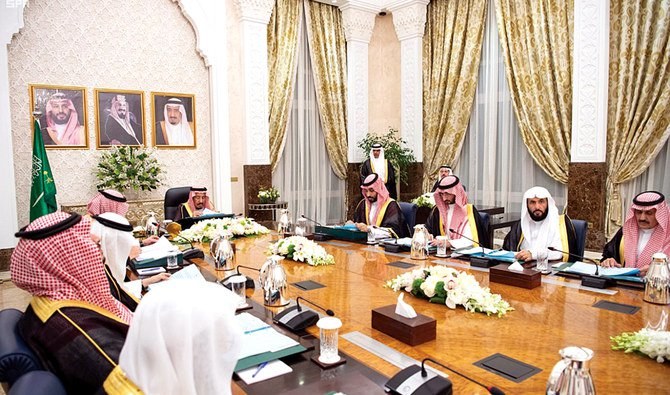
Saudi King Salman chairs the council of ministers meeting for first time in Neom. (SPA)
Updated 24 July 2019
Follow

Saudi Cabinet stresses commitment to Hajj services

  • The Custodian of the Two Holy Mosques’ Guests Program for Hajj and Umrah has benefited over 52,000 pilgrims

NEOM: The Saudi Cabinet on Tuesday reviewed topics related to the services provided to Hajj pilgrims, and to the service of the Two Holy Mosques.

Chaired by King Salman, the Cabinet discussed his directive to host thousands of pilgrims from all over the world each year as part of the Custodian of the Two Holy Mosques’ Guests Program for Hajj and Umrah. The program has benefited more than 52,000 pilgrims since its inception in 1996. 

Media Minister Turki Al-Shabanah said the opening of water projects in Makkah and the holy sites reflects the Saudi leadership’s care and attention, the Saudi Press Agency reported.

The opening of the water projects, which cost a total of more than SR1.3 billion ($346.6 million), coincides with this year’s pilgrimage season.

The Cabinet condemned the Israeli demolition of dozens of houses in East Jerusalem, making hundreds of Palestinians homeless.

It urged the international community to intervene to stop this aggression and Israel’s attempts to change the legal and demographic character of the city.

The Cabinet was briefed on regional and international developments, including Iran’s violations of international law, such as the interception of civilian ships in the Arabian Gulf.

The Cabinet praised the results of the 50th ordinary session of the Council of Arab Information Ministers chaired by Saudi Arabia.

Participants stressed the role of Arab media in consolidating citizenship, strengthening national identity, and combating terrorism and extremist thought.

The Cabinet expressed its condolences to Japan’s government and people on the deadly fire in the city of Kyoto, and wished the injured a speedy recovery.

Al-Shabanah said local affairs discussed by the Cabinet included the King Abdullah International Parks project in Riyadh.

The Cabinet praised the crown prince’s support for sports, and the distribution of SR2.5 billion to sports clubs.


The founding economy: A blueprint for stability in the First Saudi State

Updated 23 February 2026
Follow

The founding economy: A blueprint for stability in the First Saudi State

  • The establishment of the First Saudi State created a secure environment that facilitated the arrival of caravans, secured vast trade routes, and revived commerce across the Arabian Peninsula

RIYADH: The economy during the founding stage of the First Saudi State served as a fundamental pillar in building the nation, consolidating its influence, and ensuring its stability. This early economic growth was inextricably linked to achieving security, unifying regions, and organizing society—factors that directly stimulated trade, stabilized markets, and enhanced the foundations of daily life in Diriyah and its surrounding areas.
According to Dr. Abdullah Al-Saleh Al-Othaimeen's "Diriyah: Origins and Development during the First Saudi State," published by the King Abdulaziz Foundation for Research and Archives (Darah), the founding economy stands as a historical model reflecting the reciprocal relationship between political stability and early economic prosperity.

Beyond its political and intellectual prominence, Diriyah emerged as a vibrant economic hub. (SPA)

The establishment of the First Saudi State created a secure environment that facilitated the arrival of caravans, secured vast trade routes, and revived commerce across the Arabian Peninsula.
Beyond its political and intellectual prominence, Diriyah emerged as a vibrant economic hub. Its active markets attracted merchants and students from across the region, all of whom benefited from the state-provided stability. The local society relied on diverse activities for its livelihood, including trade, agriculture, and livestock breeding, with horses and camels playing crucial roles in transportation, commerce, and securing roads.
The social and administrative organization upon which the state was founded ensured the continuous availability of goods and sustained market stability. Ultimately, the close relationship between public security and economic growth during this founding phase solidified Diriyah's position as a premier political and commercial center in the Arabian Peninsula.