Pakistani naval chief, UAE counterpart discuss maritime cooperation in Dubai

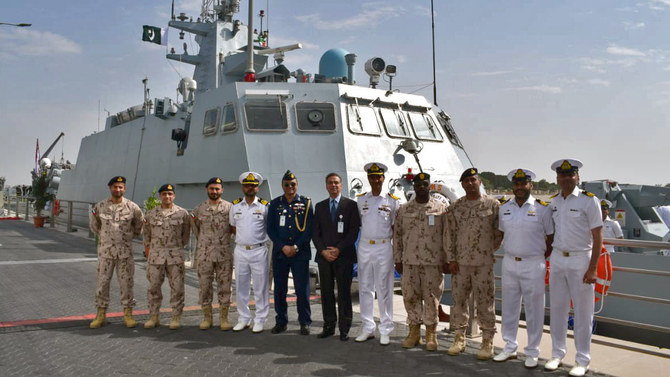
In this file photo, Pakistani and UAE officials welcome the arrival of Pakistan Navy ships in the UAE to participate in joint exercises in February 2019. (Photo courtesy: Pakistan Navy)
Updated 22 July 2019
Follow

Pakistani naval chief, UAE counterpart discuss maritime cooperation in Dubai

  • Pakistan’s navy chief also met with the UAE army chief for talks
  • Admiral Abbasi will visit UAE Navy Units

ISLAMABAD: Pakistan’s Chief of Naval Staff, Admiral Zafar Mahmood Abbasi, held a meeting with the United Arab Emirates Navy chief and discussed cooperation in maritime affairs at Dubai Naval Headquarters on an official visit to the UAE, Pakistan Navy media wing said on Monday.
On Sunday, Admiral Abbasi held talks with UAE army chief and under-secretary of the defence ministry.
“On the second leg of visit he (Admiral Abbasi) will visit different units of UAE Navy,” Pakistan Navy said and added that the visit would “improve bilateral ties specially in the file of maritime affairs.”
Pakistan and UAE navies have maintained close relations over the decades and Pakistan Navy collaborates with its UAE counterparts on various professional issues including training exercises, provision of trained manpower and port visits by fleet units in line with their long-standing collaboration.
In February, a Pakistan Navy flotilla comprising navy ships TARIQ and HIMMAT visited Abu Dhabi to participate in a leading trade show, the International Defence Exhibition/ Naval Defence Exhibition.
In the same month, both navies conducted bilateral exercises aimed at enhancing interoperability between them.
“During two days exercise, a number of evolutions pertaining to Maritime Security Operations, Search and Rescue, maneuvering drills, Maritime Infrastructure Protection, Communication, and Warfare related exercise were undertaken,” Pakistan Navy had said after the joint exercise.


IMF hails Pakistan privatization drive, calls PIA sale a ‘milestone’

Updated 52 min 54 sec ago
Follow

IMF hails Pakistan privatization drive, calls PIA sale a ‘milestone’

  • Fund backs sale of national airline as key step in divesting loss-making state firms
  • IMF has long urged Islamabad to reduce fiscal burden posed by state-owned entities

KARACHI: The International Monetary Fund (IMF) on Saturday welcomed Pakistan’s privatization efforts, describing the sale of the country’s national airline to a private consortium last month as a milestone that could help advance the divestment of loss-making state-owned enterprises (SOEs).

The comments follow the government’s sale of a 75 percent stake in Pakistan International Airlines (PIA) to a consortium led by the Arif Habib Group for Rs 135 billion ($486 million) after several rounds of bidding in a competitive process, marking Islamabad’s second attempt to privatize the carrier after a failed effort a year earlier.

Between the two privatization attempts, PIA resumed flight operations to several international destinations after aviation authorities in the European Union and Britain lifted restrictions nearly five years after the airline was grounded following a deadly Airbus A320 crash in Karachi in 2020 that killed 97 people.

“We welcome the authorities’ privatization efforts and the completion of the PIA privatization process, which was a commitment under the EFF,” Mahir Binici, the IMF’s resident representative in Pakistan, said in response to an Arab News query, referring to the $7 billion Extended Fund Facility.

“This privatization represents a milestone within the authorities’ reform agenda, aimed at decreasing governmental involvement in commercial sectors and attracting investments to promote economic growth in Pakistan,” he added.

The IMF has long urged Islamabad to reduce the fiscal burden posed by loss-making state firms, which have weighed public finances for years and required repeated government bailouts. Beyond PIA, the government has signaled plans to restructure or sell stakes in additional SOEs as part of broader reforms under the IMF program.

Privatization also remains politically sensitive in Pakistan, with critics warning of job losses and concerns over national assets, while supporters argue private sector management could improve efficiency and service delivery in chronically underperforming entities.

Pakistan’s Cabinet Committee on State-Owned Enterprises said on Friday that SOEs recorded a net loss of Rs 122.9 billion ($442 million) in the 2024–25 fiscal year, compared with a net loss of Rs 30.6 billion ($110 million) in the previous year.