HONG KONG: Anger soared in Hong Kong on Monday over a vicious assault against pro-democracy protesters by suspected triad gangsters that left dozens wounded, in a dramatic escalation of the political turmoil plaguing the Chinese city.
The financial hub’s roiling unrest took a dark turn late Sunday when gangs of men — most wearing white T-shirts and carrying bats, sticks and metal poles — set upon anti-government demonstrators as they returned from another huge march earlier that day.
Footage from the attack broadcast live on Facebook showed people screaming as the men beat multiple protesters and journalists in Yuen Long station and inside subway trains, leaving pools of blood on the floor.
Hospital authorities said 45 people were wounded in the attack, with one man in critical condition and five others with serious injuries.
Critics rounded on the city’s embattled police force, accusing officers of taking more than an hour to reach the station despite frantic calls from those under attack and then failing to arrest the armed men who stayed in the streets around the station into Monday morning.
Some men in white shirts were later filmed leaving the scene in cars with Chinese mainland number plates.
Lam Cheuk-ting, a pro-democracy lawmaker, was one of those wounded in the melee, sustaining lacerations to his face and arms.
He criticized police for their response and accused “triad members” of being behind the attacks.
“Their very barbaric and violent acts have already completely violated the bottom line of Hong Kong’s civilized society,” he told reporters early Monday.
Nathan Law, a prominent pro-democracy activist, added on Twitter: “When the Chinese mobs are attacking the citizens, no law enforcement are there. Shame on the government.”
The clashes have ratcheted up fears that the city’s feared triad gangs are wading into the political conflict.
Yuen Long lies in the New Territories near the Chinese border where the criminal gangs and staunchly pro-Beijing rural committees remain influential.
Similar assaults by pro-government vigilantes against demonstrators during the 2014 “Umbrella Movement” protests were blamed on triads.
Hong Kong has been plunged into its worst crisis in recent history by weeks of marches and sporadic violent confrontations between police and pockets of hardcore protesters.
The initial protests were lit by a now-suspended bill that would have allowed extraditions to mainland China.
But they have since evolved into a wider movement calling for democratic reforms, universal suffrage and a halt to sliding freedoms in the semi-autonomous territory.
The city’s parliament was trashed by protesters earlier this month, as Beijing’s authority faces its most serious challenge since Hong Kong was handed back to China in 1997.
As the mob rampage unfolded in Yuen Long police were simultaneously battling hardcore democracy protesters in the middle of the city’s commercial district.
Riot officers fired tear gas and rubber bullets at anti-government protesters, hours after China’s office in the city was daubed with eggs and graffiti in a vivid rebuke to Beijing’s rule.
Wang Zhimin, the head of the office, blasted the protesters on Monday, saying they had insulted “all Chinese people” as he called on Hong Kong’s government to pursue the “rioters.”
Xinhua added the demonstration “blatantly challenged the authority of the central government” and was “absolutely intolerable.”
Earlier in the day, another huge and peaceful anti-government march had made its way through the city — the seventh weekend in a row that residents have come out en masse.
Six weeks of huge protests have done little to persuade the city’s unelected leaders — or Beijing — to change tack on the hub’s future.
Under the 1997 handover deal with Britain, China promised to allow Hong Kong to keep key liberties such as its independent judiciary and freedom of speech.
But many say those provisions are already being curtailed, citing the disappearance into mainland custody of dissident booksellers, the disqualification of prominent politicians and the jailing of pro-democracy protest leaders.
Authorities have also resisted calls for the city’s leader to be directly elected by the people.
Protesters have vowed to keep their movement going until their core demands are met such as an independent inquiry into police tactics, an amnesty for those arrested, a permanent withdrawal of the bill, universal suffrage and Lam’s resignation.
There is little sign that either Lam or Beijing will budge.
Beyond agreeing to suspend the extradition bill there have been few other concessions and fears are rising that Beijing’s patience is running out.

Anger soars over vicious mob attack on Hong Kong protesters
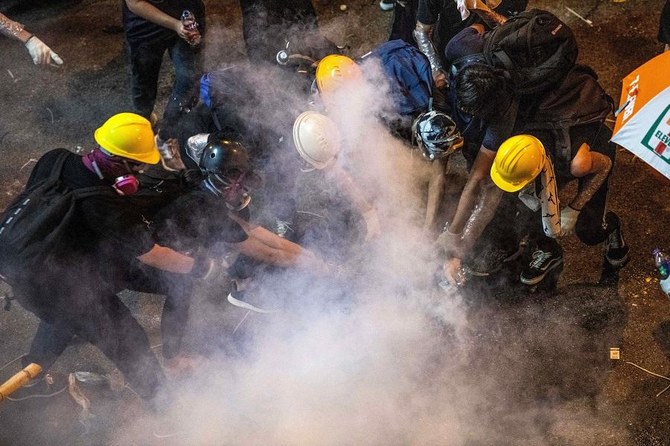
- Footage from the attack broadcast live on Facebook showed people screaming as the men beat multiple protesters and journalists in Yuen Long station and inside subway trains
- The clashes have ratcheted up fears that the city’s feared triad gangs are wading into the political conflict
Trump signals interest in easing tensions, but Minneapolis sees little change on the streets
- Immigration enforcement operations and confrontations with activists continued Wednesday in Minneapolis and St. Paul
MINNEAPOLIS: President Donald Trump seemed to signal a willingness to ease tensions in Minneapolis after a second deadly shooting by federal immigration agents, but there was little evidence Wednesday of any significant changes following weeks of harsh rhetoric and clashes with protesters.
The strain was evident when Trump made a leadership change by sending his top border adviser to Minnesota to take charge of the immigration crackdown. That was followed by seemingly conciliatory remarks about the Democratic governor and mayor.
Trump said he and Gov. Tim Walz, whom he criticized for weeks, were on “a similar wavelength” following a phone call. After a conversation with Mayor Jacob Frey, the president praised the discussion and declared that “lots of progress is being made.”
But on city streets, there were few signs of a shift. Immigration enforcement operations and confrontations with activists continued Wednesday in Minneapolis and St. Paul.
A group of protesters blew whistles and pointed out federal officers in a vehicle on a north Minneapolis street. When the officers’ vehicle moved, a small convoy of activists followed in their cars for a few blocks until the officers stopped again.
When Associated Press journalists got out of their car to document the encounter, officers with the federal Bureau of Prisons pushed one of them, threatened them with arrest and told them to get back in their car despite the reporters’ identifying themselves as journalists. Officers from multiple federal agencies have been involved in the enforcement operations.
From their car, the AP journalists saw at least one person being pepper sprayed and one detained, though it was unclear if that person was the target of the operation or a protester. Agents also broke car windows.
Attorney General Pam Bondi, who is visiting Minnesota, said 16 people were arrested Wednesday on charges of assaulting, resisting or impeding law enforcement in the state. She said more arrests were expected.
“NOTHING will stop President Trump and this Department of Justice from enforcing the law,” Bondi said in a social media post.
Messages seeking comment were left with Immigration and Customs Enforcement and the Border Patrol.
Woman tells agents: ‘They’re good neighbors’
On Wednesday afternoon in the Minneapolis suburb of Brooklyn Center, half a dozen agents went to a house in a small residential neighborhood.
One agent knocked on the door of the home repeatedly. Another told the AP they were seeking a man who had been twice deported and was convicted of domestic abuse. The agent said the man had run into the home and the agents lacked a judicial warrant to get inside.
Some federal immigration officers have asserted sweeping power to arrest someone considered illegally present or otherwise deportable using an administrative warrant but without a judge’s warrant. The key difference in the two warrants is whether agents can forcibly enter a private property to make an arrest, as they were captured on video doing in Minneapolis earlier this month.
A handful of activists blew whistles at the agents in Brooklyn Center. One agent said: “They’d rather call the police on us than to help us. Go figure.”
As the agents were preparing to leave, a woman called out to them saying, “You need to know they’re good neighbors.”
Kari Rod told the AP that she didn’t know these neighbors well, but they had come to her garage sale, kept their yard clean and waved hello when she drove by. She didn’t believe enforcement agents to be speaking the truth about whom they arrest, including another neighbor whom she said was deported to Laos last summer.
“I don’t trust a single thing they said about who they are,” Rod said. “From my interactions, I know them way better than anyone else does, any one of those federal agents.”
Immigrants are ‘still very worried’
Many immigrant families are still fearful of leaving their homes, and Latino businesses are still closed, said Daniel Hernandez, who owns the Minneapolis grocery store Colonial Market. He also runs a popular Facebook page geared toward informing the Hispanic community in the Twin Cities.
While Colonial Market is open, all but one of the dozen immigrant-run businesses that rented space inside have closed since late December, and none has plans to reopen, Hernandez said.
“The reality is the community is still very worried and afraid,” Hernandez said.
Hernandez referenced Border Patrol commander Gregory Bovino, who helped lead the administration’s crackdown in the Twin Cities and who has reportedly been assigned elsewhere.
Bovino “was removed, but the tactics so far are still the same,” Hernandez said. “Nobody now is trusting the government with those changes.”
The federal enforcement extended to the city’s Ecuadorian consulate, where a federal law enforcement officer tried to enter before being blocked by employees.
Judge warns ICE about not complying with federal orders
In Minnesota federal court, the issue of ICE not complying with court orders came to the fore as Chief Judge Patrick Schiltz said the agency had violated 96 court orders in 74 cases since Jan. 1.
“This list should give pause to anyone — no matter his or her political beliefs — who cares about the rule of law,” he wrote. “ICE has likely violated more court orders in January 2026 than some federal agencies have violated in their entire existence.”
Schiltz earlier this week ordered ICE’s acting director to personally appear in his courtroom Friday after the agency failed to obey an order to release an Ecuadorian man from detention in Texas. The judge canceled the order after the agency freed the man.
The judge, who was appointed by President George W. Bush, warned ICE that future noncompliance may result in future orders requiring the personal appearances of Acting Director Todd Lyons or other government officials.
ICE didn’t immediately respond to an email seeking comment.
Veteran visits sidewalk memorial
Elsewhere on Wednesday, Donnie McMillan placed a cardboard sign reading “In remembrance of my angel” at the makeshift memorial where Alex Pretti was shot.
The Vietnam veteran knelt to pay his respects and saluted to honor the nurse whom he said he remembered seeing during his frequent visits to the Veterans Affairs hospital where Pretti worked.
“I feel like I’ve lost an angel right here,” McMillan, 71, said, pointing to the growing sidewalk memorial covered in flowers, candles and signs. “This is not the way we should operate.”
Also Wednesday, the Department of Homeland Security said two federal agents involved in Pretti’s death have been on leave since Saturday, when the shooting happened.
US Rep. Ilhan Omar, a Democrat, spoke to journalists one day after a man attacked her during a town hall meeting by squirting a strong-smelling substance on her as she denounced the Trump administration.
“What is unfolding in our state is not accidental. It is part of a coordinated effort to target Black and brown, immigrant and Muslim communities through fear, racial profiling and intimidation,” Omar said. “This administration’s immigration agenda is not about law enforcement — it is about making people feel they do not belong.”


