

Saudi scholarships: An investment in the nation’s future

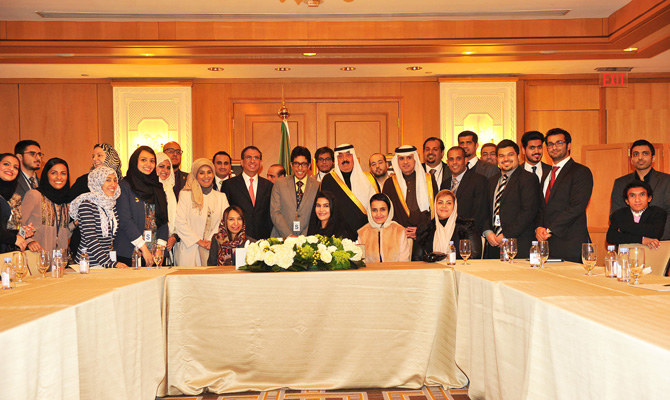
Saudi Scholarship students with Saudi officials during an event at the Saudi Embassy in Washington D.C. (SPA file photo)
Updated 22 July 2019
Follow

Saudi scholarships: An investment in the nation’s future

  • Kingdom provides financial assistance and fully paid tuition to all who qualify for scholarship
  • Many of the current recipients of scholarships are third-generation beneficiaries of the policy

JEDDAH: In an age when it is regarded as both essential and expensive, Saudi Arabia’s scholarship program provides a world-class education, ensuring financial assistance and paid tuition to all those who qualify. 

Beneficiaries of the program study abroad, returning with degrees and skills needed for the Kingdom’s development into a modern society.

In 1928, King Abdul Aziz Al-Saud ordered the first batch of students to be sent on scholarships to Egypt. A total of 14 went to complete their education in medicine, agriculture, engineering and law.

It was a crucial time for the young Kingdom, and the students contributed towards building the formative nation. Many became ministers, councillors, ambassadors and engineers in top positions, helping establish ministries and forming Saudi government entities.

The early Kingdom understood the importance of education as a vehicle for national development. Today, Saudi Arabia is among the leading countries measured by annual expenditure on education, with an impressive SR193 billion ($51.4 billion) allocated for Vision 2030 initiatives, as well as projects across the Kingdom, in 2019.

Success stories abound: Abdullah Tariki, the first Saudi oil minister appointed by King Saud and a co-founder of OPEC, graduated from Cairo University and later obtained his master’s degree in petroleum engineering from the University of Texas.

The first Saudi woman to obtain a government scholarship was Dr. Thoraya Obaid in 1963, who served as executive director of the United Nations Population Fund and undersecretary-general of the UN from 2000-2010. Success stories like these paved the way for other Saudi women to pursue higher education in the US, UK, Egypt and Lebanon and become prominent names in their fields, both within the Kingdom and abroad.

Many of the latest recipients of Saudi scholarships are third-generation beneficiaries, following in the footsteps of their parents and grandparents.

With the launch of the King Abdullah Scholarship Program in 2005, droves of Saudi students began to explore new avenues of education beyond just the West and Middle East. As of 2018, more than 90,000 Saudi students study abroad. Of these, 850 are at the world’s top 10 universities, and 1,600 are medical residents and fellows.


ALSO READ: Saudi students in US fear atmosphere of bullying and intimidation


Experimental farm in Al-Lith looks into future of Saudi Arabian agriculture

Updated 02 February 2026
Follow

Experimental farm in Al-Lith looks into future of Saudi Arabian agriculture

  • Research initiative reflects strategic transformation

JEDDAH: An experimental farm in Saudi Arabia’s Al-Lith Governorate is one of the research initiatives reflecting the strategic transformation taking place in the Kingdom’s agricultural sector.

The farm uses highly efficient, sustainable production models that combine scientific research with commercial application, contributing to strengthening the country’s food security system and the sustainability of water resources.

Located in the Ghumaiqa Center on an area of about 10 hectares, the cutting-edge farm is a testing platform for modern agricultural technologies that tackle the challenge of water scarcity.

The farm includes developed open fields and modern greenhouses, supported by smart irrigation encompassing drip and sprinkler irrigation alongside surface and subsurface technologies.

All the systems operate via smart controls that enable the monitoring of water consumption and ensure improved efficiency, thereby achieving a balance between agricultural production and water conservation.

The farm also uses treated and diluted low-salinity seawater.

It aims to diversify agricultural water sources, reduce reliance on freshwater, and open new horizons for agriculture in coastal and semi-arid environments.

A view of the experimental farm in Al-Lith. (SPA)

The project represents a promising investment opportunity in the field of smart agriculture, enabling the development of commercially scalable production models, particularly for high-value vegetables and fruits, while reducing operational costs associated with water and energy, enhancing the economic feasibility of future agricultural projects.

In addition, the project contributes to transferring and localizing agricultural expertise, supporting local food supply chains, and creating an attractive environment for agricultural investment.

This aligns with Sustainable Development Goals and enhances the efficiency of the private sector in adopting innovative agricultural solutions.

Yahya bin Abdulrahman Al-Mahabi, the director of the Ministry of Environment, Water and Agriculture office in Al-Lith Governorate, told the Saudi Press Agency that the project represented the future of agriculture in the Kingdom.

He explained that the vision was based on investing in technology, enhancing the return on water per unit, and integrating scientific research with investment opportunities.

Al-Mahabi spoke of the experimental farm as a modern, scalable and replicable model applicable in several regions of the Kingdom, particularly in coastal environments.

Al-Mahabi highlighted the Ministry of Environment, Water and Agriculture’s commitment to supporting distinctive projects that contributed to achieving food security while developing rural areas and enhancing agricultural production efficiency, in line with the objectives of the Kingdom’s Vision 2030.