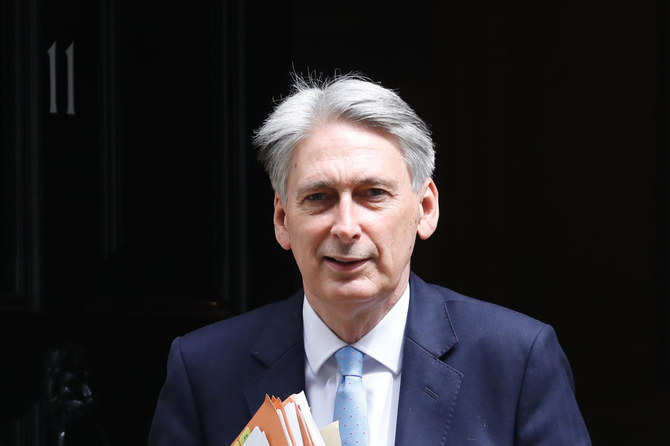
LONDON: British finance minister Philip Hammond said on Sunday he would resign if Boris Johnson became prime minister because he felt unable to support a leader happy to take the country out of the European Union without a deal.
Hammond’s decision underlines the strength of feeling in parliament against a no-deal Brexit, which some lawmakers and many businesses say would be catastrophic for the economy.
A loyal Conservative who has served in a number of ministerial roles, Hammond is an unlikely rebel. He said his fears over a no deal forced him to vote against the government for the first time in his 22-year political career last week.
Britain’s new prime minister is tipped to be former London mayor Johnson, who has promised to leave the EU “do or die” by an Oct. 31 deadline. That leaves him facing a tricky Brexit challenge from the moment he would take office on Wednesday.
Johnson has said he would ramp up preparations for a no deal to try to force the EU’s negotiators to make changes to the agreement that Prime Minister Theresa May sealed with Brussels and UK lawmakers voted down three times.
But parliamentary opposition to a no deal is growing and the EU is refusing to budge over that withdrawal agreement.
“I am sure I am not going to be sacked because I am going to resign before we get to that point,” Hammond told the BBC’s Andrew Marr Show, adding he would resign to May before she tendered her own resignation to the Queen on Wednesday.
“Assuming that Boris Johnson becomes prime minister, I understand that his conditions for serving in his government would include accepting a no-deal (EU) exit on the 31st of October. That is not something I could ever sign up to.”
ONE OF MANY?
Johnson has said his most senior ministers “would have to be reconciled” with the possibility of a no-deal Brexit on Oct. 31, a departure he does not want to see happen, but one he says must be planned for to try to increase pressure on the EU.
That stance means several more ministers who want to leave with a deal may seek to quit before facing the prospect of being sacked by Johnson.
Justice minister David Gauke has indicated he will also step down on Wednesday, and some lawmakers say they expect more pro-EU Conservatives to leave their positions to hold talks in parliament to find a way to prevent a no deal.
Keir Starmer, Brexit policy chief in the main opposition Labour Party, said on Twitter he respected Hammond’s decision.
“I want to work with all those MPs (members of parliament) who, like me, want to ensure parliament can stop a disastrous no-deal exit,” Starmer said.
Hammond, who according to sources close to Johnson often infuriated the former mayor who felt the finance minister was “talking Britain down,” said he did not believe his former colleague could win a deal with the EU by the deadline.
He instead advised the new prime minister to ask the EU for a little longer if there were signs that the two sides could agree on a compromise position — something Johnson’s rival for the premiership, Jeremy Hunt, has said he is open to.
But the EU has so far been steadfast in its view that it cannot open the withdrawal agreement, and Irish Foreign Minister Simon Coveney said both sides would be “in trouble” if the new prime minister was intent on tearing up the deal.
He suggested the new leader could secure changes to the political declaration on future ties to get rid of the Northern Irish backstop — an insurance policy to avoid the return of a hard border between the British province and Ireland.
“We hope that the backstop that many in the UK don’t seem to like can be avoided,” Coveney told the BBC. “(But) we are simply not going to move away from that withdrawal agreement.”
Johnson and his supporters say the hard-line stance is little more than a negotiating ploy. But if the standoff failed to be broken and a no deal Brexit was in the offing, Hammond would become a high-profile backer of attempts in parliament to stop a no deal.
“Yes, (I will campaign) to stop no deal happening on Oct. 31 without the consent of parliament,” Hammond said.
“I want to be a loyal supporter of the next Conservative government and if (it).. can deliver a negotiated Brexit deal that protects our economy then I will strongly support that government. And I hope I will be able to.”


![]()

UK finance minister to quit over no-deal Brexit if Johnson become PM
UK finance minister to quit over no-deal Brexit if Johnson become PM
- Hammond is the third minister within a week to quit or say they will resign in order to try to block a no-deal Brexit
- Johnson is the strong favorite to win a two-person runoff to lead the Conservative Party and the country


Latest updates



© 2026 SAUDI RESEARCH & PUBLISHING COMPANY, All Rights Reserved And subject to Terms of Use Agreement.