

In sluggish Russian economy, halal sees growth

The halal economy, worth more than $2.1 trillion globally, is far from limited to meat, and in Russia it’s developing fast. (File/AP)
Updated 22 July 2019
Follow

In sluggish Russian economy, halal sees growth

  • Ever more producers are catering for the domestic Muslim community, which accounts for around 15 percent of Russia’s population
  • The halal economy, worth more than $2.1 trillion globally, is far from limited to meat

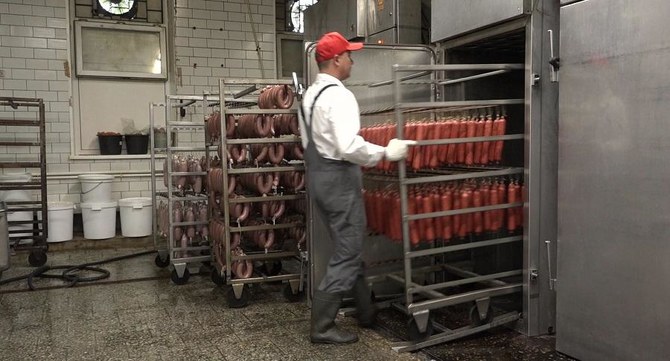
SHCHYOLKOVO, Russia: The manager of a sausage factory near Moscow, Arslan Gizatullin says his halal business has been feeling the pinch — not so much from Russia’s sluggish economy but competitors vying for a piece of a growing Islamic market.

Ever more producers are catering to the domestic Muslim community, which accounts for around 15 percent of Russia’s population and is set to expand, and in some cases are also setting their sights on export.
“In the last few years in general, halal’s become something of a trend in Russia,” said Gizatullin, who has been at the Halal-Ash plant in the city of Shchyolkovo for seven years.
The factory was among the first of its kind when it opened two decades ago, recreating sausages in accordance with Islamic law, among other products.
“Now I go to shop displays and I see sausage from one, two, three producers ... I see that competition is growing,” he adds from the factory, which employs 35 people and puts out up to 1.5 tons of products a day.
The halal economy, worth more than $2.1 trillion globally, is far from limited to meat.
Cosmetics firms and services such as halal hotels have received licenses from the body that oversees Islamic production in Russia, while state-owned Sberbank is looking into creating an Islamic finance entity.
The Center for Halal Standardization and Certification, under the authority of the Russian Council of Muftis, has approved more than 200 companies since it opened in 2007.
The center says that number is growing by five to seven companies a year — from a standing start at the collapse of the Soviet Union.
Rushan Abbyasov, the deputy head of the Council of Muftis, told AFP the Russian Agriculture Ministry was supporting the center in its efforts to increase exports to the Arab world and Muslim-majority ex-Soviet republics.

HIGHLIGHTS

• The Muslim community in Russia accounts for around 15 percent of the country’s population and is set to expand.

• Cosmetics firms and services such as halal hotels have received licenses from the body that oversees Islamic production in Russia.

• The halal food market accounted for around 7 billion rubles a year ($110 million) — or just over three percent of the region’s gross agricultural output.

“We’ve looked at international experience in the Arab world, in Malaysia, and we’ve developed our Russian (halal certification) standard following that model,” Abbyasov said in an interview at Moscow’s central mosque.
“We’re doing it in a way that matches international halal standards as well as the laws of the Russian Federation.”
The mufti pointed to an annual exhibition of halal goods and producers in the Muslim-majority Russian republic of Tatarstan, which this year saw its biggest ever turnout, as an example of the sector’s growth.
Tatar officials told Russian media the halal food market accounted for around 7 billion rubles a year ($110 million) — or just over 3 percent of the region’s gross agricultural output.
But they said the sector was growing at a rate of between 10 and 15 percent a year.
The certification center said Russia’s overall halal economy was also growing at a rate of 15 percent every year, but declined to give a breakdown of its figures.
Russia’s overall economy is stagnant, with the government predicting growth of only 1.3 percent this year, after 2.3 percent growth in 2018.
Alif, a Moscow-based cosmetics firm, is a new company at the forefront of the move toward exporting halal goods from Russia.
Manager Halima Hosman told AFP that, a year after launching, Alif’s products were being sold in the Muslim-majority Russian republics of Dagestan and Chechnya, as well as ex-Soviet Uzbekistan and Kazakhstan.
“Our priority targets for export now are France, Turkey, Iran, Saudi Arabia,” she said, adding that the company had nonfinancial support from the halal certification center.


PIF-backed AviLease achieves revenue of $664m and 19% growth in 2025

Updated 27 February 2026
Follow

PIF-backed AviLease achieves revenue of $664m and 19% growth in 2025

RIYADH: Saudi Arabia’s Public Investment Fund-backed AviLease achieved exceptional performance and sustainable business growth during 2025, supported by the strategic expansion of its global platform.

According to its financial results for 2025, AviLease recorded total revenues of $664 million, an annual increase of 19 percent, driven by disciplined growth in its asset portfolio and strong performance in aircraft remarketing amid sustained global demand for modern, fuel-efficient aircraft, the Saudi Press Agency reported.

Profit before tax doubled compared to the previous year, reaching $122 million. The year witnessed an expansion in AviLease’s portfolio, reaching 202 owned and managed aircraft, leased to over 50 airline companies in more than 30 countries. 

The total value of the company’s assets stabilized at $9.3 billion. AviLease maintained a 100 percent fleet utilization rate, reflecting the resilience of its business model, the efficiency of its asset management, and the strength of its strategic relationships with airlines around the world.

AviLease concluded purchase agreements for aircraft from Airbus, including the A320neo family and A350F, and Boeing 737 aircraft, aiming to enhance its future asset portfolio with modern, fuel-efficient aircraft. This step will contribute to supporting future growth and meeting increasing customer demand for the latest aircraft, aligning with the Kingdom’s ambitions to become a leading global aviation hub.

AviLease strengthened its prestigious credit standing by obtaining a strong Baa2 credit ratings from Moody’s and BBB from Fitch, reflecting its financial solidity, managerial discipline, and efficiency in managing leverage. The company also successfully issued senior unsecured bonds worth $850 million last November under Regulation 144A/RegS. This issuance contributed to diversifying its funding sources and enhancing its financial flexibility.

Commenting on the results, AviLease CEO Edward O’Byrne said: “This exceptional performance reflects the quality of the company’s investment portfolio, the strength of its partnerships with airlines, and its strategic focus on responsibly deploying capital into highly sought-after, efficient, modern aircraft assets.”

He added: “As aviation markets continue to grow, AviLease is strategically positioned to continue its expansion plans and deliver sustainable long-term value for shareholders, contributing to the Kingdom’s ambitions.”

Throughout 2025, AviLease continued to play a pivotal role in the Kingdom’s growing aviation sector and contributed directly to the launch and scaling of the new national carrier, Riyadh Air, by completing a sale and leaseback transaction for a Boeing 787-9 aircraft, which thereby became the first aircraft to join the airline’s fleet.

AviLease also established a strategic partnership with Hassana Investment Co. This partnership aims to provide an opportunity for local and international investors to enter the aircraft financing asset class and benefit from AviLease’s technical expertise and operational capabilities to support partnership growth and enhance performance. 

Hassana Investment Co. has agreed to acquire an initial portfolio of 10 modern aircraft from AviLease.