


DUBAI: The causes and consequences of climate change are among the most controversial issues in the world today. But where some analysts see a threat to global stability, even a challenge to human well-being on the planet, some businessmen see an opportunity.
Last month in Saint Petersburg, Sultan Ahmed bin Sulayem, chairman and chief executive of the UAE ports and logistics company DP World, announced a partnership with three leading Russian companies that could resolve one of the biggest challenges facing global commerce: The establishment of a permanent maritime sea route from Europe to Asia in the Arctic.
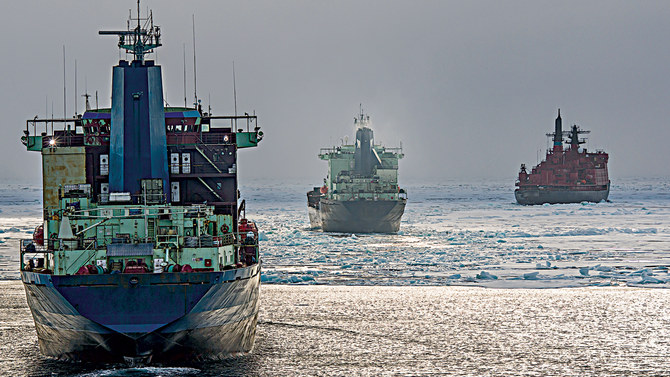
The Northern Sea Route (NSR), as the Russians call it, is the latest name for what western Europeans for centuries called the Northeast Passage. However, repeated attempts to open a viable maritime route were frustrated because of the ice and freezing temperatures that dominate that part of the world for much of the year.
With global warming, the Russians believe that the time has come to create a permanent route that will challenge the Suez Canal as the key gateway between East and West — and they have called in Arab maritime skills to help.
Bin Sulayem told Arab News: “Time is money in business and the route could cut travel time substantially more than traditional trade arteries for cargo owners in the Far East wanting to connect with Europe, coupled with benefits to the Russian economy. We need to explore the opportunities that the route would bring with our partners, and that was the purpose of the announcement.”
The Russians are represented by the country’s Direct Investment Fund (RDIF), which has done a number of deals with partners in Saudi Arabia and the UAE. The other Russian participants are Rosatom, the country’s atomic energy agency, which operates the nuclear-powered ships that will ply the route, and Norilsk Nickel, the mining and commodities company that is already in business in Russia’s far north and which hopes to exploit the region’s resources further once the NSR is fully functioning.
As the only non-Russian member of the consortium that is examining the feasibility of the route, DP World was something of a surprise ingredient. It is one of the leading ports operators in the world, operating from its base at Jebel Ali in the Arabian Gulf — the biggest port between Singapore and Rotterdam. But virtually all its rapid expansion over the past 15 years has taken place in warm and temperate waters.
Bin Sulayem seems to be relishing the challenge of working in the Arctic. “Our expertise is global and our footprint in over 45 countries means we have experience of all types of climates from Europe to Canada, from South America to Asia.
“I am a firm believer in opportunities that arise from any project and focus on solutions to challenges — extreme temperatures and ice flows have to be factored in and we will see what answers there are when our teams get together in the working group,” he said.
DP World, which has long experience in setting up and operating port facilities, would be a natural choice to develop the string of maritime hubs along Russia’s Arctic coast that is needed to service the route.
FASTFACT
11 days - Maritime experts estimate that the journey from South Korea to Europe, currently around 34 days via Suez, would be cut by 11 days to 23 days on the Northern Sea Route.
The potential prize if DP World and its Russian partners overcome the challenge is big. Maritime experts estimate that the journey from South Korea to Europe, currently around 34 days via Suez, would be cut to 23 days on the NSR, and that the route would be specially suited for transportation of commodities and energy products.
The development of the NSR does pose a danger to the delicate eco-system of the Arctic region, already under threat from global warning that has seen the ice sheet shrink dramatically in the past two decades.
Bin Sulayem says that understanding the effects on the Arctic environment is very important and will be a central part of the feasibility study currently under way.
“Environmental impact will be a key feature of any due diligence. The actual routes in question will be more adjacent to the Russian coastline at this stage,” he said.
But the Russians believe the strategic commercial logic of the Arctic route are worth the risk. Kirill Dmitriev, the chief executive of the RDIF, told Arab News when the deal was first unveiled: “Because of global warming, there are some things happening that open some opportunities. Russia has this frozen coast all of the seasons. Now it’s opening up and it’s possible to navigate for nine months. When you have special ships you can actually have 12 months navigation. That could cut the length of travel for many ships by half. So that’s a huge opportunity to reduce time of delivery, reduce costs of delivery.”
There are geopolitical factors at play, too, with many countries claiming sovereignty in the Arctic region. China — which would be a major beneficiary of the route — has already invested heavily in facilities in the region.
“This is a matter for governments. We are working with our Russian partners to examine the trade and business opportunities,” bin Sulayem said. The partners agreed to set up a working group to conduct an analysis of the project and report back in six months, when delicate financial calculations will have to be made about the extent of cash commitment to the new route.
“Each of the partners has expertise in their own sector. As a global trade enabler our experience of operating ports and other logistics assets around the world will play a major role in the exploration of the commercial options as part of the study,” bin Sulayem said.
The NSR agreement is another sign of increasing commercial ties between Russia and the Middle East. DP World is already committed to investment in Russian logistics infrastructure with the RDIF. Saudi Arabia, mainly via the Public Investment Fund, has also invested in Russian infrastructure and energy-related projects.


