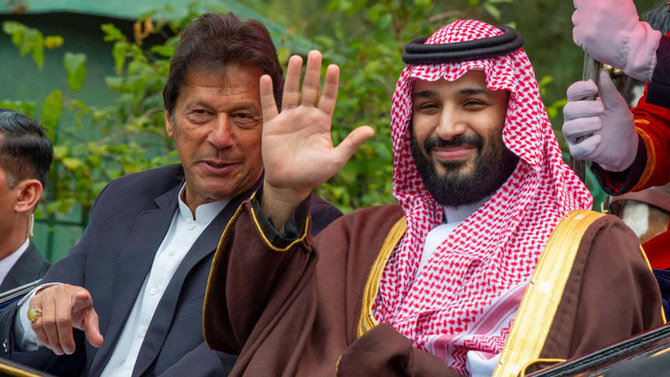
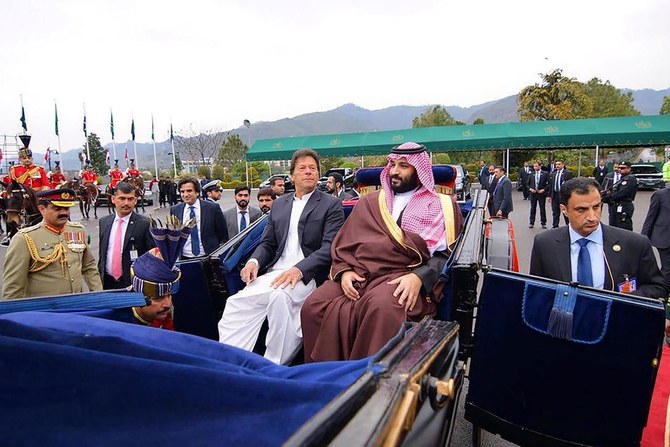
DUBAI: Pakistani Prime Minister’s invitation to visit the United States and meet President Donald Trump was arranged through direct assistance from Saudi Crown Prince Mohammed bin Salman, two senior officials said on Saturday.
Khan will arrive in Washington today, Saturday, ahead of a meeting with Trump that Pakistan hopes will help restore trust and attract much-needed foreign investment.
When asked if Prince Salman had played an “instrumental role” in paving the way for the Khan-Trump meeting, a senior Pakistani foreign office official said “absolutely.” He declined to give further details and requested anonymity as he is not the official spokesman of the foreign ministry.
A senior member of Khan’s cabinet also confirmed the role of the crown prince in setting up the meeting, saying he had used his personal friendship with Jared Kushner, Trump’s son-in-law, to help arrange the meeting.
Kushner’s friendship and support for Prince Salman has been one of the most important bonds that has helped draw Trump into an embrace of Saudi Arabia as one of his most important international allies. Now the friendship seems to have come in handy for Pakistan, a longtime Saudi ally itself.
The now jailed former Prime Minister Nawaz Sharif was the last Pakistani head of state to visit the US in October 2015. Since then, relations have soured and last year, Trump cut off hundreds of millions of dollars in security aid to Pakistan, accusing Islamabad of offering “nothing but lies and deceit” while giving safe haven to terrorists, a charge Pakistan vehemently rejected.
In February this year, however, Trump said the US had developed a “much better” relationship with Pakistan. Recently, attempts to placate the other have been made on both sides, with Pakistan arresting the alleged mastermind of the 2008 Mumbai attacks, Hafiz Saeed, who has for years had a $10 million US bounty on his head. The US also recently added the separatist Balochistan Liberation Army to its list of terror groups, honoring a long-time request by Islamabad which has been fighting the group in the southwestern Balochistan province for decades.
On Saturday, Khan will lead a high-level delegation to Washington, which includes ministers of his cabinet, commerce adviser, financial advisers, the foreign minister and in a first, the country’s powerful army chief, head of intelligence, and military spokesperson.
“The purpose of Khan’s visit is to take Pak-America relations out of the cold storage (they) have been in and request the US to reimburse the owed $800 million Coalition Support Fund to Pakistan,” defense analyst retired Air Marshall Abid Rao told Arab News.
He said Khan would emphasize that Pakistan was not interested in aid but would rather like to “develop trade with the US which mutually benefits and serves each other’s interests, an economic partnership.”
“This meeting and its conclusion is very important for Pakistan’s image internationally and for the US,” Rao said. “Today, Iran is a threat, the Gulf oil flow is under threat... and the US is trying to pullout from Afghanistan...Pakistan has solutions and suggestions.”
Defense expert Group Captain Sultan Hali, said that Khan would set the record straight during his meeting with Trump, especially on the core issue of Afghanistan. With a powerful delegation accompanying Khan, decisions, suggestions, and agreements would be made “right then and there without seeking approvals from back home.”
“He should be able to look Trump in the eye and speak without worrying,” Hali said, stressing that Khan must build his “personal reputation with Trump.”
The Prime Minister will also meet prominent members of the US Congress, corporate leaders and opinion-makers as well as members of the Pakistani diaspora in Washington. He is also scheduled to address over 19,000 overseas Pakistanis at the Capital One Arena in Washington DC on Sunday.


![]()
![]()

Khan-Trump meeting arranged through Saudi crown prince: Pakistani officials
Khan-Trump meeting arranged through Saudi crown prince: Pakistani officials
- Crown Prince used his personal friendship with Trump son-in-law Jared Kushner to line up Khan’s visit
- In a first, the PM’s high-level delegation includes the country’s army and spy chiefs and military spokesman
Latest updates


© 2026 SAUDI RESEARCH & PUBLISHING COMPANY, All Rights Reserved And subject to Terms of Use Agreement.