YANGON: Hundreds of people demonstrated in Myanmar’s largest city, Yangon, on Wednesday in support of proposed constitutional amendments that would reduce the power of the military.
A separate protest against the reforms was planned for later in the day.
Aung San Suu Kyi’s ruling National League for Democracy (NLD) party is pushing for change despite objections from military lawmakers, who hold a veto over amendments.
The demonstrators, led by activists not aligned to the party, wore red headbands printed with the words “Amend the 2008 Constitution.”
“The current government is trying to move forward, but they can’t because of the 2008 constitution,” said protest organizer Pyae Phyo Zaw, who also called for elected leaders to be given oversight of the security forces.
After decades of military rule, Nobel laureate Suu Kyi took the reins in 2016 after an electoral landslide, but is forced to share power with the generals.
Under the constitution drafted by the former junta, the military chief nominates a quarter of lawmakers and the ministers of defense, home affairs and border affairs.
It also blocks Suu Kyi from becoming president, with a prohibition on presidential candidates with foreign spouses or children. Suu Kyi had two sons with her late husband, Michael Aris, a British academic.
A flyer for Wednesday’s separate counter protest called on “those who love their race and religion” to turn out to help preserve that clause.
A nationalist movement led by Buddhist monks is critical of Suu Kyi and casts the military as protector of the Buddhist-majority nation.
A report containing thousands of amendments proposed by various political parties was submitted on Monday for debate at the parliament in the capital, Naypyitaw, but has not been made public.
Nay Phone Latt, an NLD lawmaker in Yangon’s regional parliament, told Reuters one of the party’s key proposals was to set a timeline for the gradual reduction of military seats in parliament, beginning with a move from 25 percent to 15 percent in 2021.
The NLD holds most seats in parliament, but the military lawmakers mean it lacks the 75 percent majority needed to amend the constitution.
“We need military men’s support, so it depends on the stance of the military,” Nay Phone Latt said. “But we hope that it can be accepted by the military as it would reduce bit by bit over time.”
Kyaw Khine Win, another demonstrator, said he rallied in favor of amending the charter because it was written to bar Suu Kyi from leading the country and imposed “forcefully.”
“We want a country which is commanded by the people,” he said.

Aung San Suu Kyi’s bid to reform charter sparks rival protests in Myanmar
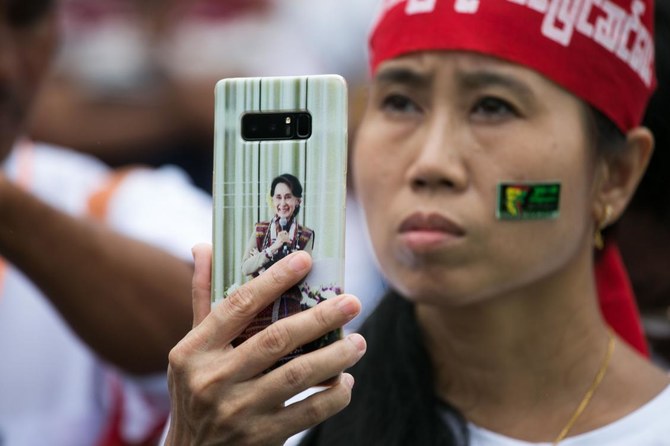
- Aung San Suu Kyi’s ruling National League for Democracy party is pushing for change despite objections from military lawmakers
- Military lawmakers hold a veto over amendments
EU, India successfully conclude major trade deal: New Delhi
- Indian government officials say the pact, which was two decades in the making, will be unveiled Tuesday
- European Commission President Ursula von der Leyen and European Council president Antonio Costa appear as guests of honor at India’s Republic Day parade
NEW DELHI: India and the European Union have finalized a massive free trade deal, Indian government officials said on Monday, about two decades after negotiations were first launched.
Facing challenges from China and the United States, Brussels and New Delhi have sought closer ties, producing a pact that is to be unveiled in the Indian capital on Tuesday.
Feted Monday as guests of honor at India’s Republic Day parade, European Commission President Ursula von der Leyen and European Council president Antonio Costa are to meet Indian Prime Minister Narendra Modi for a summit.
“Official level negotiations are being concluded and both sides are all set to announce the successful conclusion” of talks at the Tuesday summit, Indian commerce secretary Rajesh Agrawal told AFP.
The EU has eyed India — the world’s most populous nation — as an important market for the future, while New Delhi sees the European bloc as an important source of much-needed technology and investment to rapidly upscale its infrastructure and create millions of new jobs.
’Mother of all deals’
Bilateral trade in goods reached 120 billion euros ($139 billion) in 2024, an increase of nearly 90 percent over the past decade, according to EU figures, with a further 60 billion euros ($69 billion) in trade in services.
India’s Commerce Minister Piyush Goyal has described the new pact as “the mother of all deals.”
“Final negotiations have been focused and fruitful, and we are now very optimistic that we will land this historic trade deal,” an EU official said Monday speaking on condition of anonymity.
Under the agreement, India is expected to ease market access for key European products, including cars and wine, in return for easier exports of textiles and pharmaceuticals, among other things.
“The EU stands to gain the highest level of access ever granted to a trade partner in the traditionally protected Indian market,” von der Leyen said on Sunday, adding that she expected exports to India to double.
“We will gain a significant competitive advantage in key industrial and agri-good sectors.”
Talks went down to the wire on Monday, focusing on a few sticking points, including the impact of the EU’s carbon border tax on steel, according to sources familiar with the discussions.
The accord comes as both Brussels and New Delhi have sought to open up new markets in the face of US tariffs and Chinese export controls.
India and the EU were also expected to conclude an accord to facilitate movement for seasonal workers, students, researchers and highly skilled professionals, and a security and defense pact.
“India and Europe have made a clear choice. The choice of strategic partnership, dialogue and openness,” von der Leyen wrote on social media. “We are showing a fractured world that another way is possible.”
New Delhi, which has relied on Moscow for key military hardware for decades, has tried to cut its dependence on Russia in recent years by diversifying imports and pushing its own domestic manufacturing base.
Europe is doing the same with regard to the United States.
Facing challenges from China and the United States, Brussels and New Delhi have sought closer ties, producing a pact that is to be unveiled in the Indian capital on Tuesday.
Feted Monday as guests of honor at India’s Republic Day parade, European Commission President Ursula von der Leyen and European Council president Antonio Costa are to meet Indian Prime Minister Narendra Modi for a summit.
“Official level negotiations are being concluded and both sides are all set to announce the successful conclusion” of talks at the Tuesday summit, Indian commerce secretary Rajesh Agrawal told AFP.
The EU has eyed India — the world’s most populous nation — as an important market for the future, while New Delhi sees the European bloc as an important source of much-needed technology and investment to rapidly upscale its infrastructure and create millions of new jobs.
’Mother of all deals’
Bilateral trade in goods reached 120 billion euros ($139 billion) in 2024, an increase of nearly 90 percent over the past decade, according to EU figures, with a further 60 billion euros ($69 billion) in trade in services.
India’s Commerce Minister Piyush Goyal has described the new pact as “the mother of all deals.”
“Final negotiations have been focused and fruitful, and we are now very optimistic that we will land this historic trade deal,” an EU official said Monday speaking on condition of anonymity.
Under the agreement, India is expected to ease market access for key European products, including cars and wine, in return for easier exports of textiles and pharmaceuticals, among other things.
“The EU stands to gain the highest level of access ever granted to a trade partner in the traditionally protected Indian market,” von der Leyen said on Sunday, adding that she expected exports to India to double.
“We will gain a significant competitive advantage in key industrial and agri-good sectors.”
Talks went down to the wire on Monday, focusing on a few sticking points, including the impact of the EU’s carbon border tax on steel, according to sources familiar with the discussions.
The accord comes as both Brussels and New Delhi have sought to open up new markets in the face of US tariffs and Chinese export controls.
India and the EU were also expected to conclude an accord to facilitate movement for seasonal workers, students, researchers and highly skilled professionals, and a security and defense pact.
“India and Europe have made a clear choice. The choice of strategic partnership, dialogue and openness,” von der Leyen wrote on social media. “We are showing a fractured world that another way is possible.”
New Delhi, which has relied on Moscow for key military hardware for decades, has tried to cut its dependence on Russia in recent years by diversifying imports and pushing its own domestic manufacturing base.
Europe is doing the same with regard to the United States.
© 2026 SAUDI RESEARCH & PUBLISHING COMPANY, All Rights Reserved And subject to Terms of Use Agreement.


