

Pakistan cracks down on cattle smuggling to Afghanistan ahead of Eid

Heavy vehicles head toward Afghanistan via Ghulam Khan border in North Waziristan tribal district. Following a ban slashed by the Peshawar High Court on sacrificial animals’ export to Afghanistan, authorities in tribal areas intensified efforts to control illegal smuggling of cattle ahead of Eid-ul-Adha to avoid artificial inflation in local market (Jan 31, 2019). File photo AN
Updated 17 July 2019
Follow

Pakistan cracks down on cattle smuggling to Afghanistan ahead of Eid

  • Peshawar High Court orders federal and Khyber Pakhtunkhwa governments to check illegal trafficking of animals from tribal areas
  • Officials say more personnel deputed at border crossings, police patrols increased, all vehicles being searched

PESHAWAR: Pakistan is taking measures to check cattle trafficking to Afghanistan from its northwestern tribal areas ahead of Eid-al-Adha next month, officials said, following an order by the Peshawar High Court (PHC) to end the menace which has seen a sharp surge in the prices of animals in local markets in previous years. 
Eid Al-Adha, which will fall on August 12 in Pakistan this year, commemorates Prophet Ibrahim’s willingness to sacrifice his son as an act of obedience to Allah, before Allah replaced the son with a ram to be sacrificed instead. 
On Eid, thus, it is a tradition for those who can afford it to sacrifice domestic animals as a symbol of Ibrahim’s willingness to sacrifice his only son. The result is a booming pre-holiday trade in goats, cows and sheep. In Pakistan alone, more than 10 million animals, worth over $3 billion, are slaughtered during the two days of Eid Al-Adha, according to the Pakistan Tanners’ Association.
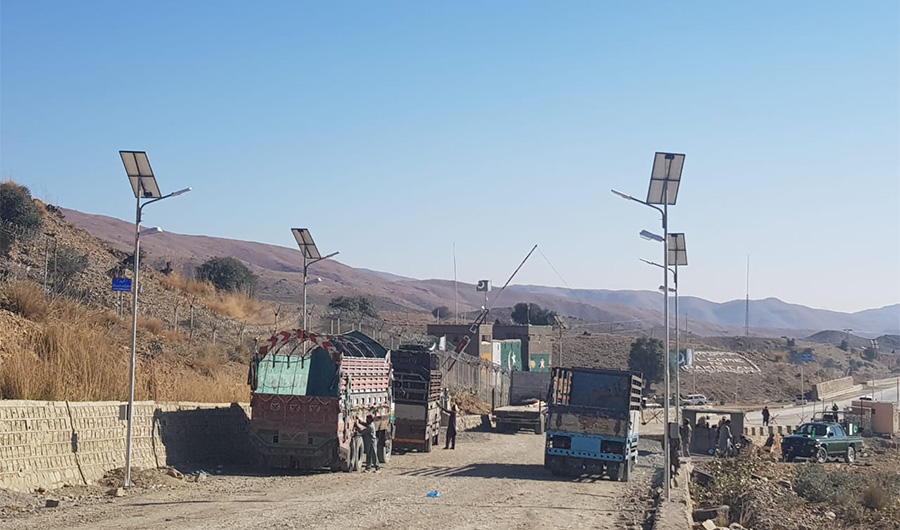


Heavy vehicles are being checked at Ghulam Khan border in North Waziristan tribal district. Following a ban slashed by the Peshawar High Court on sacrificial animals’ export to Afghanistan, authorities in tribal areas intensified efforts to control illegal smuggling of cattle ahead of Eid-ul-Adha to avoid artificial inflation in local market (Jan 31, 2019). File photo AN

“This year we have put certain measures in place to control the export of animals to Afghanistan ahead of Eid Al-Adha,” Muhammad Hussain, a senior police officer in Khyber district, told Arab News.
Hussain and other local administration officials said customs and the federal investigation agency officers were now stationed at main border crossings to check against smuggling. 
“We have circulated strict directives among the departments concerned and the police throughout the entire tribal areas to keep an eye on smuggling and illegal transportation of animals to Afghanistan,” Muhammad Imran, an assistant commissioner in Khyber district, said. “Smuggling activities have now been totally curtailed at main border points because we have put in place two or three layers of checking, and all vehicles are also being searched. In addition, police have increased patrolling on main routes, which has helped counter illegal activities and businesses in the known border areas.”
Last week, a two-member bench of the Peshawar High Court had ordered the government to crackdown on the illegal smuggling of animals to Afghanistan, ruling on a petition that said the trend was causing artificial inflation and a shortage of animals in the domestic market. The bench ordered both the federal and provincial governments to apprise the court of the measures it would take to limit the illegal export of animals.
Aftab Shinwari, a Pakistani businessman who frequents the Pakistan-Afghanistan Torkham border, said a month ago at least 10 to 15 trucks loaded with animals could be seen entering Afghanistan every week. 
“This [animals smuggling] cannot be seen now on the Torkham border, most likely because of the court verdict,” he said. 
Arafat Khan, a Pakistani custom clearance agent who works along the Torkham border, said though illegal trafficking through known points such as Torkham, Ghulam Khan in North Waziristan and Angoor Adda in South Waziristan tribal districts had reduced significantly, hundreds of buffaloes and cows were still being smuggled to the neighboring country through unknown routes.


Pakistan, UK sign £35 million Green Compact to strengthen climate resilience

Updated 4 sec ago
Follow

Pakistan, UK sign £35 million Green Compact to strengthen climate resilience

  • Pakistan ranks among nations most vulnerable to climate change and has seen erratic changes in its weather patterns
  • UK will help Pakistan mobilize climate finance, strengthen regulatory frameworks and develop bankable climate projects

ISLAMABAD: Pakistan and the United Kingdom (UK) have formalized a comprehensive climate partnership with the launch of a Green Compact that aims to enhance climate resilience, accelerate clean energy transition and scale up nature-based solutions, including mangrove conservation, Pakistani state media reported on Sunday.

The agreement, signed in Islamabad by Federal Minister for Climate Change and Environmental Coordination Dr. Musadik Malik and UK Minister for International Development Jennifer Chapman, unlocks £35 million in targeted support for green development and long-term climate action, according to Radio Pakistan broadcaster.

Pakistan ranks among nations most vulnerable to climate change and has seen erratic changes in its weather patterns that have led to frequent heatwaves, untimely rains, storms, cyclones, floods and droughts in recent years. In 2022, monsoon floods killed over 1,700 people, displaced another 33 million and caused over $30 billion losses, while another 1,037 people were killed in floods this year.

Mohammad Saleem Shaikh, a spokesperson for Pakistan’s Ministry of Climate Change, described the compact as a “decisive move toward action-oriented climate cooperation,” noting that its implementation over the next decade will be critical for Pakistan which regularly faces floods, heatwaves and water stress.

“The Compact is structured around five core pillars: climate finance and investment, clean energy transition, nature-based solutions, innovation and youth empowerment, and adaptation and resilience,” the report read.

“Under the agreement, the UK will work with Pakistan to mobilize public and private climate finance, strengthen regulatory frameworks for green investment, and develop bankable climate projects.”

Clean energy forms a central component of Pakistan’s transition, with Islamabad planning to expand solar and wind generation to reduce fossil fuel dependence, improve energy security and stabilize power costs, according to Shaikh.

“Renewable energy is now economically competitive, making the transition both environmentally and financially viable,” he was quoted as saying.

“Nature-based solutions, particularly large-scale mangrove restoration, will protect coastal communities from storm surges and erosion while enhancing biodiversity and carbon sequestration.”

Under the Compact, technical support, mentoring and access to investors will be provided to climate-smart startups and young innovators, reflecting Pakistan’s recognition of youth-led initiatives as central to future climate solutions.

On the occasion, Chapman, on her first official visit to Pakistan, underscored the urgency of climate action, highlighting the UK’s support for renewable energy, mangrove and ecosystem restoration, early-warning systems, climate budgeting and international investment flows into Pakistan.

Shaikh described the Green Compact as “a strategic turning point” in Pakistan–UK relations on climate change, saying its effective implementation is essential for Pakistan to meet its national climate targets.