



PESHAWAR: Pakistan is taking measures to check cattle trafficking to Afghanistan from its northwestern tribal areas ahead of Eid-al-Adha next month, officials said, following an order by the Peshawar High Court (PHC) to end the menace which has seen a sharp surge in the prices of animals in local markets in previous years.
Eid Al-Adha, which will fall on August 12 in Pakistan this year, commemorates Prophet Ibrahim’s willingness to sacrifice his son as an act of obedience to Allah, before Allah replaced the son with a ram to be sacrificed instead.
On Eid, thus, it is a tradition for those who can afford it to sacrifice domestic animals as a symbol of Ibrahim’s willingness to sacrifice his only son. The result is a booming pre-holiday trade in goats, cows and sheep. In Pakistan alone, more than 10 million animals, worth over $3 billion, are slaughtered during the two days of Eid Al-Adha, according to the Pakistan Tanners’ Association.
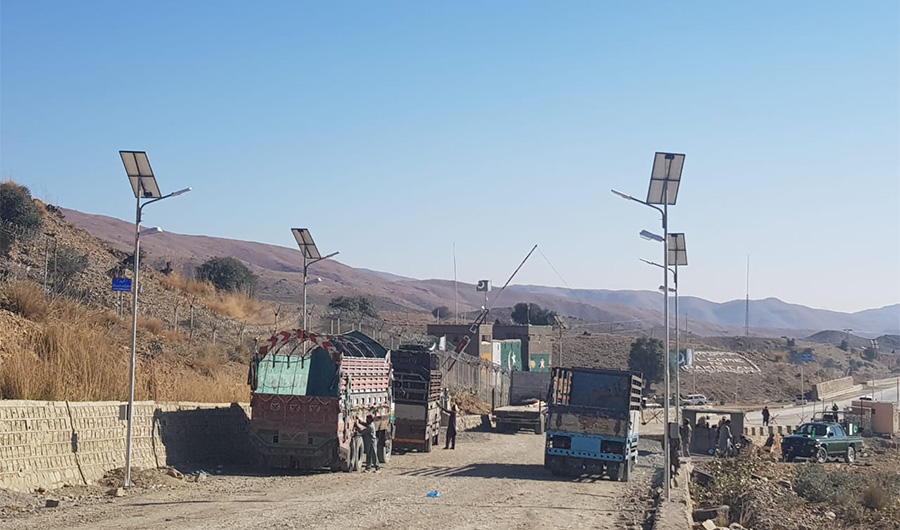
Heavy vehicles are being checked at Ghulam Khan border in North Waziristan tribal district. Following a ban slashed by the Peshawar High Court on sacrificial animals’ export to Afghanistan, authorities in tribal areas intensified efforts to control illegal smuggling of cattle ahead of Eid-ul-Adha to avoid artificial inflation in local market (Jan 31, 2019). File photo AN
“This year we have put certain measures in place to control the export of animals to Afghanistan ahead of Eid Al-Adha,” Muhammad Hussain, a senior police officer in Khyber district, told Arab News.
Hussain and other local administration officials said customs and the federal investigation agency officers were now stationed at main border crossings to check against smuggling.
“We have circulated strict directives among the departments concerned and the police throughout the entire tribal areas to keep an eye on smuggling and illegal transportation of animals to Afghanistan,” Muhammad Imran, an assistant commissioner in Khyber district, said. “Smuggling activities have now been totally curtailed at main border points because we have put in place two or three layers of checking, and all vehicles are also being searched. In addition, police have increased patrolling on main routes, which has helped counter illegal activities and businesses in the known border areas.”
Last week, a two-member bench of the Peshawar High Court had ordered the government to crackdown on the illegal smuggling of animals to Afghanistan, ruling on a petition that said the trend was causing artificial inflation and a shortage of animals in the domestic market. The bench ordered both the federal and provincial governments to apprise the court of the measures it would take to limit the illegal export of animals.
Aftab Shinwari, a Pakistani businessman who frequents the Pakistan-Afghanistan Torkham border, said a month ago at least 10 to 15 trucks loaded with animals could be seen entering Afghanistan every week.
“This [animals smuggling] cannot be seen now on the Torkham border, most likely because of the court verdict,” he said.
Arafat Khan, a Pakistani custom clearance agent who works along the Torkham border, said though illegal trafficking through known points such as Torkham, Ghulam Khan in North Waziristan and Angoor Adda in South Waziristan tribal districts had reduced significantly, hundreds of buffaloes and cows were still being smuggled to the neighboring country through unknown routes.


