

Internet a lifeline for Venezuela’s embattled independent media

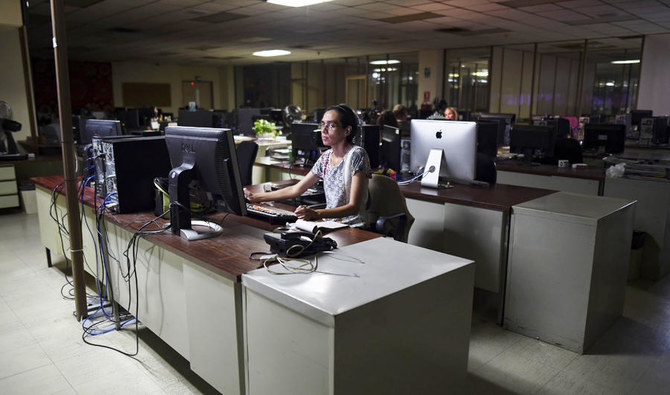
In this file photo taken on June 13, 2019 A journalist works in one of the newsrooms of the Panorama newspaper in Maracaibo, Venezuela. (AFP)
Updated 17 July 2019
Follow

Internet a lifeline for Venezuela’s embattled independent media

  • Regional newspaper Panorama, which served Venezuela’s second city Maracaibo, struggled on until May 14 when “a perfect storm” of massive power cuts finally sounded it’s physical death knell

CARACAS: Starved of advertising revenue and battling a stranglehold on the newspaper industry by the government, Venezuela’s independent media have been decimated by the country’s years-long crisis — with many migrating online to survive.
“It was a course we couldn’t get away from,” Jorge Makriniotis, manager at the 75-year-old El Nacional, told AFP.
The newspaper ran its last physical edition — which had already dropped from 72 to just 16 pages — on December 13 last year.
Like many other former print media, it is only available on the Internet now.
In 2013, Venezuela’s socialist government created a state-run company to control the import and distribution of paper.
Carlos Correa, director of the Espacio Publico non-governmental organization, said the move created “discriminatory dynamics” that saw pro-regime media favored — while others were starved of printing paper, and advertising revenue.
Since then, 58 daily newspapers have ceased circulation, Correa says.
“There’s never been an official response” to the claims from independent media, said Gisela Carmona, the director of El Impulso — one of the papers that has migrated online, requiring an investment of more than a million dollars.
After 100 years in print, the newspaper disappeared from the streets in February 2018, having received no paper for 12 months.

Beyond controlling paper supply, critics accuse the Venezuelan government of oppressing dissenting media voices across the board.
The national union of press workers has denounced a “systematic policy” of asphyxiation as dozens of independent radio and television stations also closed.
“Over the past years, the Government has attempted to impose a communicational hegemony by enforcing its own version of events and creating an environment that curtails independent media,” said UN High Commissioner for Human Rights Michelle Bachelet in a report on Venezuela earlier this month.
One example from 2018 saw El Nacional lose a case brought by Diosdado Cabello, widely regarded as the most powerful regime figure after President Nicolas Maduro, for having published drug-trafficking allegations made against him in the Spanish press.
The economic crisis had a major impact on the media too, as on all businesses.
Five years of recession and rampant hyperinflation — which the International Monetary Fund expects to reach a staggering 10 million percent this year — have decimated advertising revenues.
Carminda Marquez opened a kiosk in Caracas 18 years, selling dozens of newspapers and other publications.
“Now I sell three or four,” said the 80-year-old.
Regional newspaper Panorama, which served Venezuela’s second city Maracaibo, struggled on until May 14 when “a perfect storm” of massive power cuts finally sounded it’s physical death knell, its editorial director Maria Ines Delgado told AFP.
Panorama never had to lay off any journalists as one by one they resigned and left for foreign shores.
“Every time we replaced one, another left,” Delgado said from a near-empty editorial room.
Like El Impulso, Panorama is now fed by banner advertising.

The move online has not solved independent media’s myriad problems, though, least of all the ability to reach readers.
Between frequent power outages, patchy Internet and the second slowest connectivity in Latin America — after landlocked Paraguay — readers have trouble loading pages, especially on smartphones.
“We know nothing any more,” complained Belkis Nava, who used to read Panorama.
Despite the difficulties, some journalists have launched new media directly on the Internet, such as El Pitazo.
Specializing in investigative journalism — it won the prestigious Ortega y Gasset prize awarded by Spanish newspaper El Pais this year — El Pitazo supported itself through a 2017 crowdfunding campaign, director Cesar Batiz told AFP.
However, like other news websites, El Pitazo has come under cyberattack — four times over two years.
Before the first attack in 2017, El Pitazo had 110,000 visits a day. Traffic has since dropped by more than half, and 65 percent of that comes from abroad.
“People aren’t receiving information,” said Melanio Escobar, the director of the Redes Ayuda (Network Help) NGO.


UK, France mull social media bans for youth as debate rages

Updated 19 January 2026
Follow

UK, France mull social media bans for youth as debate rages

  • Countries including France and Britain are considering following Australia’s lead by banning children and some teenagers from using social media

PARIS: Countries including France and Britain are considering following Australia’s lead by banning children and some teenagers from using social media, but experts are still locked in a debate over the effectiveness of the move.
Supporters of a ban warn that action needs to be taken to tackle deteriorating mental health among young people, but others say the evidence is inconclusive and want a more nuanced approach.
Australia last month became the first nation to prohibit people under-16s from using immensely popular and profitable social media platforms such as Instagram, Facebook, Tiktok and YouTube.
France is currently debating bills for a similar ban for under-15s, including one championed by President Emmanuel Macron.
The Guardian reported last week that Jonathan Haidt, an American psychologist and supporter of the Australian ban, had been asked to speak to UK government officials.
Haidt argued in his bestselling 2024 book “The Anxious Generation” that too much time looking at screens — particularly social media — was rewiring children’s brains and “causing an epidemic of mental illness.”
While influential among politicians, the book has proven controversial in academic circles.
Canadian psychologist Candice Odgers wrote in a review of the book that the “scary story” Haidt was telling was “not supported by science.”
One of the main areas of disagreement has been determining exactly how much effect using social media has on young people’s mental health.
Michael Noetel, a researcher at the University of Queensland in Australia, told AFP that “small effects across billions of users add up.”
There is “plenty of evidence” that social media does harm to teens, he said, adding that some were demanding an unrealistic level of proof.
“My read is that Haidt is more right than his harshest critics admit, and less right than his book implies,” Noetel said.
Given the potential benefit of a ban, he considered it “a bet worth making.”
After reviewing the evidence, France’s public health watchdog ANSES ruled last week that social media had numerous detrimental effects for adolescents — particularly girls — while not being the sole reason for their declining mental health.
Everything in moderation?
Noetel led research published in Psychological Bulletin last year that reviewed more than 100 studies worldwide on the links between screens and the psychological and emotional problems suffered by children and adolescents.
The findings suggested a vicious cycle.
Excessive screen time — particularly using social media and playing video games — was associated with problems. This distress then drove youngsters to look at their screens even more.
However, other researchers are wary of a blanket ban.
Ben Singh from the University of Adelaide tracked more than 100,000 young Australians over three years for a study published in JAMA Pediatrics.
The study found that the young people with the worst wellbeing were those who used social media heavily — more than two hours a day — or not at all. It was teens who used social networks moderately that fared the best.
“The findings suggest that both excessive restriction and excessive use can be problematic,” Singh told AFP.
Again, girls suffered the most from excessive use. Being entirely deprived of social media was found to be most detrimental for boys in their later teens.
’Appallingly toxic’
French psychiatrist Serge Tisseron is among those who have long warned about the huge threat that screens pose to health.
“Social media is appallingly toxic,” he told AFP.
But he feared a ban would easily be overcome by tech-savvy teens, at the same time absolving parents of responsibility.
“In recent years, the debate has become extremely polarized between an outright ban or nothing at all,” he said, calling for regulation that walks a finer line.
Another option could be to wait and see how the Australian experiment pans out.
“Within a year, we should know much more about how effective the Australian social media ban has been and whether it led to any unintended consequences,” Cambridge University researcher Amy Orben said.
Last week, Australia’s online safety watchdog said that tech companies have already blocked 4.7 million accounts for under 16s.