

BEIRUT: Palestinian refugees in Lebanon expressed their anger on Tuesday at the decision of the Lebanese Ministry of Labor to classify Palestinian labor similarly to illegal Syrian labor.
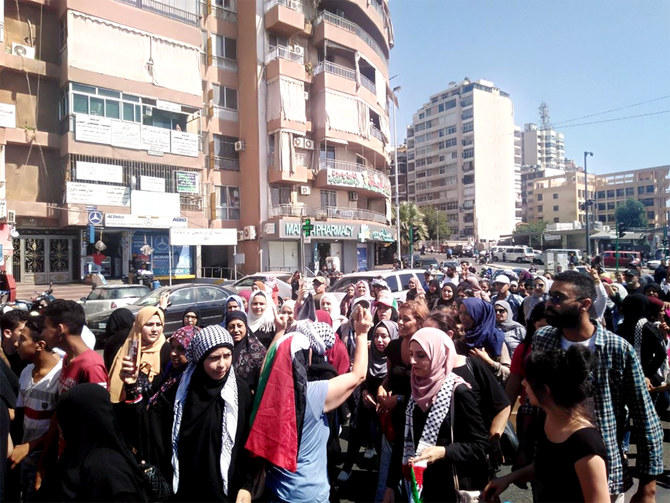
The refugees carried out a general strike and protests across 12 camps.
The protests, under the slogan “Day of Anger,” paralyzed movement in the camps. Protesters closed the entrances with burning tyres. All Palestinian political forces and popular committees took part in the protests.
The speaker of the Lebanese Parliament, Nabih Berri, received a letter from the head of the Palestinian National Council, Salim Zanoun, calling on him to “address the negative effects of the decision of the Lebanese Ministry of Labor.”
Zanoun said that Palestinians would support “Lebanon and its stability, as well as our determination to struggle together for the return of the Palestinian refugees, who have been graciously hosted by Lebanon for 71 years, and all refugees to their land and homes from which they were displaced by terrorism and the Israeli killing machine.”
Zanoun added that the decision of the Ministry of Labor has “caused great damage to human and civil rights and closed the doors of life for the Palestinian refugees.”
A source in the Lebanese-Palestinian Dialogue Committee (LPDC) said: “The protests are an expression of the deteriorating social and living conditions experienced by Palestinians in Lebanon. The decision of the Ministry of Labor inspired these protests.”
The source added: “The census conducted by the Lebanese state in cooperation with the Palestinian Authority in 2017 showed that the number of Palestinian refugees in Lebanon has reached 174,000 and the Palestinian labor force doesn’t exceed 40,000 workers. But if we repeat the census this year, we’ll find that there’s a decline in the labor force because of the quest to migrate, even if illegally, and to move to a third country in search of a better life.”
The Lebanese Parliament introduced amendments to laws 128 and 129 on labor and social security in 2010, which excludes “exclusively Palestinian refugee workers, who are duly registered in the records of the Ministry of the Interior, from the terms of reciprocity and work permit issued by the Ministry of Labor.”
The LPDC source said: “The amendment needed implementation decrees from the Council of Ministers, signed by the president, the prime minister and the minister of labor, but they’ve not been issued for nine years.”
The Palestinian labor force is present in fragile sectors such as construction and small crafts, but more problems arise among Palestinians who graduate from Lebanese universities and cannot work in their specialties because of trade union limitations. The source said that the Order of Nurses in Lebanon is the only union that allows Palestinians to work in their sector.
Alongside the protests, a meeting was held between various Palestinian factions at the headquarters of the LPDC with representatives of the General Confederation of Lebanese Workers. The Palestinian side called for “ending the measures of the Ministry of Labor regarding Palestinian refugees and not linking Palestinian labor in Lebanon with foreign labor.”
Ghassan Ayoub, a Palestinian member of the LPDC, said that the ministry’s actions “have a political impact. The Palestinian refugee isn’t a guest who has remained in Lebanon because he liked the hospitality. He’s a forced refugee who was born in Lebanon and lives on his territory. He isn’t a foreign expatriate who came to work in Lebanon. This must be taken into account in the enforcement of the Ministry of Labor’s procedures.”
Ayoub said the situation demanded “the application of the spirit of the law and not the text of the law. There are many complications in the law in terms of obtaining a work permit and conditions for establishing a business. They’re impossible conditions for the Palestinians.”
As for the implications of applying the ministry’s procedures to the refugees in Lebanon, Ayoub said: “Ninety percent of professions are forbidden to Palestinians, which means that they’re entitled to work in only a few sectors, namely porterage and digging, which are arduous. That means you’re telling the Palestinians ‘you have 10 percent of the air to breathe.’ What do you want from the Palestinians? Where should they go? What are the alternatives?”
Palestinian refugees are not entitled to work in 72 professions in Lebanon, and are not permitted access to social security. One of the contradictions of the law is that Palestinians have the right to purchase a taxi but are forbidden to work in it. Moreover, Palestinians are only allowed to fish after obtaining a special permit.
“The plan of the ministry to combat illegal foreign labor force isn’t aimed at the Palestinians and has nothing to do with conspiracy theories,” Lebanese Labor Minister Kamil Abu Sulaiman said.
“There’s a labor law in Lebanon. We approved a plan a month and a half ago to implement the law and gave a grace period of one month before we began inspections. The law applies to everyone and law enforcement can’t be fragmented.”
Abu Sulaiman added: “The Palestinian reaction is incomprehensible and meaningless.”
He received a call from Ashraf Dabbour, the Palestinian ambassador to Lebanon, and said he informed the diplomat of the ministry’s readiness to facilitate the affairs of the Palestinians.
In an open letter, Dabbour called on Palestinian refugees in Lebanon to avoid being “dragged into what does not serve our just cause. Our goal in the stage of our forced presence in Lebanon is to have a decent life until our return to our homeland, supported by our Lebanese brothers.”
The LPDC said that the Ministry of Labor “ignores the special case of the Palestinian refugees under the amendment of laws 128 and 129 and treats them as foreign workers.”
The LPDC added: “The Palestinian refugees can’t return to their country, and everything that they produce inside Lebanon remains in it, which strengthens the economic cycle of the country, whether it comes from small entrepreneurs or the hard work of laborers and craftsmen.
“Lebanon also benefits from the funds flowing through the UN Relief and Works Agency for Palestine Refugees in the Near East’s $80 million budget. They also gain from the efforts of international organizations in Palestinian camps, as well as what Palestinian refugees send to their refugee families in Lebanon, which is estimated at several hundred million dollars.”
Fathi Abu Al-Ardat, secretary in Lebanon of Fatah and the Palestine Liberation Organization, said: “The Palestinian refugees in Lebanon are guests in this country and we respect its sovereignty, but we also respect the decent living of Palestinians in the camps.”