KARACHI: Pakistani journalists are holding nationwide protests to denounce rampant censorship by the country’s powerful security services, massive layoffs due to budget cuts and months-long delays in payments of their wages.
Tuesday’s rallies, dubbed Day of Protests, are spearheaded by the Pakistan Federal Union of Journalists. It says journalists, who face the roughest phase in the country’s history, have decided to “fight the unprecedented censorship.”
Afzal Butt, president of the union, says the rallies are only the “beginning of a protest movement.”
Journalists and press freedom advocates say the country’s military is pressuring media outlets to quash critical coverage while the newly elected government is slashing its advertising budget, squeezing a key source of revenue for private newspapers and TV stations.


Pakistani journalists stage protests to denounce censorship
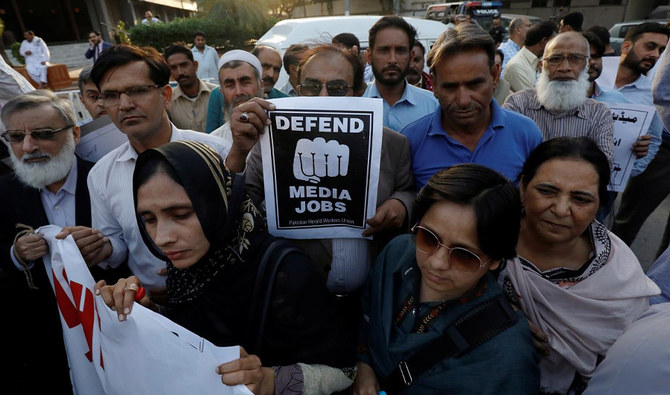
Pakistani journalists stage protests to denounce censorship

- Rallies are only the "beginning of a protest movement", says journalist union
- Budget cuts in media houses also result in massive layoffs

Pakistan cricket chief says boycott of India match aimed at restoring Bangladesh’s dignity
- Mohsin Naqvi says Pakistan sought to highlight Bangladesh’s grievances in World Cup dispute
- His comments come a day after Pakistan reversed decision to boycott the Feb. 15 India clash
ISLAMABAD: Pakistan’s decision to briefly threaten a boycott of its Twenty20 World Cup match against India was intended to highlight what it saw as unfair treatment of Bangladesh and to press for the concerns raised by Bangladeshi officials to be addressed, Pakistan Cricket Board Chairman Mohsin Naqvi said on Tuesday.
Pakistan withdrew its decision a day earlier to skip the Group A clash scheduled for Feb. 15 in Colombo, ending a week-long standoff with the International Cricket Council (ICC) that had drawn intervention from several member boards amid fears of disruption to the tournament.
“Our objective was only to ensure that Bangladesh was treated with dignity and that the injustice done to them was highlighted,” Naqvi told journalists in Peshawar. “You saw that whatever points Bangladesh raised were accepted. That’s it. We had no personal agenda of our own in this.”
Bangladesh had raised security concerns about playing its World Cup matches in India amid political tensions between the two countries and sought the relocation of its fixtures to Sri Lanka, a request that was turned down by the ICC. Subsequently, Bangladesh chose to withdraw from the tournament and were replaced by Scotland instead.
Pakistan cited Bangladesh’s removal from the original schedule as unjust when it initially instructed its team not to face India, a move that would have resulted in a forfeiture.
The decision led to a crisis situation since the India-Pakistan match is the biggest and most lucrative clash in the world of cricket, leading to a frantic weekend of negotiations.
The reversal allows Pakistan to proceed with the marquee India match after Bangladesh’s concerns were accommodated by the ICC, Naqvi said.
Pakistan, who edged past the Netherlands in their opening game, face the United States today in Group A, with India set to travel to Colombo for the Feb. 15 clash.
Pakistan and India, bitter political rivals, have not played bilateral cricket for more than a decade and meet only at global tournaments at neutral venues.


