

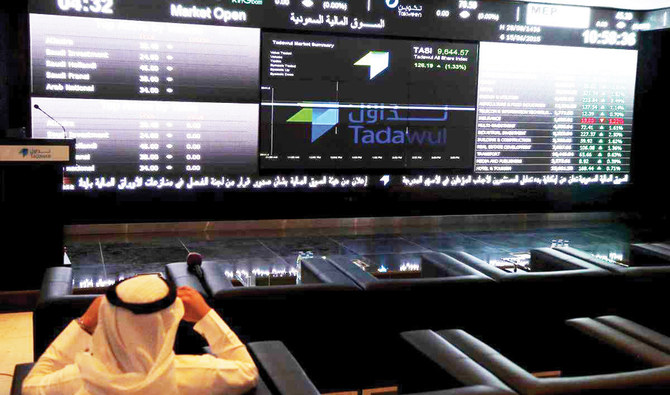
Banking, petrochemical shares boost Tadawul

The Tadawul All Share Index rose 0.5 percent on Sunday. (Reuters)
Updated 16 July 2019
Follow

Banking, petrochemical shares boost Tadawul

  • In Saudi Arabia, the Tadawul main index rose 0.5 percent, with banks and petrochemical companies leading the gains

DUBAI: Major Gulf stock markets closed higher on Sunday, mirroring gains late last week in global markets, and supported by some companies’ positive second-quarter results.In Saudi Arabia, the Tadawul main index rose 0.5 percent, with banks and petrochemical companies leading the gains.Dubai’s Arqaam Capital said in a research note last week it expected Saudi Arabia to deliver the strongest second-quarter earnings performance in the Gulf.

“We, however, expect growth to peter out as (the) rate cut cycle kicks in, given the significant positive ALM (asset liability management) position of KSA (Saudi) banks,” it said.
Alinma Bank rose 1.2 percent, while Al-Rajhi Banking and Investment Corp gained 1 percent.  
Mobile Telecommunications Company Saudi Arabia (Zain Saudi) gained 3.2 percent after reporting an 11 percent increase in second-quarter revenues to SR2.06 billion ($549.26 million).
Petchem firms Saudi Kayan Petrochemical Co. and Saudi Basic Industries Corp. (SABIC) rose 1.2 percent and 0.5 percent, respectively.
The Dubai index rose 0.7 percent, lifted by property developers Union Properties, up 3.6 percent, and heavyweight Emaar Properties, up 1 percent.
In Abu Dhabi, where the index was up 0.1 percent, blue chip Aldar Properties gained 3.9 percent.  
The company said last week it had partnered with the Abu Dhabi government to deliver projects worth AED5 billion ($1.36 billion).
Abu Dhabi-based Waha Capital was among the top performers, up 5.3 percent.   
Waha, which has seen its stocks tumble around 50 percent since the beginning of the year, has been in talks with another investment firm, Gulf Capital, regarding a merger, sources told Reuters earlier this year.
Recent changes at management level might suggest the company is charting a new growth strategy.
In Egypt, the index shed 1 percent, as Orascom Investment Holding dropped 3.9 percent. Orascom’s stocks last week soared after the firm’s board withdrew an offer to acquire Nile Sugar.


Saudi stock market opens its doors to foreign investors

Updated 06 January 2026
Follow

Saudi stock market opens its doors to foreign investors

RIYADH: Foreigners will be able to invest directly in Saudi Arabia’s stock market from Feb. 1, the Kingdom’s Capital Market Authority has announced.

The CMA’s board has approved a regulatory change which will mean the capital market, across all its segments, will be accessible to investors from around the world for direct participation.

According to a statement, the approved amendments aim to expand and diversify the base of those permitted to invest in the Main Market, thereby supporting investment inflows and enhancing market liquidity.

International investors' ownership in the capital market exceeded SR590 billion ($157.32 billion) by the end of the third quarter of 2025, while international investments in the main market reached approximately SR519 billion during the same period — an annual rise of 4 percent.

“The approved amendments eliminated the concept of the Qualified Foreign Investor in the Main Market, thereby allowing all categories of foreign investors to access the market without the need to meet qualification requirements,” said the CMA, adding: “It also eliminated the regulatory framework governing swap agreements, which were used as an option to enable non-resident foreign investors to obtain economic benefits only from listed securities, and the allowance of direct investment in shares listed on the Main Market.”

In July, the CMA approved measures to simplify the procedures for opening and operating investment accounts for certain categories of investors. These included natural foreign investors residing in one of the Gulf Cooperation Council countries, as well as those who had previously resided in the Kingdom or in any GCC country. 

This step represented an interim phase leading up to the decision announced today, with the aim of increasing confidence among participants in the Main Market and supporting the local economy.

Saudi Arabia, which ‌is more than halfway ‍through an economic plan ‍to reduce its dependence on oil, ‍has been trying to attract foreign investors, including by establishing exchange-traded funds with Asian partners in Japan and Hong Kong.