

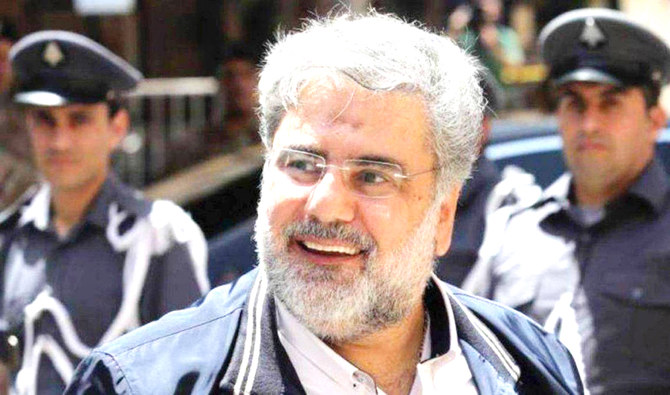

BEIRUT: Hezbollah Member of Parliament Nawaf Musawi led a group storming an Internal Security Forces (ISF) station in Damour on Saturday night and shot a young man inside the station, the National News Agency (NNA) reported.
The victim, who is from the Mokdad family, is Musawi’s son-in-law and is in dispute with his ex-wife, Musawi’s daughter Ghadeer.
Musawi stormed the police station with 30 people, who included his brother, the director of his bureau, and several other relatives. There were two members of the security forces in the police station and, according to the NNA, Musawi shot the young man with a service revolver, wounding his hand. Musawi’s brother stabbed the young man twice in the thigh. The group intimidated the officers inside the police station, preventing them from intervening.
The incident was caused by former disagreements between Mokdad and his ex-wife over the custody of their children. Mokdad had chased his ex-wife and her sister in Damour and accosted them.
A video taken by Ghadeer’s sister during the chase went viral, and her screams could be heard as she called for her father. The video also showed Mokdad shouting insults at his ex-wife and threatening her and her sister for recording the incident. A telegram sent by the commander of the Damour platoon, Col. Joseph Ghannoum, to the director general of the ISF explained that Musawi’s daughter and her ex-husband quarrelled on the highway between Damour and Sidon over the right to see their children. They were then escorted by a patrol to the Damour police station. The telegram said: “At the beginning of the investigation, four men arrived at the police station and attacked the ex-husband of Musawi’s daughter with a screwdriver, severely injuring his leg and prompting the police to arrest two of them while the others managed to escape.”
“After the station’s main gate was closed, MP Nawaf Musawi arrived with 20 armed men, but a police officer denied them entry and tried to calm Musawi, who was furious.”
According to the telegram, “while first aid was administered to the wounded man, unknown individuals opened fire from outside the station at the chief’s office, wounding Mokdad in the wrist and causing heavy bleeding. After that, MP Musawi left to an unknown destination.” Musawi denied reports that he had shot a man from the Mokdad family and said to the NTV channel: “These are all lies.”
Musawi explained that his son-in-law attacked his daughter Ghadeer and shouted insults at her. He added: “No one hit him with a screwdriver nor shot him. I came to take my daughter from the station’s yard.
“This is my daughter and I want to protect her. She is the world to me. Her ex-husband won’t leave us alone, and we have been patient with him.” He also accused Mokdad of acting aggressively inside the station. The incident sparked reactions on social media.
FASTFACT
Hezbollah MP Nawaf Musawi is known for his irritability. Last February, there had been some tense disagreements between him and MPs Sami and Nadim Gemayel during a public meeting of Parliament.
Former Minister Ashraf Rifi said: “When a Member of Parliament and his guards storm an ISF station by force and attempt to kill someone, does this not undermine the state’s security and require the case to be referred to the judicial council?”
Former MP Faris Saeed said: “MP Musawi’s attack in the police station deserves to be referred to the judicial council because it is an assault against security forces.”
Activist Diana Moukalled said on Twitter: “The daughter of the Hezbollah MP is waging a battle over the custody of her children under unfair personal status laws and in the shadow of a party that stands firmly against the amendment of these laws. Musawi resorted to arms and force to defend his daughter. This tale is filled with amazing paradoxes in relation to the political, legal and security situation in Lebanon.”
Musawi is known for his irritability. Last February, there had been some tense disagreements between him and MPs Sami and Nadim Gemayel during a public meeting of Parliament.
After Sami Gemayel criticized Hezbollah and said “Hezbollah has brought President Michel Aoun to Baabda,” Musawi interjected and said: “It is honorable for Aoun to reach office with the support of the resistance’s rifle, while others had arrived on an Israeli tank,” referring to President Bachir Gemayel.
MP Nadim Gemayel joined the quarrel and said: “You greeted the Israeli army with rice when they entered Lebanon.” Musawi replied: “You are no bigger than an Israeli tank that can be destroyed with a Kornet missile.”
At the time, the Hezbollah leadership decided to suspend Musawi from Parliament for two months.
Journalist Dima Sadek said: “A question for the MP’s parliamentary bloc: Wouldn’t it have been better for you to enact personal status laws that offer adequate redress to women instead of standing—alongside others—against amending them? Are you happy with the alternative law of the jungle that you have contributed to enacting?”
Musawi supporters defended him on Twitter. MP Jamil Al-Sayyed said: “Regardless of the evaluation of MP Musawi’s conduct, he is a father after all. What was done to his daughter on the highway by her ex-husband put her in danger, and no father can bear this.”


