

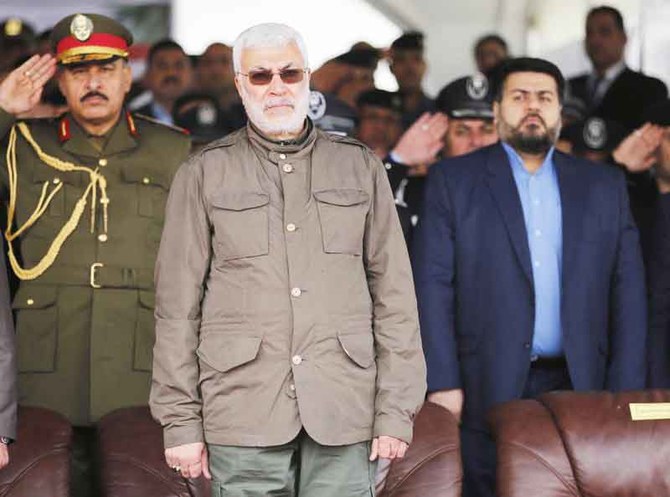

BAGHDAD: Dismantling pro-Iranian armed factions operating in Iraq under the umbrella of the Popular Mobilization Commission (PMC) and integrating its fighters with independent volunteers within the same body is at the heart of Prime Minister Adel Abdul Mahdi’s plan to institutionalize the PMC and limit Iran’s control over its fighters.
The drive to “restructure and reorganize” the PMC’s forces is Abdul Mahdi’s response to pressure from the powerful Shiite cleric Ayatollah Ali Al-Sistani, who sees these factions as a threat to the political process and a tool to undermine the authority of the state.
Sistani, global head of the Shiite community and the most revered cleric in Iraq, has been the sponsor of the political process since the 2003 US-led invasion that toppled Saddam Hussein — and the only one who can end it with one word.
The PMC was created by former Iraqi prime minister Nouri Al-Maliki in July 2014 to provide a government umbrella for armed factions and volunteers who fought Daesh alongside the government. It comprises at least 150,000 fighters, mostly Shiites.
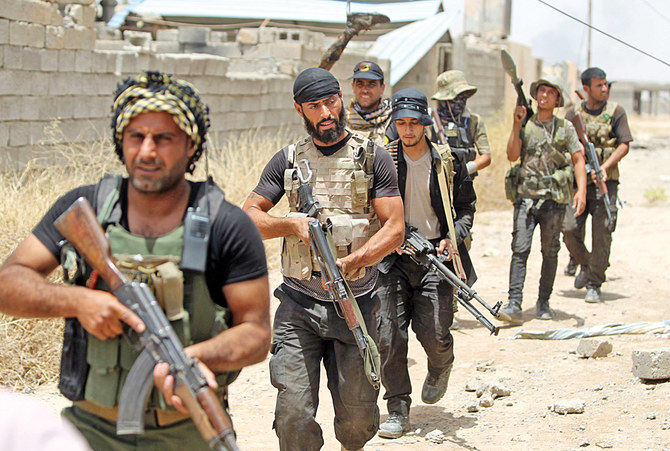
Armed Shiite factions, including Iranian-backed groups such as the Badr Organization, Kata’ib Hezbollah-Iraq and Asa’ib Ahl Al-Haq — the most powerful in terms of numbers and equipment — are the backbone of the Popular Mobilization Forces (PMF) and have played a pivotal role in defeating Daesh. However, they have been accused of atrocities against Sunnis, and of being tools to pressure the government for illegal financial and political gain.
Under a law passed in 2016, the PMF’s duties are determined by the commander-in-chief of the Iraqi armed forces, but the reality is that most of the factions are not subject to the orders of the Iraqi government and do not report to Iraqi military authorities.
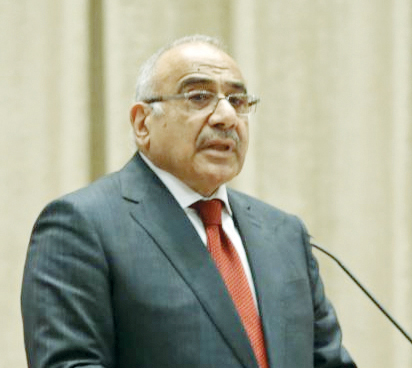
Iraqi PM Adil Abdul Mahdi
Restructuring these factions and integrating their fighters with independent volunteers would dilute their power and prevent their commanders from taking advantage of the PMC’s financial and human resources, PMC commanders close to Sistani told Arab News.
“We want the decisions of the PMC to be Iraqi, and not to use their forces to implement an Iranian agenda,” one said.“The PMC must be institutionalized and subordinated to the regular military organization’s controls. The PMF must not be stronger than the army under any circumstances.”
The plan was prepared by a committee formed by Abdul Mahdi, and led by Lt. Gen. Abdul Amir Yarallah, commander of joint military operations. The other members are Abu Montadher Al-Husseini, commander of PMFs operations,and Hamed Al-Shatri, deputy head of the National Security Service and administrative assistant to the head of the PMC. There are three stages: A decree outlining the proposals, approval of the organizational structure, and the settlement of salaries. The decree was issued on July 1, and salaries have been agreed upon.
“The first and third stages have been implemented because we have been working on this since last year, and work is underway to implement the second stage, which is the most difficult,” one of Abdul Mahdi’s security advisers told Arab News. “The signs so far are that all the factions are responding positively, but we don’t feel comfortable. The real situation will not be be clear until at least July 30.”
Creating a new organizational structure begins with dismantling the brigades of each armed faction. “The core of the idea is to end the factions by dismantling their brigades and forming new ones, each of which will contain fighters from different factions along with independent fighters, taking into account the sectarian and ethnic balance,” a leading commander involved in the process told Arab News.
“This is the most difficult step because the factions associated with Iran are trying to circumvent it by accepting all the proposals except those that require the dissolution of their brigades and the integration of their fighters with others.
“Everything depends on this step. It will mean reducing the risk of these factions by 80 percent, which is what Sistani wants.”
Under the new salary settlement, which is already in operation, each fighter receives his salary directly from government banks using Q Cards, a form of electronic payment. Before, unit commanders received and distributed salaries, a system that reinforced their control of the fighters and was open to widespread corruption.
“We discovered thousands of spacemen (fake fighters) who were either expelled, left or lost during the fighting, but their names were not removed from the payroll so their commanders continued to receive their salaries,” Abdul Mahdi’s adviser said.
“We also found that most of the fighters were not getting their full salaries because the faction leaders were using the cash to fund their own fighters and activities outside the PMC.”
The plan will also curb the powers of some PMC leaders and remove others, with the aim of limiting Iran’s influence. At the top of that list is Jamal Jaafar, also known as Abu Mahdi Al-Mohandes, or “the Engineer,” deputy head of the PMC but de facto commander of its forces. Mohandes, 65, was sentenced to death in his absence by a court in Kuwait for his role in deadly bombings there in 1983, he has been designated a terrorist by the US, and he is close to Qasem Soleimani, commander of the Quds Force of the Islamic Revolutionary Guard Corps.
The organizational restructuring requires that Faleh Al-Fayadh, current head of the PMC, head of the National Security Service and known as “Iran’s man in Iraq,” retain his roles in return for appointing Al-Mohandes chief of staff and vice-chairman of the PMC — but stripped of any financial or administrative authority. In addition, Abu Zainab Al-Lami will be moved from his role as the manager of PMC security to be a deputy to the Interior Minister, and Abu Montadher Al-Husseini becomes a secretary-general for Abdul Mahdi.
These moves resulted in a heated dispute between Al-Mohandes and Fayyad, three prominent PMF commanders told Arab News. However, Ayatollah Al-Sistani’s insistence on “trimming the nails of Al-Mohandes” and reducing Iran’s influence on the PMC “forced everyone to accept the settlement.”
“The Engineer represents the biggest challenges to Abdul Mahdi’s plan because he works without laws or regulations, so he had to be dealt with calmly, transferring the battle from outside the body to inside, between the Engineer and Fayyad.
“Limiting Al-Mohandes’s authority is great progress compared to before, when all the authority was exclusively in his hands, although he was not the head of the PMC.”
Abdul Mahdi’s adviser said: “All the indications are that Al-Mohandes is a burnt card, and that Iran has offered him up as a scapegoat to please Sistani.
“Iran is in an unenviable position, and it is not in its interest now to provoke Sistani or create any problem leading to a new front that may end its influence in Iraq.”
Most of the influential Shiite armed factions have publicly announced their acceptance of the new structure, except Kata’ib Hezbollah; they want the inclusion of Kurdish peshmerga forces, armed groups linked to the Kurdish leaders, and the Sunni tribes linked exclusively to US troops in Iraq. The structure also requires the disclosure of the names of fighters and their leaders, and their real addresses, which does sit well with Kata’ib Hezbollah’s usual secrecy.However, a PMC commander close to Soleimani said all factions would be subject to the structure, including Kata’ib, and there would be intensive meetings in the coming days to agree on the details.
“There is great pressure on the prime minister from Sistani and the Americans to rein in the factions and control them,” a prominent PMF commander close to Soleimani told Arab News.
“The regional and international challenges are great, and it is not in the interests of Iran or Iraq that any Iranian-backed faction act against the will of the Iraqi government.”


