

Britain to deploy second warship to the Gulf amid tensions with Iran

1 / 2
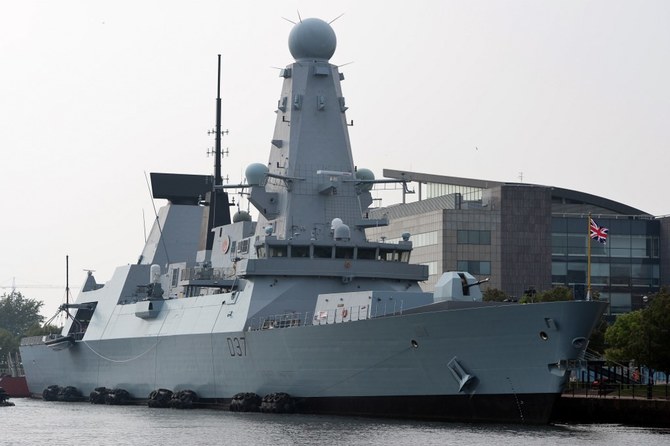
British warship HMS Duncan’s rotation into the Gulf was moved forward by a number of days as tensions with Iran mounted. (AFP)
2 / 2
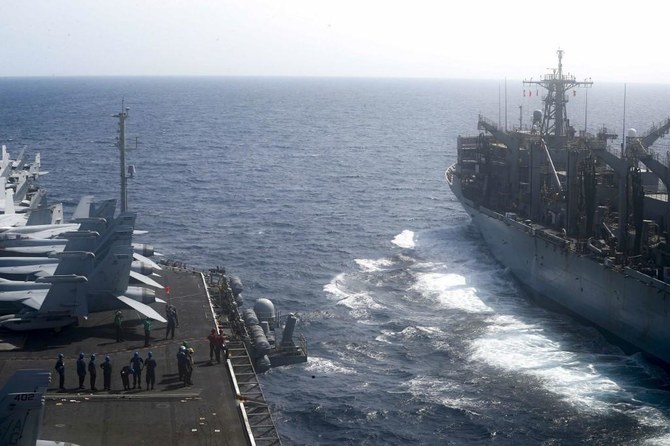
The aircraft carrier Abraham Lincoln pulls alongside the fast combat support ship Arctic during a replenishment-at-sea in this May 19, 2019. The Abraham Lincoln Carrier Strike Group is deployed to the US’s 5th Fleet area operations, which includes the Arabian Gulf. (Navy Office of Information/AFP)
Updated 13 July 2019
Follow

Britain to deploy second warship to the Gulf amid tensions with Iran

  • Relations between Tehran and the West have been increasingly strained
  • Talks between Britain and the US on building up their military presence in the Gulf are ongoing

LONDON: Britain said on Friday it would deploy the destroyer HMS Duncan warship to the Gulf to replace HMS Montrose, maintaining a continuous presence there during a time of heightened tension in the region.

Relations between Tehran and the West have been increasingly strained after Britain seized an Iranian tanker in Gibraltar and London said HMS Montrose had to fend off Iranian vessels which sought to block a British-owned tanker passing through the Strait of Hormuz.

“As part of our long-standing presence in the Gulf, HMS Duncan is deploying to the region to ensure we maintain a continuous maritime security presence while HMS Montrose comes off task for pre-planned maintenance and crew change over,” the government said.

“This will ensure that the UK alongside international partners can continue to support freedom of navigation for vessels transiting through this vital shipping.”

Discussions between Britain and the United States on building up their military presence in the Gulf are ongoing, Prime Minister Theresa May’s spokeswoman said on Friday amid tensions with Iran.

Britain is not seeking to escalate the situation with Iran, foreign minister Jeremy Hunt said on Friday, as tensions continue between London and Tehran over a seized Iranian tanker and the passage of vessels through the Strait of Hormuz.
"We are reacting to what is happening in a measured and careful way and we are being clear to Iran that we are not seeking to escalate this situation," Jeremy Hunt told Sky News.

Bahrain said on Friday it "strongly condemned" what it called an Iranian attempt to intercept a British tanker in the Gulf, according to a statement from its foreign ministry.
"This hostile action embodies Iran's insistence on threatening security and peace, and harming maritime navigation," the statement said.

Relations between Tehran and the West have been increasingly strained after Britain seized an Iranian tanker in Gibraltar and London said the British Heritage, operated by oil company BP, had been approached in the strait between Iran and the Arabian peninsula.
“We are talking to the US about building on our presence in the face of recent threats to shipping in the area,” May’s spokeswoman said on Friday.


Syria asks Lebanon to hand over Assad-era officers after Reuters report

Updated 4 sec ago
Follow

Syria asks Lebanon to hand over Assad-era officers after Reuters report

  • Among the names handed over by Syrian officials to ‍Lebanon were several high-ranking figures acting as intermediaries for Makhlouf or Hassan in ‍Lebanon

DUBAI: Syrian authorities have asked Lebanese security forces to hand over more than 200 senior officers who fled to Lebanon after the fall of Bashar Assad, following a Reuters investigation that showed how the neighboring country was a hub for insurgent plotting.
On Dec. 18, a ​top Syrian security official, Brig. Abdul Rahman Al-Dabbagh, met with his Lebanese counterparts in Beirut to discuss the exiled Assad-era officers, according to three senior Syrian sources, two Lebanese security officials, and a diplomat with knowledge of the visit.
The meetings came days after a Reuters investigation detailed rival plots being pursued by Rami Makhlouf, the billionaire cousin of the ousted president, and Maj. Gen. Kamal Hassan, former head of military intelligence, both living in exile in Moscow, to finance potential Alawite militant groups in Lebanon and along the Syrian coast. Syria and Lebanon share a 375-kilometer border.
The two rival camps aim to undermine the new Syrian government under President Ahmed Al-Sharaa. Reuters found they are sending money to intermediaries in Lebanon to try and stir uprisings that would divide Syria and allow the plotters to regain control over the coastal areas. The population of those areas is dominated ‌by Alawites, the minority ‌sect associated with the Assad family and the dictatorship’s ruling elite.
Al-Dabbagh, an aide to the ‌head ⁠of ​internal security ‌in Syria’s Latakia province, an Alawite stronghold, met with Lebanese intelligence chief Tony Kahwaji and Major General Hassan Choucair, head of the General Security Directorate, and presented them with the list of senior officers wanted by Syria.
The visit focused on gathering information about the whereabouts and legal status of the officers, as well as trying to find ways to prosecute or extradite them to Syria, according to the Syrian sources.
They described it as a direct request from one security agency to another, rather than a demand for extradition.
Three senior Lebanese security officials confirmed the meetings. One of the Lebanese officials denied receiving any demands from the Syrians to hand over the officers. Two others acknowledged receiving a list of names but said none were senior officers.
One of the Lebanese security ⁠officials said there is no evidence of any insurgency being planned, despite the threats against Syria’s new government detailed in the Reuters reporting.
All the officials spoke on condition of anonymity to reveal details of ‌a highly sensitive cross-border issue.
Among the names handed over by Syrian officials to ‍Lebanon were several high-ranking figures acting as intermediaries for Makhlouf or Hassan in ‍Lebanon, according to a Syrian source who saw the list.
A Lebanese judicial official said Syria had not made a formal extradition request to ‍Lebanon, typically done through the two countries’ justice and foreign ministries.
Accompanying Dabbagh on his Beirut visit was Khaled Al-Ahmad, a former Assad adviser and childhood friend of Sharaa, who is leading the government’s efforts to win over the Alawite community through development projects 
and aid, according to two witnesses who saw the men together on that mid-December day.
According to the two witnesses, who are both ex-Assad officers, Al-Ahmad and Dabbagh went together to Azmi, an upscale Beirut restaurant that is popular among Assad’s ​men. The two witnesses said they and others interpreted the outing as a warning to those trying to influence Alawites to rise up against Syria’s new leaders that Lebanon is no longer a haven.
A manager at Azmi declined to ⁠comment on the visit.
In a Jan. 2 post on X, Lebanese Deputy Prime Minister Tarek Mitri called on his government’s security agencies to verify the information circulating in the media and take action against the Lebanon-based agents for Assad’s former insiders, Makhlouf and Hassan.
“It is incumbent upon them, and upon all of us, to avert the dangers of any actions that undermine Syria’s unity or threaten its security and stability, whether in Lebanon or originating from it,” the tweet read.
In response to questions from Reuters, Lebanon’s General Security referred to Jan. 11 remarks by Lebanese President Joseph Aoun, who said Lebanon’s military intelligence and other security agencies had carried out raids in several areas of the country’s north and east. Aoun said the raids did not produce evidence of the presence of officers linked to the Assad dictatorship and said Lebanon was continuing to coordinate with Syria on the issue.
Syrian government officials did not respond to requests for comment.
From Jan. 3 to Jan. 6, Lebanese soldiers raided locations and shelters housing displaced Syrians. The Lebanese Army said 38 Syrians were arrested during the raids on different charges such as possession of drugs or weapons, or entering the country illegally.
A senior Lebanese security official told Reuters those ‌raids were linked to the exiles’ plots.
Another senior Lebanese security official emphasized that there was no arrest warrant for the Syrian officers in Lebanon, nor Interpol requests for them.
“We can’t do anything against them,” the official added.