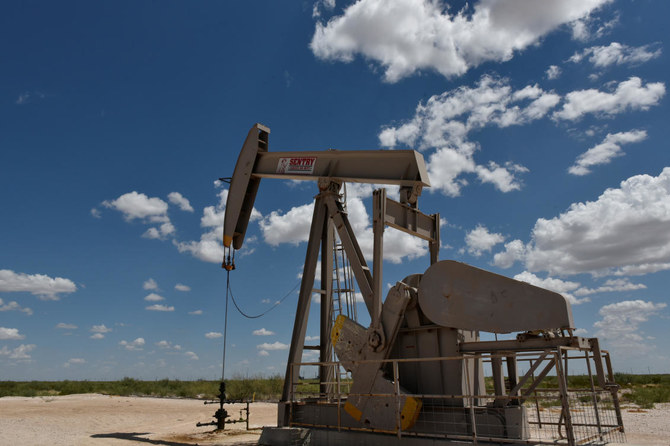
Oil market oversupplied in 2019 on US production: energy watchdog

The International Energy Agency predicted that global oil stocks could rise by 136 million barrels by the end of the first quarter of 2020. (Reuters)
Updated 12 July 2019
Follow

Oil market oversupplied in 2019 on US production: energy watchdog

  • The demand for OPEC crude oil in early 2020 could fall to only 28 million barrels per day

LONDON: Surging US oil output will outpace sluggish global demand and lead to a large stock build around the world in the next nine months, the International Energy Agency (IEA) said on Friday.
The forecasts appear to predict the need for producer club OPEC and its allies to reduce production to balance the market despite extending their existing pact, forecasting a fall in demand for OPEC crude to only 28 million barrels per day (bpd) in early 2020.
“Market tightness is not an issue for the time being and any rebalancing seems to have moved further into the future,” the IEA said in its monthly report.
“Clearly, this presents a major challenge to those who have taken on the task of market management,” it added, referring to the Organization of the Petroleum Exporting Countries and producer allies such as Russia.
The demand for OPEC crude oil in early 2020 could fall to only 28 million bpd, it added, with non-OPEC expansion in 2020 rising by 2.1 million bpd — a full 2 million bpd of which is expected to come from the United States.
At current OPEC output levels of 30 million bpd, the IEA predicted that global oil stocks could rise by 136 million barrels by the end of the first quarter of 2020.
Maintaining its forecasts for oil demand for the rest of 2019 and 2020, the Paris-based agency cited expected improvement in US-China trade relations and US economic expansion as encouraging but flagged tailwinds elsewhere.
“There are indications of deteriorating trade and manufacturing activity. Recent data show that global manufacturing output in 2Q19 fell for the first time since late 2012 and new orders have declined at a fast pace,” it said.
The IEA said that markets were concerned by escalating tension between Iran and the West over oil tankers leaving the Gulf but that incidents in the region’s shipping lanes have been overshadowed by supply concerns.
“The oil price impact has been minimal with no real security of supply premium,” the IEA said. “For now, maritime operations in the region are close to normal and markets remain calm.”
Tightened US sanctions on Iranian crude drove down Tehran’s June exports by 450,000 bpd to 530,000 bpd, near three-decade lows.


Airlines across Middle East, Asia extend flight suspensions for 3rd straight day 

Updated 12 sec ago
Follow

Airlines across Middle East, Asia extend flight suspensions for 3rd straight day 

RIYADH: Airlines and airport operators across the Middle East extended flight suspensions for a third consecutive day after US and Israeli strikes on Iran triggered widespread airspace closures, disrupting global travel routes. 

Major Gulf hubs halted operations as authorities kept sections of regional airspace closed, forcing carriers to cancel thousands of flights and reroute long-haul services linking Europe, Asia and Australia.  

This comes as flight cancellations affected seven airports across the Middle East on March 1, including Dubai and Abu Dhabi in the UAE, Doha in Qatar, and Manama in Bahrain.

Emirates said in a statement that, due to multiple regional airspace closures, it has temporarily suspended all operations to and from Dubai until 3:00 p.m. UAE time on March 3. 

“The situation remains dynamic and is assessed continuously. We urge all customers to review the latest operational updates on emirates.com and check their email for any notifications about changes or cancellations to their flights before travelling to the airport,” the airline said. 

Hamad International Airport said flights remain suspended and will resume once the Civil Aviation Authority announces the reopening of Qatari airspace. The airport advised passengers not to travel to the airport and to contact their airlines for updates. 

The closures disrupted key hub airports in Dubai, Abu Dhabi and Doha. Emirates, Qatar Airways and Etihad — which operate from these hubs — normally handle around 90,000 passengers daily, with even more traveling to other Middle Eastern destinations, according to aviation analytics firm Cirium.

The disruption has compounded volatility in airline shares amid concerns over higher fuel costs and prolonged operational uncertainty.   

Ipek Ozkardeskaya, senior analyst at Swissquote, said: “The weekend was marked by tensions between the US, Israel, and Iran, leading to hundreds of explosions targeting broader Middle East countries as well, including the UAE, Saudi Arabia, Qatar, Bahrain and Kuwait.” 

He added: “The flare-up was predictable; markets had been preparing for weeks as US warships advanced to the region preceding the explosions.”  

Asian airlines shares plunge 

Asian airline stocks slid on March 2, with Hong Kong’s Cathay Pacific, Australia’s Qantas, Singapore Airlines, and Japan Airlines falling more than 5 percent after the escalation disrupted travel flows and heightened concerns over fuel prices, Asharq Bloomberg reported. 

Qantas shares dropped as much as 10.4 percent to a 10-month low at the Australian market open before trimming losses to trade down nearly 6 percent. 

Other carriers, including Japan Airlines, Air China and Malaysia Airlines, also declined. 

Cathay Pacific canceled all flights to the Middle East, including passenger services to Dubai and Riyadh, until further notice. 

Singapore Airlines suspended flights to and from Dubai until March 7, while Japan Airlines halted services between Tokyo and Doha for the time being.  

Flight data provider VariFlight said Chinese airlines have canceled 26.5 percent of their services to and from the Middle East scheduled between March 2 and 8.