

Saudi General Entertainment Authority, Qiddiya launch job placement programs

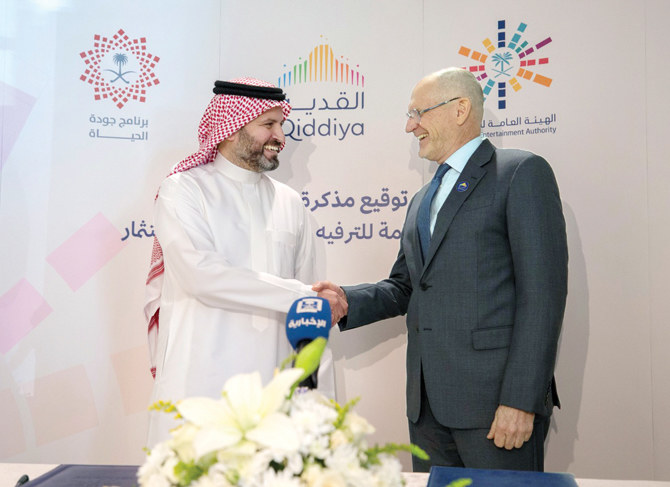
The General Entertainment Authority is taking steps to create a diverse entertainment sector in Saudi Arabia. (Photo/Supplied)
Updated 10 July 2019
Follow

Saudi General Entertainment Authority, Qiddiya launch job placement programs

  • MoU signed to provide scholarships for 60 students
  • The program will begin in the autumn of 2019, lasting five years

JEDDAH: The General Entertainment Authority (GEA) and Qiddiya Investment Co. signed a memorandum of understanding (MoU) to launch joint programs to develop human capital.

It is part of the GEA’s scholarship program launched last week. The signing ceremony took place at the authority’s headquarters in Riyadh on Sunday. GEA Chief Executive Office Amr bin Ahmed Banaja and Qiddiya Investment Co. chief Michael Reininger signed the MoU on behalf of their respective organizations.

The agreement will provide scholarships for 60 students to study at Rosen College of Hospitality Management at the University of Central Florida in the US.

The first batch of students will receive scholarships in event management and entertainment management degree programs. The program will begin in the autumn of 2019, lasting five years. It will include English language preparation and internships at the Six Flags Entertainment Corp.

Through this ambitious scholarship program, the GEA is keen to achieve its strategic objectives in developing local content and creating a robust, diverse entertainment sector in line with Saudi Vision 2030. Moreover, the partnership aims to achieve Qiddiya’s goals in creating career paths for young Saudis to work at the company

HIGHLIGHTS

  • The first batch of students will receive scholarships in event management and entertainment management degree programs.
  • The program will begin in the autumn of 2019, lasting five years.
  • It will include English language preparation and internships at the Six Flags Entertainment Corp.

The registration process to win a scholarship opportunity will end on July 12. It has so far witnessed a large turnout by Saudi students eager to study and work in the Kingdom’s promising entertainment sector.


Interested candidates can get themselves registered by visiting https://www.gea.gov.sa/hr-development/qiddiya.

The GEA is one of the key drivers of transformation in the Kingdom, with clarity of purpose to build a world-class entertainment industry that will put Saudi Arabia on the global tourism and entertainment map.

Qiddiya, one of the three megaprojects, besides the Neom smart-city and the Red Sea Project launched by Crown Prince Mohammed bin Salman, will be located about 40 kilometers from the city center.

Upon completion, the prominent landmark is expected to be the world’s largest entertainment city.

The project targets local, regional and international tourists and will be Saudi Arabia’s pre-eminent entertainment, sports and cultural destination that embodies the Saudi identity. It is expected to be the world’s largest entertainment city by 2030, with a total area of 334 square kilometers, surpassing Walt Disney World in Florida, which is only 110 sq. km. Investors hope the project will attract high numbers of international visitors. 

The project aims to improve the quality of local life not only through entertainment, but also by providing around 57,000 jobs for citizens and opening new opportunities for the private sector in various industries. It will also serve the Kingdom’s goal of elevating Riyadh to become one of the world’s top 100 cities to live in.


National program identifies 165 native plants for afforestation efforts in Asir

Updated 29 December 2025
Follow

National program identifies 165 native plants for afforestation efforts in Asir

  • The survey is part of broader plans focused on restoring degraded land, using native vegetation 

JEDDAH: Saudi Arabia’s National Afforestation Program has identified more than 165 species of native plants suitable for afforestation in the Asir region, highlighting the ecological diversity of one of the Kingdom’s most environmentally varied areas, the Saudi Press Agency reported.

The findings form part of broader national efforts to expand vegetation cover, address land degradation, and support sustainability goals linked to the Saudi Green Initiative and Vision 2030.

According to the program, the identified species are distributed across a wide range of natural environments in Asir, including mountainous terrain, highlands, slopes, valleys, plains, rocky landscapes, and coastal areas stretching from the Red Sea to Tihama.

The species belong to numerous plant families, including Fabaceae, Anacardiaceae, Burseraceae, Capparaceae, Ebenaceae, Euphorbiaceae, Malvaceae, Myrtaceae, Oleaceae, and Primulaceae, among others.

Plants suitable for afforestation range from large and small trees to perennial and annual shrubs, herbs, succulents, bulbs, and climbing plants. 

Among the most notable species identified are the grey mangrove, mastic tree, mooring or ben tree, juniper, sycamore fig, wild olive, henna, wild jasmine, hawthorn, and arak.

The Saudi Arabian Botanical Society described the announcement as an important step in protecting plant diversity and strengthening the ecosystem conservation in the Kingdom. 

Munirah bin Hamad Al-Hazani, founder and president of the society, said that prioritizing native species is central to sustainable afforestation.

“Focusing on the cultivation of native plants adapted to diverse environments forms the cornerstone of sustainable afforestation projects, as it plays a pivotal role in enhancing vegetation cover, combating land degradation, and conserving natural and financial resources,” she told Arab News.

Al-Hazani added that long-term success depends on cooperation between government bodies and the nonprofit sector, alongside community involvement and environmental awareness programs.

The National Afforestation Program has increasingly emphasized community participation, working with government agencies, private companies, and nonprofit organizations to support planting initiatives and environmental education. Its approach includes promoting volunteerism and discouraging harmful environmental practices, while focusing on the use of native plants adapted to local conditions.

Parallel efforts are underway in other regions of the Kingdom to support vegetation restoration through research and infrastructure development. In Jouf, often referred to as the Kingdom’s food basket, the King Salman bin Abdulaziz Royal Reserve Development Authority has established a Central Nursery and a Wild Seeds Research and Production Station to address the growing demand for reliable sources of native seeds and seedlings.

The project was launched in 2023 under the directive of Prince Abdulaziz bin Saud bin Naif, the minister of interior and chairman of the authority’s board of directors. 

Since then, the facilities has become a key component of vegetation restoration efforts within the reserve.

The authority has focused on building operational capacity by recruiting and training specialists to manage cultivation and research activities. The research and production station includes 14 mother-seed production fields containing over 400,000 trees and shrubs. 

Planting began in late 2024, with more than 30 native plant species represented, selected for their role in the reserve’s natural ecosystem. 

The facility also includes two seed storage units with a combined capacity of 3,000 kilograms. Seeds are collected annually from multiple sites within the reserve and used for seedling production habitat rehabilitation.

The Central Nursery spans 6,000 square meters and includes 30 greenhouses spanning 1,500 square meters, as well as two shade houses used during summer months. A plant hardening facility, designed to prepare seedlings for natural environmental conditions, covers 10,000 square meters and is divided into seven sections. The nursery’s annual production capacity reaches 1.5 million seedlings, representing more than 15 native plant species. 

Together, these initiatives underscore the growing role of native plant research and propagation in Saudi Arabia’s afforestation strategy, particularly as the Kingdom works to balance environmental restoration with long-term sustainability goals.