

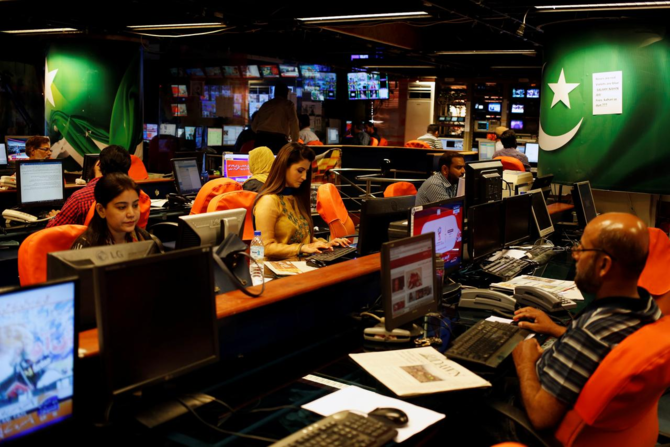

Pakistan’s media organizations are faced with an ‘unprecedented censorship’ by the government for their coverage of opposition parties, journalists said on Tuesday — a day after three news channels were abruptly taken off air in various parts of the country.
The blackout came after Maryam Nawaz, daughter of former premier Nawaz Sharif, in a live press conference on July 6, accused an accountability court judge Arshad Malik of convicting her father “under immense pressure from hidden hands.” She had also released a purported video showing the judge telling a person that there was no solid evidence of corruption against Sharif in the case.
Sharif, who is the supreme leader of opposition party Pakistan Muslim League-Nawaz (PML-N) and has served as the country’s prime minister thrice, is currently serving a seven-year prison term in Lahore’s Kot Lakhpat jail in connection with Al-Azizia corruption case.
Pakistan’s anti-corruption watchdog, the National Accountability Bureau (NAB), had filed a reference against him after the Supreme Court disqualified him from holding a public office, in July 2017, as part of the verdict for the Panama Papers’ case.
Pakistan’s Electronic Media Regulatory Authority (PEMRA) later issued notices to 21 television channels for the “unedited live telecast” of Maryam’s press conference wherein she questioned the judicial process in graft cases against her father.
“Transmission of our news channel has not been restored so far, which we suspect was taken off air for covering Maryam Nawaz’s press conference and her public rally,” Mian Tahir, director news of 24 News told Arab News.
On Monday evening, PEMRA allegedly took three news channels – 24 News, Capital TV and Abb Takk News – off air for what these channels said was providing coverage to the opposition, especially Maryam’s recent press conference and address to a public rally in which she lambasted Prime Minister Imran Khan’s government.
Tahir said that PEMRA had not provided them with any substantial reason for the move. “This is an unprecedented censorship, and we believe it is being done on behest of the Prime Minister Secretariat,” he said, adding that “the channel’s one day closure takes us at least two months behind in terms of advertisements revenue.”
He added that journalists were already facing a “financial crunch due to stringent advertisement policy of this government” and the channels’ shutdown was akin to adding insult to injury.
An interview of former President Asif Ali Zardari was taken off air on Geo News on July 1 within a few minutes of broadcasting. The government later said that PEMRA’s rules do not allow for broadcasting of an interview of a person who is facing court trial.
Shahab Mehmood, director news at Abb Takk TV, said that transmission of his channel has started to resume after nearly 19 hours of being suspended. “Nobody, no government institution including the PEMRA has provided us any justification for the channel’s forced shutdown,” he told Arab News.
He, however, said that they suspect the move was in place for their coverage of opposition leaders including Maryam. “One this is for sure this all does not augur well for press freedom in Pakistan,” he added.
Pakistan’s constitution guarantees freedom of the press and access to information, and the country has a large and robust media industry, including an extensive privately-held broadcast news. And yet, as Committee to Protect Journalists (CPJ) found in one of its reports last year: “true press freedom is elusive.”
“The forced shutdown of the television channels is a condemnable act, and the government must refrain from such acts in the future,” Rana Azeem, secretary-general Pakistan Federal Union of Journalists (PFUJ), told Arab News.
He, however, called on managers of the television channels to abide by PEMRA’s rules and code of conduct while broadcasting any news.
Muhammad Tahir, General Manager (Operations) PEMRA, did not respond to calls and text messages seeking the authority’s comments over blocking of the television channels’ transmission.
Earlier on Monday, Pakistan Broadcasters Association “condemned taking off air three of its member channels by Pemra” and demanded their immediate restoration. “By not giving them the right of hearing and unilaterally taking them off air was against all norms of justice and threatened freedom of expression,” the PBA said in a statement.
“The channels are restored now and the issue stands resolved,” the PBA chairman Shakeel Masud Hussain told Arab News.


