KARACHI: As shopkeeper Ali Akbar went to open his store last week along the main street of Thatta, in Pakistan’s Sindh province, he found himself wading through a sea of people who had blocked the road, causing an enormous traffic jam.
It wasn’t a political rally – the normal cause of such crowds. It was people without water.
“They were demanding the government declare a water emergency and resolve their woes on a war footing,” Akbar told the Thomson Reuters Foundation in a telephone call. “It was extremely hot, but they remained resolute.”
Over a week, the people had walked 140 km (85 miles) from the Indus delta region, desperate to find an answer to worsening water shortages and land losses to erosion in their home villages.
Zuhaib Ahmed Pirzada, a young environmental activist from Thatta, said an original 50 or so marchers from the area around Kharo Chan – where the delta meets the Arabian Sea — were joined by others as they marched north.
By the time the crowd reached Thatta, there were 1,500 marchers.
Tanzeela Qambrani, a legislator from Badin district, in southern Sindh province, said the region has seen the “slow death” of the delta for many years.
Water expert Simi Kamal, who works at the Pakistan Poverty Alleviation Fund and started a foundation focused on water and food security, said the spread of large-scale irrigation along the Indus River is partially to blame for less water reaching the delta.
But she said “mismanagement” of water, including wasteful flood irrigation and failure to leave enough water in systems to support nature, played a far bigger role.
“Together these have been catastrophic for the environment as well as the local population,” she said, predicting that a shifting climate would only make the problem worse.
LOWER FLOW
The Indus is a water lifeline for over 200 million Pakistanis, about 50 million of them near the river’s end in Sindh, according to the US-Pakistan Center for Advanced Studies in Water and other agencies.
A report by environmental and development group Lead Pakistan said that as demands on the Indus’ water grow, the delta is receiving less than a third of the water it needs.
The flow is also less than what it is due under a 1991 water sharing accord among Sindh, Punjab, Balochistan and Khyber Pakhtunkhwa provinces, the report said.
Khalid Hyder Memon, a former irrigation department official in the Sindh provincial government, said he felt Punjab province, upstream, was “stealing” water that should be Sindh’s share.
He said repeated protests and requests over the last two years for a water audit by an independent body had not yet been acted on by the Indus River System Authority, which monitors water distribution and sharing.
“An audit would establish how much water there is in the system and how much is released to each province,” said Memon, who worked on irrigation issues for 37 years.
But Usman Tanveer, deputy commissioner of Thatta, said recent shortages of water in Sindh were in part the result of cool June temperatures in Gilgit-Baltistan’s Skardu district, with less snowmelt coming from the foothills of the Karakoram mountains.
“It takes between 17 to 25 days for the water from Skardu to reach us. The unprecedented and persistent low temperatures delayed snow melt and created havoc for us,” he explained.
Qambrani said the Sindh government needs to show “seriousness” in dealing with growing water threats as climate pressures become the new normal, and as sea level rise and less water and sediment flowing down the Indus erodes delta land.
“Here in the delta, the sea is fast swallowing up our land. The government must come up with a sound plan now or we will have a huge population of climate refugees to deal with,” the legislator said.
On Sunday, the international Green Climate Fund announced it was providing $35 million in funding, supported by $12.7 million in funds from Pakistan, to improve water management and farming practices in eight climate-hit districts in Pakistan, including in Sindh and Punjab provinces.
The six-year project, which the UN Food and Agriculture Organization will begin running this year, aims in part to help small-scale farmers learn how to farm with less water.
It will also give them access better weather information to plan more effectively for droughts and other climate-related risks.
MORE DESALINATION, FEWER FISH
On the orders of Sindh province’s chief minister, a government team met with those leading the march to Thatta, and listened to their demands.
Those included remodeling of waterways, installation of many more desalination plants, repair of non-working plants, and closure of illegal fish farms.
“If they install at least 100 other reverse osmosis plants for the nearly 400 big and small villages in the coastal belt of Sindh, our drinking water problem would be resolved,” said 27-year old Ayaz Lashari, one of the organizers of the march.
Tanveer, the Thatta district commissioner, said the irrigation department had already begun visiting illegal fish farms, which had been “slapped with notices of closure,” he told the Thomson Reuters Foundation.
The farms use water allocated for irrigation and do not pay the required water tax, he said.
“We would like people to come up and tell us exactly who is stealing the water and from where and we will take immediate action,” he promised.
Lashari, one of the marchers, and his large extended family once owned 600 acres of farmland, where they had 300 cows, 250 buffalos and a Jeep, “which was unheard of” then, he said.
They grew sugarcane, cotton, wheat, rice, vegetables and “the finest, most sweet bananas”, he said.
Now, however, 267 acres of their land have now been lost to the sea, he said, and another 275 acres have become saline and infertile.
“My brothers and uncles just cultivate 27 acres of the remaining 58 acres, as we do not have the financial resource to buy inputs for the entire 58 acres,” he said.
He and his family live in a rented house on rented land, with his father supplementing the farm income by working in a government department, Lashari said.
Lashari has his own ambition: To become a lawyer.


![]()

As water disappears, parched southern Pakistan farmers march north
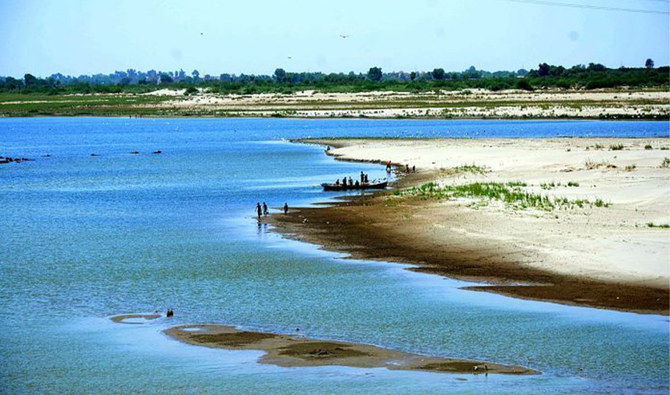
As water disappears, parched southern Pakistan farmers march north
- Indus is a water lifeline for over 200 million Pakistanis
- The delta is receiving less than a third of the water it needs
Latest updates


© 2026 SAUDI RESEARCH & PUBLISHING COMPANY, All Rights Reserved And subject to Terms of Use Agreement.