WASHINGTON: The United States will not waver from its course of maximum pressure against Iran, Vice President Mike Pence said Monday, as tensions rise and the US-brokered nuclear deal between Tehran and world powers appears to be unraveling with the Trump administration’s pullout.
Pence’s assertion to a pro-Israel Christian organization that the US “will never allow Iran to obtain a nuclear weapon” came on the same day that Iran began enriching uranium to 4.5 percent , breaking the limit set in the 2015 agreement sealed under President Barack Obama.
The speech, amplified in later remarks to the group by the Secretary of State Mike Pompeo and national security adviser John Bolton, also comes as the other partners in the agreement must decide how to respond to Iran’s announcement. President Donald Trump discussed the issue by phone Monday with French President Emmanuel Macron.
Echoing comments made repeatedly by Trump, Pence said the international accord simply delayed Iran from obtaining a nuclear weapon by “roughly a decade” and gave away billions in economic relief that Iran could then use to wage terrorist attacks.
Since Trump withdrew from that deal more than a year ago, his administration has reimposed crippling sanctions on Tehran and designated its Revolutionary Guard a foreign terrorist group.
“Iran must choose between caring for its people and continuing to fund its proxies who spread violence and terrorism throughout the region and breathe out murderous hatred against Israel,” Pence said.
Pence said the US’s actions have succeeded in “cutting off” Iran’s ability to support terrorism in the Middle East, but he also charged that Iran had increased its “malign activity and violence in the region” over the past several months.
Tensions in the region have risen in recent weeks after oil tankers were attacked near the Strait of Hormuz and Iran downed an unmanned US military surveillance drone. The downing of the drone nearly led to a US military strike against Iran; it was called off at the last minute by Trump.
Instead, the US military’s cyberforces launched a retaliatory strike against Iranian military computer systems that controlled the country’s rocket and missile launchers.
The US has sent thousands of troops, an aircraft carrier, nuclear-capable B-52 bombers and advanced fighter jets to the Middle East.
“Let me be clear,” Pence said. “Iran should not confuse American restraint with a lack of American resolve.”
Iran has long maintained it was enriching uranium for peaceful reasons. While enriched uranium at the 3.67 percent level is enough for peaceful pursuits, it isn’t close to the weapons-grade levels of 90 percent. At 4.5 percent, the enriched uranium is enough to help power Iran’s Bushehr reactor, the country’s only nuclear power plant.
Iran has been trying to gain European help in bypassing US sanctions, which have targeted oil sales and top officials, including Supreme Leader Ayatollah Ali Khamenei. The remaining signatories to the deal include Britain, France, Germany, China and Russia.
“We hope for the best, but the United States of America and our military are prepared to protect our interests and to protect our personnel and citizens in the region,” Pence said.
Later Monday, Bolton, the White House national security adviser and a longtime advocate of tough measures against Iran, devoted a large portion of his speech at the same summit to Iran, noting that the that the administration has expanded sanctions to cover metals and the petrochemical sector.
“As we pressure the Iranian regime, we will also continue to stand with the long-suffering Iranian people, who as President Trump has said, are the “rightful heirs to a rich culture and an ancient land,” Bolton said.
Secretary of State Mike Pompeo said the US has implemented the “strongest pressure campaign in history against the Iranian regime,” before adding “and we are not done.”


![]()

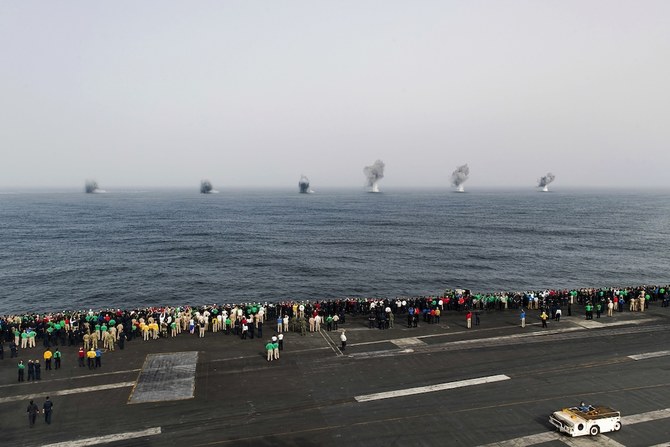
Pence says US action has cut off Iran’s ability to support terrorism
Pence says US action has cut off Iran’s ability to support terrorism
- US Vice President says Iran deal gave away billions in economic relief that Iran could then use to wage terrorist attacks
- Pence says the US’s actions have succeeded in 'cutting off' Iran’s ability to support terrorism in the Middle East


Latest updates


© 2026 SAUDI RESEARCH & PUBLISHING COMPANY, All Rights Reserved And subject to Terms of Use Agreement.