RIYADH: Saudi Arabian budget airline flyadeal will operate an all Airbus A320 fleet in the future, it said in a statement on Sunday, months after it announced it was reconsidering a Boeing order.
The airline is to take delivery from 2021 of 30 A320neo jets that were ordered by its parent, state-owned Saudi Arabian Airlines, at the Paris Air Show in June, it said in the statement.
“This order will result in flyadeal operating an all- Airbus A320 fleet in the future,” it said.
The status of the Boeing order was not immediately clear. Flyadeal and Boeing did not immediately respond to emailed requests for comment.
Flyadeal Chief Executive Con Korfiatis said in April a decision on whether it would proceed with an order for 30 Boeing 737 MAX jets was “imminent.” It was reconsidering the order after two MAX aircraft fatally crashed in Ethiopia in March and Indonesia in October.
The order, which included additional purchasing options for 20 MAX jets, was worth $5.9 billion at list prices, according to Boeing.
The two disasters killed a total of 346 people, triggered the global grounding of the aircraft and wiped billions off Boeing’s market value.
The 737 MAX was grounded worldwide after the second crash and regulators must approve the fix and new pilot training before the jets can fly again.

Saudi airline flyadeal picks Airbus jets over grounded Boeing MAX
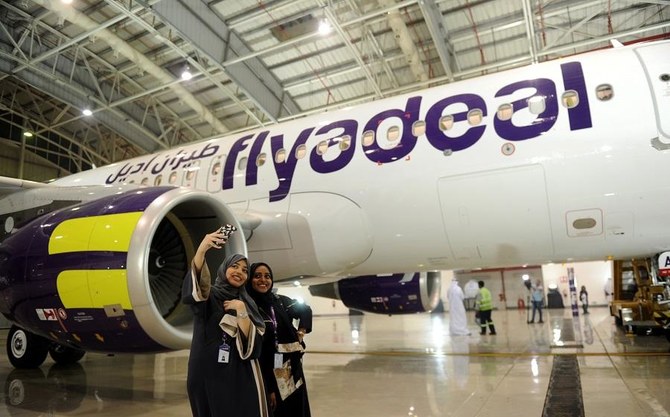
- The airline is to take delivery from 2021 of 30 A320neo jets that were ordered by its parent at the Paris Air Show
- “This order will result in flyadeal operating an all- Airbus A320 fleet in the future,” flyadeal said
Aramco’s 13% rally helps Saudi stocks post second weekly gain
RIYADH: Saudi Aramco extended its year-to-date rally to nearly 13 percent on Thursday, helping the Kingdom’s benchmark stock index secure a second straight weekly gain despite a weaker final trading session.
Saudi Aramco shares, which carry the heaviest weighting on the Saudi Exchange, closed at SR26.86 ($7.16), leaving the stock 12.72 percent higher since the start of 2026. The stock also remained 3.09 percent above last week’s close, even after falling 1.1 percent in Thursday’s session.
The rise in energy shares came as escalating tensions in the Middle East pushed oil prices above $100 a barrel, after attacks on tankers in the Gulf and the Strait of Hormuz heightened concerns over supply disruptions.
The Tadawul All Share Index maintained its weekly uptrend, rising nearly 1.07 percent week on week to close at 10,778.32, despite falling 0.45 percent in Thursday’s session. Compared with the first trading day of the year, the index has gained 4.01 percent.
Total trading turnover on the benchmark index reached SR5.05 billion at Thursday’s close, with 88 stocks advancing and 176 declining.
Aramco’s performance continued to anchor sentiment after the company reported adjusted net income of $104.7 billion for 2025 earlier this week, while net profit fell 12.1 percent year on year to $93.39 billion, compared with $106.25 billion in 2024, as lower crude prices weighed on earnings despite higher sales volumes across oil, gas and refined products.
On a March 10 earnings call, Aramco CEO Amin Nasser warned that prolonged disruption in the Strait of Hormuz could have severe implications for global energy markets. Roughly 20 percent of the world’s oil normally passes through the waterway each day, but shipments have been largely blocked.
“There would be catastrophic consequences for the world’s oil markets and the longer the disruption goes on ... the more drastic the consequences for the global economy,” he said.
“While we have faced disruptions in the past, this one by far is the biggest crisis the region’s oil and gas industry has faced.”
Saudi equities showed mixed performance in Thursday’s session. The MSCI Tadawul Index fell 5.99 points, or 0.40 percent, to close at 1,476.76.
The Kingdom’s parallel market Nomu gained 132.47 points, or 0.6 percent, to close at 22,370.4, with 38 stocks advancing and 34 declining.
On March 11, the International Energy Agency announced the release of 400 million barrels of oil from its reserves, the largest such move in its history. As part of that, the US said it would release 172 million barrels starting next week.


