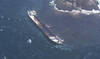
Pakistan Navy warship in Jeddah as part of regional security patrol

Undated photo for Pakistan Naval Ship ‘PNS ASLAT’. ( Courtesy Pakistan Navy )
Updated 08 July 2019
Follow

Pakistan Navy warship in Jeddah as part of regional security patrol

  • Deployment aimed at ensuring maritime security in line with Pakistan's policy and international obligations
  • ASLAT is a front line warship "capable of undertaking wide range of maritime operations in multi-threat environment”

ISLAMABAD: Pakistan Navy Ship ASLAT with an embarked AL-43 helicopter visited the Jeddah Port of Saudi Arabia as part of overseas deployment for Regional Maritime Security Patrols in the Arabian Sea, the Pakistan Navy said in a statement on Saturday.
Deployment of the Pakistani Navy ship is aimed at ensuring maritime security in the region in line with the Pakistan government’s policy and international obligations.
“PNS ASLAT is front line warship of Pakistan Navy Fleet and fourth ship of Sword Class frigate project; built at Karachi Shipyard and Engineering Works,” Pakistan Navy said, adding that “the ship is fitted with state of the art weapons and sensors, capable of undertaking wide range of maritime operations in multi-threat environment.”
Commander Replenishment Group Royal Saudi Naval Forces (RSNF) Western Fleet along with the Joint Operations Center Jeddah welcomed the Pakistani Ship at Jeddah port.
Commanding Officer ASLAT, Captain Shafiq Ur Rehman, met with Saudi Navy officials and highlighted that the visit was a part of a multifaceted long-term collaboration between the two navies. 
“Pakistan and Kingdom of Saudi Arabia are tied in eternal bonds of religion and brotherhood,” the Pakistan Navy statement said. “The visit by ASLAT will further enhance Pakistan Navy’s bilateral relations with Royal Saudi Naval Forces in diverse avenues.” 
Last month, on June 29, three Saudi naval officers were among 175 graduates of the Pakistan naval academy’s 111th course commissioning parade in Karachi, where the commander of the Royal Saudi Naval Forces, Vice Admiral Fahad Bin Abdullah Al-Ghofaily, was the chief guest.
While addressing the graduating officers, Al-Ghofaily highlighted the close collaboration between the armed forces of Pakistan and Saudi Arabia, and said there was a common desire in both nations for regional peace and stability.


Pakistan reports current account surplus in Jan. owing to improved trade, remittances

Updated 17 February 2026
Follow

Pakistan reports current account surplus in Jan. owing to improved trade, remittances

  • Pakistan’s exports crossed the $3 billion mark in Jan. as the country received $3.5 billion in remittances
  • Last month, IMF urged Pakistan to accelerate pace of structural reforms to strengthen economic growth

ISLAMABAD: Pakistan recorded a current account surplus of more than $120 million in January, the country’s finance adviser said on Tuesday, attributing it to improved trade balance and remittance inflows.

Pakistan’s exports rebounded in January 2026 after five months of weak performance, rising 3.73 percent year on year and surging 34.96 percent month on month, according to data released by the country’s statistics bureau.

Exports crossed the $3 billion mark for the first time in January to reach $3.061 billion, compared to $2.27 billion in Dec. 2025. The country received $3.5 billion in foreign remittances in Jan. 2026.

Khurram Schehzad, an adviser to the finance minister, said Pakistan reported a current account surplus of $121 million in Jan., compared to a current account deficit of $393 million in the same month last year.

“Improved trade balance in January 2026, strong remittance inflows, and sustained momentum in services exports (IT/Tech) continue to reinforce the country’s external account position,” he said on X.

Pakistan has undergone a difficult period of stabilization, marked by inflation, currency depreciation and financing gaps, and international rating agencies have acknowledged improvements after Islamabad began implementing reforms such as privatizing loss-making, state-owned enterprises (SOEs) and ending subsidies as part of a $7 billion International Monetary Fund (IMF) loan program.

Late last month, the IMF urged Pakistan to accelerate the pace of these structural reforms to strengthen economic growth.

Responding to questions from Arab News at a virtual media roundtable on emerging markets’ resilience, IMF’s director of the Middle East and Central Asia Jihad Azour said Islamabad’s implementation of the IMF requirements had been “strong” despite devastating floods that killed more than 1,000 people and devastated farmland, forcing the government to revise its 4.2 percent growth target to 3.9 percent.

“What is important going forward in order to strengthen growth and to maintain the level of macroeconomic stability is to accelerate the structural reforms,” he said at the meeting.

Azour underlined Pakistan’s plans to privatize some of the SOEs and improve financial management of important public entities, particularly power companies, as an important way for the country to boost its capacity to cater to the economy for additional exports.

“This comes in addition to the effort that the authorities have made in order to reform their tariffs, which will allow the private sector of Pakistan to become more competitive,” the IMF official said.