

Pakistan army sets up special assistance cell on missing persons

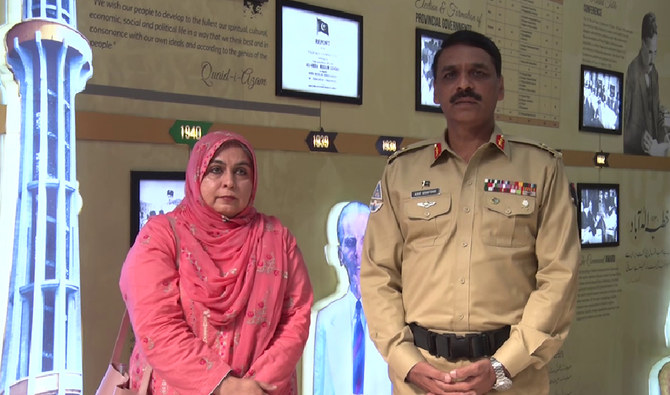
Amina Masood Janjua, chairperson of the Defence of Human Rights in Pakistan, an independent organisation working for the release of illegally detained citizens, pictured with army spokesman Maj Gen Asif Ghafoor in Rawalpindi on July 5, 2019. (Screen grab from video released by Pakistan army's media wing)
Updated 06 July 2019
Follow

Pakistan army sets up special assistance cell on missing persons

  • Amina Janjua, longtime campaigner for families of disappeared people, meets army spokesman, reposes “full confidence” in the state
  • Gen Ghafoor says judicial commission “working day and night” to resolve all cases

ISLAMABAD: A special assistance cell has been established at the Pakistan army’s headquarters to resolve cases of missing persons, the military said on Friday after the head of its media wing met with Amina Janjua, an activist for the families of the missing whose own husband was detained over 10 years ago.
Cases of missing persons, for years a divisive issue in Pakistan, have come into the limelight in recent months due to the Pashtun Tahaffuz Movement (PTM), a vast civil rights movement campaigning for the rights of the country’s ethnic Pashtuns and against alleged extrajudicial killings, arbitrary detention and “disappearances” of young Pashtun men. The PTM has compiled a list of approximately 1,200 missing persons. Amnesty International said last year that a UN working group on enforced disappearances had 700 pending cases from Pakistan. 
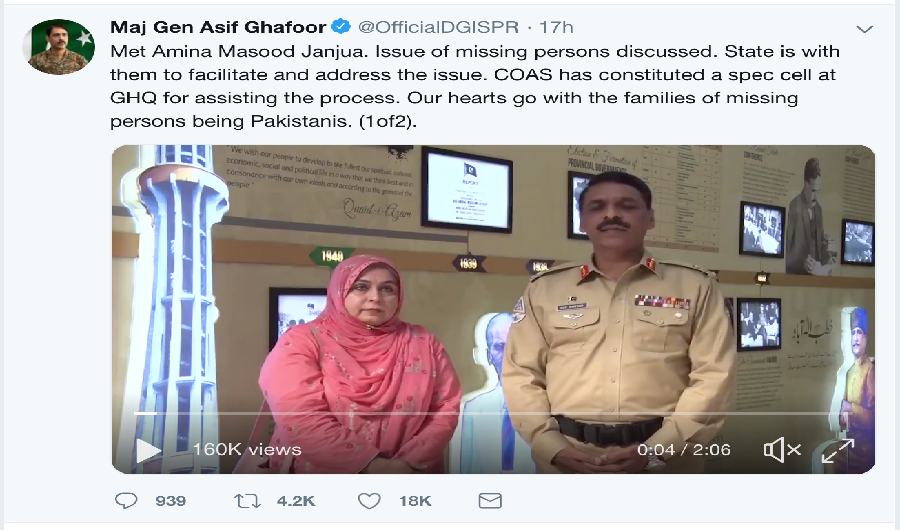
“Met Amina Masood Janjua. Issue of missing persons discussed,” army spokesman Maj Gen Asif Ghafoor said in a Twitter post. “State is with them to facilitate and address the issue. COAS [chief of army staff] has constituted a spec cell at GHQ [general headquarters] for assisting the process. Our hearts go with the families of missing persons.”

Janjua, the chairperson of the Defense of Human Rights, has been fighting for years, along with human rights lawyers and relatives of hundreds of missing prisoners, to get information about people allegedly detained by Pakistan’s security agencies. Some of the disappeared have links to radical mosques and militant outfits. Others went missing from jail. Most have not appeared in court charged with a crime, while some were acquitted but seized after they were freed.
The Pakistan army has for long said many of the missing persons have joined Taliban militants fighting against the Pakistani state. Security agencies also complain that Pakistan’s criminal courts, which have an overall conviction rate of between five and ten percent, simply release militant suspects. Police investigations are notoriously poor and judges are subject to intimidation.
“Not every person missing is attributable to state,” Ghafoor said on Friday. “Many are there as part of TTP in Afghanistan/ elsewhere or got killed fighting as part of TTP. Those with state are under legal process.”
He said a judicial commission was “working day and night” to resolve the issue of missing persons. 
According to a statement released by the military press wing, Janjua acknowledged the efforts of the state and security forces in resolving the cases of missing persons and reiterated that affected families would not allow any anti-state force to exploit them. She also reposed “full confidence” in the state.


Pakistan says $50 million meat export deal with Tajikistan nearing finalization

Updated 09 December 2025
Follow

Pakistan says $50 million meat export deal with Tajikistan nearing finalization

  • Islamabad expects to finalize agreement soon after Dushanbe signals demand for 100,000 tons
  • Pakistan is seeking to expand agricultural trade beyond rice, citrus and mango exports

ISLAMABAD: Tajikistan has expressed interest in importing 100,000 tons of Pakistani meat worth more than $50 million, with both governments expected to finalize a supply agreement soon, Pakistan’s food security ministry said on Tuesday.

Pakistan is trying to grow agriculture-based exports as it seeks regional markets for livestock and food commodities, while Tajikistan, a landlocked Central Asian state, has been expanding food imports to support domestic demand. Pakistan currently exports rice, citrus and mangoes to Dushanbe, though volumes remain small compared to national production, according to official figures.

The development came during a meeting in Islamabad between Pakistan’s Federal Minister for National Food Security and Research Rana Tanveer Hussain and Ambassador of Tajikistan Yusuf Sharifzoda, where agricultural trade, livestock supply and food-security cooperation were discussed.

“Tajikistan intends to purchase 100,000 tons of meat from Pakistan, an import valued at over USD 50 million,” the ambassador said, according to the ministry’s statement, assuring full facilitation and that Islamabad was prepared to meet the demand.

The statement said the two sides agreed to expand cooperation in meat and livestock, fresh fruit, vegetables, staple crops, agricultural research, pest management and standards compliance. Pakistan also proposed strengthening coordination on phytosanitary rules and establishing pest-free production zones to support long-term exports.

Pakistan and Tajikistan have long maintained political ties but bilateral food trade remains below potential: Pakistan produces 1.8 million tons of mangoes annually but exported just 0.7 metric tons to Tajikistan in 2024, while rice exports amounted to only 240 metric tons in 2022 out of national output of 9.3 million tons. Pakistan imports mainly ginned cotton from Tajikistan.
