TOKYO: An Australian student on Friday thanked Swedish and his country’s diplomats for securing his release in North Korea but kept mum about what led to his weeklong detention.
“I intend now to return to normal life but wanted to first publicly thank everyone who worked to ensure I was safe and well,” Alek Sigley said in a statement released by his family’s spokeswoman in Australia, a day after he was flew from Pyongyang to Beijing and then Tokyo to be reunited with his Japanese wife.
He asked media to respect his privacy and said he has no plans to hold a news conference.
Sigley, 29, had been studying at a Pyongyang university and guiding tours in the North Korean capital before disappearing from social media contact with family and friends on June 25. He had posted about his experiences in North Korea and boasted about the extraordinary freedom he had as one of the few foreign students living there.
“I just want everyone to know I am OK, and to thank them for their concern for my wellbeing and their support for my family over the past week. I’m very happy to be back with my wife, Yuka, and to have spoken with my family in Perth (Australia) to reassure them I’m well,” he said in the statement.
He specifically thanked Sweden’s special envoy to North Korea, Kent Rolf Magnus Harstedt, Australian Prime Minister Scott Morrison and Foreign Affairs Minister Marise Payne for his release.
Swedish diplomats had raised concerns about Sigley with North Korean authorities in Pyongyang, where Australia does not have an embassy.
“This outcome demonstrates the value of discrete behind-the-scenes work of officials in resolving complex and sensitive consular cases in close partnership with other governments,” Morrison said in Parliament Thursday.
In an interview with Swedish public radio, Swedish Foreign Minister Margot Wallstrom said that Harstedt “raised the issue of this case at highest level” in North Korea and the release happened during his visit there.
Sigley’s father, Gary Sigley, a professor of Asian studies at the University of Western Australia, said Thursday that his son had been treated well in North Korea.
It was a much happier outcome than the case of American college student Otto Warmbier, who was convicted of attempting to steal a propaganda poster and imprisoned in North Korea. Warmbier died shortly after being sent back home to the US in a vegetative state in June 2017.
“We should be very fortunate, I think, looking at this, because it could have ended up very differently so a good outcome in the end,” Australian Minister for Home Affairs Peter Dutton said Friday.
He also had some word of advice for Sigley and other Australians who were thinking of visiting North Korea.
“My advice would be pretty clear. I’d stay in Japan, I’d go back to South Korea, I’d come back to Australia. All of those would have to be better options before he returns to North Korea and we’ve got advisories out to that effect, warning people,” he said. “So there needs to be an application of common sense here and I don’t think he’d put himself back in that situation.”


![]()

Australian freed in North Korea keeps mum about detention
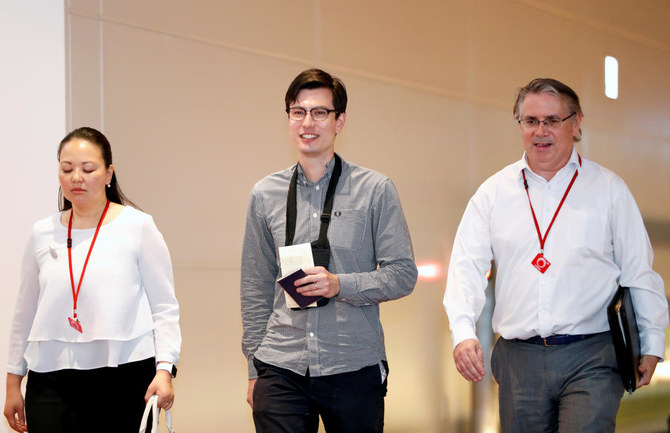
Australian freed in North Korea keeps mum about detention
- Alek Sigley had been studying at a Pyongyang university and guiding tours in Pyongyang before disappearing from social media contact
- He had boasted about the extraordinary freedom he had as one of the few foreign students living there


Latest updates


© 2026 SAUDI RESEARCH & PUBLISHING COMPANY, All Rights Reserved And subject to Terms of Use Agreement.