PARIS: The UN's special envoy on migration in the Mediterranean, Vincent Cochetel, has accused the EU of "blindness" on the plight of refugees and migrants in Libya and called for a rethink of the policy of returning migrants intercepted at sea to the war-torn country after Tuesday night's airstrike on a migrant detention center outside Tripoli claimed 44 lives.
This is a tragic event which could have been avoided (as) we had passed on to all parties the GPS coordinates of all the detention camps.
This detention center is a former military camp. It is totally inappropriate to place people there in arbitrary detention.
We knew there was this risk of attacks one day with the risk of collateral damage, intentional or unintentional, so we had called for the closure of the center but nobody listened to us.
There is a certain blindness among European countries about the situation of migrants in Libya, which has been deteriorating for months. The recent fighting has created an even worse situation. It cannot be business as usual in terms of this cooperation on returns to Libya.
We have been repeatedly saying that people should not be returned to Libya because people disappear between the points of disembarkation and the detention centers. Some people are taken to the detention centers where they are mistreated and held arbitrarily while others end up being rented out or sold to business people.
Because it has become harder to smuggle people out of Libya by boat since the middle of last summer traffickers are trying to make a return on their 'investment' in other ways. We've received accounts from migrants who've said their families at home had been held to ransom three times to get them out of detention centers.
And now migrants and refugees can also die in these centers because they have become hostages of a political and military situation over which they have no control.
On my last visit I found cases of severe adult malnutrition. You see people who are just skin and bone, like in the camps in Bosnia or under the Khmer Rouge. The Libyan authorities say they don't have the money to feed people in detention centers -- the humanitarian people say 'it's not our responsibility because the people are held arbitrarily and we shouldn't encourage this system by feeding people'. They're both talking at cross-purposes.
We're seeing a bit of food arriving in the centers. There are two scenarios: either business people who come looking for free labour in the detention centers bring a bit of food that the detainees can prepare in return, or there are centers where people say that they have to pay for food.
In the detention centers run by the authorities, or by the NLA (the National Liberation Army of General Khalifa Haftar) in the east, there are cases of mistreatment, of beatings and injuries.
Sometimes it's a punishment, other times it's to extort money. Sometimes it's not the guards themselves who carry out acts of violence or torture: they ask detainees to carry out abuses on other detainees, namely in the case of sexual torture. The aim is to humiliate people, subjugate them, create a sense of powerlessness and impose discipline.
The worst forms of torture are carried out in the secret detention centers. The people who escaped from Bani Walid, a hub for migrants trying to reach the coast, told us of the existence of around 10 hangars where people were being held -- around 500 people per hangar, so about 5,000 altogether. There is a local religious association whom the traffickers ask to remove the bodies. There are about five bodies a week, according to recent accounts. It's appalling.
The EU's new leadership team must renew pressure on Libyan authorities and all the parties to the conflict to come up with an alternative to this system of arbitrary detention. We can help the Libyan authorities manage an alternative system of controls which does not amount to arbitrary detention.
We need a very visible and quick disembarkation system for people rescued at sea and for people to be held responsible for the way they are treated. Once the migrants are disembarked those who do not need international protection should be immediately sent back to their country of origin, with the requisite support. For those who do need international protection, there needs to be a more effective distribution mechanism than the boat-by-boat approach currently taken by the EU.
I understand that Italy, France and others have undertaken efforts to boost the capacity of the Libyan coastguard, but it has to be done through certain precise norms, including verifying how the resources are used and how the coastguard behave, etc. Most Libyan coastguard members are sailors who do a good job but there are a certain number of criminal elements involved in the process, who are acting with total impunity.
I understand Europe's strategic interests but we have to move beyond that. Have the conflicts which are spurring people to travel to Libya been resolved? There are currently 19 conflicts on the African continent. We're seeing the situation in Burkina Faso and Mali deteriorate and Sudan is completely unstable. We have these really big crises unfolding all around Libya which are creating movements of people. We have to tackle the issues upstream.


![]()

UN envoy on migrants criticizes ‘blindness’ of EU on Libya
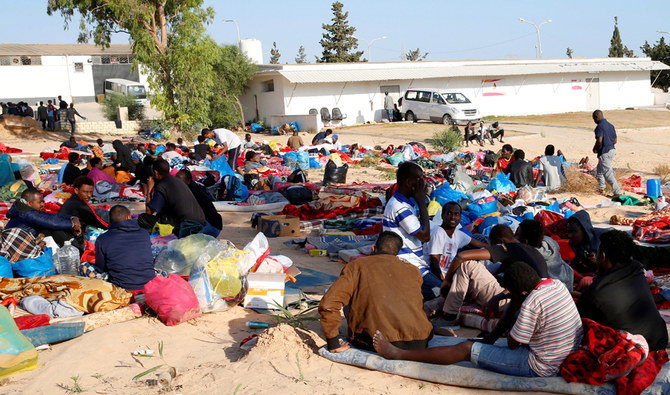
UN envoy on migrants criticizes ‘blindness’ of EU on Libya
- This detention center is a former military camp
- The worst forms of torture are carried out in the secret detention centers


Latest updates





© 2026 SAUDI RESEARCH & PUBLISHING COMPANY, All Rights Reserved And subject to Terms of Use Agreement.