Pakistan’s street cricketers bring game to life in Greece

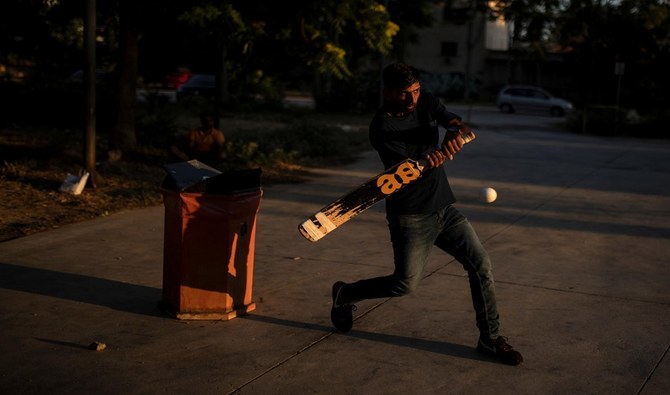
A Pakistani man living in Greece is ready to bat a ball during a tape-ball cricket game in a parking lot in the Tavros neighbourhood in Athens, Greece. Photo taken on June 29, 2019. Picture taken June 29, 2019. (REUTERS)
Updated 04 July 2019
Follow

Pakistan’s street cricketers bring game to life in Greece

  • With the Cricket World Cup under way, migrants from Pakistan compete in local tape-ball tournaments
  • About 50,000 Pakistanis live in Greece, many of them as laborers in fields or factories

ATHENS: In a barren Athens parking lot, young Pakistanis get in position for a game of cricket. On one end of the dust-covered concrete is a trash can; on the other, a pile of rocks. That is their pitch, and those are its wickets.
In football-loving Greece, cricket is an alien concept. But for its migrants from Pakistan, one of the world’s most cricket-crazy nations, it is a way of life.
On Sundays, a growing community of street cricketers travels across the capital to the unlikeliest locations, from car parks to abandoned industrial grounds, engaging in tape-ball cricket — an informal version of the game invented in Pakistan, played using a tennis ball wrapped in electrical tape.
With the Cricket World Cup under way, they compete in local tape-ball tournaments, and homes and restaurants are abuzz with fans.
“I love cricket. I’m crazy for cricket. I’m 30 years old and I’m playing for 20 years,” said Awais Mughal, a delivery worker who arrived in Greece a decade ago.
Dressed in the green jersey of his Athens team, Mughal and more than a dozen of his countrymen gathered in his apartment on a sweltering Sunday morning to watch Pakistan defeat South Africa over bottles of chilled water and soft drinks.
“In my country, whenever I go, I play all day,” Mughal said. “In Greece we play only on Sundays because we work six days a week.”
About 50,000 Pakistanis live in Greece, the embassy estimates, many of them laborers in fields or factories. Others own shops or restaurants.
“Cricket is in the genes of the people from the subcontinent,” said Yawar Abbas, the embassy’s charges d’affaires in Athens.
In Greece, the sole cricket ground is on Corfu, dating from the days when the Ionian islands were under British rule in the 19th century.
In Athens, where most migrants live, they resort to playing informally without proper gear.
“Many people play cricket here but we have no grounds in Athens,” said Mehdi Khan Choudhry, a Pakistani former player in Greece’s national cricket team who has been living in Greece since 1993.
His home is adorned with trophies won over the years. A photograph shows him posing with a large Pakistani flag during a cricket match at the 2004 Athens Olympics.
Choudhry, a mechanical engineer and cricket coach, has long campaigned for a ground in Athens and wants to open a cricket academy.
Beyond the enjoyment the sport brings, he said, it helps forge camaraderie with migrants from other cricket-playing nations including Afghanistan, Bangladesh and even India, Pakistan’s archrival on and off the pitch.
“When we stay and play together, you know there is good relations.”


Pakistan finance minister highlights economic stability, improving debt outlook at AlUla Conference

Updated 6 sec ago
Follow

Pakistan finance minister highlights economic stability, improving debt outlook at AlUla Conference

  • Global public debt remains at historic highs, exerting pressure on emerging countries, says Pakistani finance minister
  • Muhammad Aurangzeb says Pakistan’s debt-to-GDP ratio has declined to 70 percent from 74 percent over three years

ISLAMABAD: Pakistan’s Finance Minister Muhammad Aurangzeb highlighted the country’s improving debt outlook and efforts to restore economic stability at the AlUla Conference for Emerging Market Economies on Monday, calling for enhanced global coordination to address sovereign debt vulnerabilities. 

The second edition of the annual AlUla conference was launched by the Saudi Arabia’s Ministry of Finance and the International Monetary Fund (IMF) on Sunday. The conference brings together economic decision-makers, finance ministers, central bank governors, leaders of international financial institutions and a select group of experts and specialists from around the world.

This year’s conference highlights the rapid transformations in the global economy and challenges and the opportunities they present for emerging market economies, particularly in international trade, monetary and financial systems. 

Speaking at a roundtable titled: ‘Addressing Sovereign Debt Vulnerabilities,’ Aurangzeb noted that global public debt remains at historic highs, exerting pressure on emerging and developing economies through higher debt servicing costs, tighter financing conditions and constrained fiscal space, the Finance Division said. 

“The finance minister highlighted that Pakistan has made initial but meaningful progress in restoring stability through disciplined macroeconomic policies, institutional reforms, and proactive debt management, while acknowledging that the reform journey remains ongoing,” the Finance Division said. 

The minister said Pakistan remains on track to contain and better manage public debt, extending maturities, reducing costs and undertaking early debt repayments. Aurangzeb noted that these efforts have contributed to a decline in the debt-to-GDP ratio to around 70 percent from about 74 percent over the past three years.

Aurnagzeb also spoke about Pakistan’s progress in domestic resource mobilization, noting that Islamabad has raised its tax-to-GDP ratio, adding that it is now moving to the figure of 12 percent from single-digit levels in earlier years. The minister cited by tax reforms, digitization and base-broadening measures as reasons for the improvement.

“Concluding his remarks, the finance minister stressed that addressing sovereign debt vulnerabilities requires early action, strong institutions, transparency, and credible policy frameworks, supported by enhanced global coordination,” the statement said. 

“Strengthening creditor cooperation, expanding the effective use of liability management operations, and integrating climate resilience into debt frameworks, he noted, will be essential to help emerging economies manage debt sustainably while preserving growth and development priorities.”

Pakistan has recently undertaken reforms mandated by the IMF under its $7 billion loan program to strengthen its fragile economy. While the IMF has acknowledged progress on Islamabad’s part, it has also cautioned that the country’s recovery remains fragile and warned that high public debt, fiscal pressures and exposure to external shocks continue to pose risks to long-term stability.

Pakistan faced a prolonged economic crisis in recent years, marked by fiscal pressure, high debt levels and balance-of-payments difficulties, and subsequently entered an IMF-supported program to stabilize the economy.

Pakistani officials say decreasing levels of inflation and higher foreign exchange reserves reflect the government’s prudent fiscal policies and debt management.