Three French women arrested in Turkey for Daesh links

Three French citizens suspected of belonging to Daesh were detained along with nine children as they tried to enter Turkey from Syria. (File/AFP)
Updated 04 July 2019
Follow

Three French women arrested in Turkey for Daesh links

  • In the first years after the Syrian conflict began in 2011, Turkey was the main point of entry for foreign fighters seeking to join extremist groups
  • Turkish authorities stopped the three women sought by Interpol in the border province of Kilis

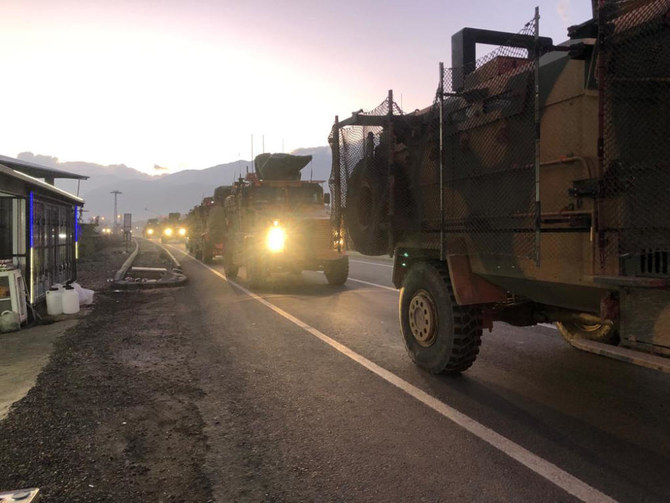
ANKARA: Three French citizens suspected of belonging to Daesh were detained along with nine children as they tried to enter Turkey from Syria, Turkish media reported Thursday.
Turkish authorities stopped the three women, sought by Interpol and identified by their initials JC, CA and MD, in the border province of Kilis, according to state news agency Anadolu.
A security source told AFP that JC referred to Jennifer Clain, niece of the brothers Fabien and Jean-Michel Clain, who claimed responsibility on behalf of Daesh for the attacks that hit the Bataclan nightclub and other Paris locations in November 2015.
She is also married to Kevin Gonot, a French citizen sentenced to death in Iraq last May for his role in Daesh.
Anadolu said 12 people had been arrested and were being transferred to immigration authorities awaiting their expulsion from Turkey.
In the first years after the Syrian conflict began in 2011, Turkey was the main point of entry for foreign fighters seeking to join extremist groups.
Accused of turning a blind eye to the problem, Ankara later tightened border controls and began widespread arrests and extraditions, especially after a spate of devastating extremist attacks in Turkey.


Analysis: The perils of ‘Sudanizing’ Yemen

Updated 14 sec ago
Follow

Analysis: The perils of ‘Sudanizing’ Yemen

  • Allowing one faction to impose its will by force and foreign backing is viewed by political observers as a recipe for disaster
  • Escalating developments in southern Yemen are raising regional concerns despite continued international calls for de-escalation

RIYADH: In a region already teetering on the edge, Yemen’s rapidly evolving situation on the ground is raising alarm bells. While international observers continue to place their bets on diplomacy and de-escalation, there is growing concern that the country may be inching toward a dangerous regional conflagration. At the heart of this anxiety lies the Yemeni government’s and the Coalition to Restore Legitimacy in Yemen’s unwavering commitment to preserving territorial unity and preventing the rise of extremist safe havens that could destabilize not just Yemen, but the broader region and beyond.

It would be naive to view developments in southern Yemen in isolation. The parallels with Sudan — where the Rapid Support Forces have left a trail of devastation and a massacre in places like El Fasher — and with the recent Israeli recognition of Somaliland, are too stark to ignore. These cases serve as cautionary tales of what could unfold in Yemen if the Southern Transitional Council were allowed to unilaterally impose a new reality through force and foreign alliances.

Saudi Arabia’s Foreign Ministry has struck a delicate but firm tone, drawing a clear red line when it comes to its own national security but acknowledging the just and historically rooted nature of the southern issue. Yet, it has also made clear that any resolution must emerge from consensus among Yemen’s diverse components — around the negotiating table, not on the battlefield. A military solution would only unravel years of painstaking efforts by the coalition and the internationally recognized Yemeni government to foster calm, even engaging with the Houthis in pursuit of a durable peace.

A Yemeni analyst familiar with the inner workings of the legitimate government noted that while southerners have a right to advocate for independence based on their historical and geographic claims, this cannot come at the expense of other Yemenis who believe in, and have arguments for, a united nation. Their voices, too, deserve to be heard.

“Historically, Yemen has been a unified and federated entity, from the Qasimid and Himyarite dynasties to the Rasulid state. The division of Yemen was not indigenous but imposed by colonial powers — most notably the British in the south, who ruled through a patchwork of emirates and sultanates, while the Ottomans held sway in the north. Even the city of Dhale was once under the rule of the imams. This artificial division persisted until 1990, when Yemen was reunited into its natural state,” he told Arab News.

To allow any group to redraw borders through armed force and foreign patronage is to invite catastrophe. It is worth recalling that these were precisely the conditions that sparked the last war, when the Houthis — backed by external actors — toppled the legitimate, UN-recognized government.

The analyst posed a sobering question: “If the STC is granted the right to establish a new state in the Arabian Peninsula under the banner of self-determination, what then of the Iran-aligned Houthis? They command a sizable following and control the historic capital. Should they too be allowed to dictate terms through force?”

He also asked: “Would the international community — and the US in particular — accept the emergence of a Houthi-Iranian state in northern Yemen? Would Washington tolerate a repeat of Sudan’s fragmentation before that tragedy is even resolved? And is the world prepared to bear the consequences of a prolonged war that threatens global shipping lanes, energy supplies, and regional stability — especially given the strategic importance of the Bab Al-Mandab Strait and the Red and Arabian seas?”

Recent history offers a grim verdict: Uncoordinated secessions without broad domestic consensus or clear international legal frameworks rarely yield stable states. Instead, they unleash prolonged chaos, institutional collapse, and open the door to armed groups and foreign meddling. Sovereignty becomes a mirage, replaced by a vacuum that breeds perpetual conflict.

In Yemen, the stakes are even higher. The country sits astride one of the world’s most vital maritime chokepoints, through which a significant share of global trade and Europe-bound energy supplies pass. Any security vacuum in southern Yemen would expose this artery to repeated shocks.

Moreover, such a vacuum would be a magnet for militant groups — whether terrorist networks or regional proxies — creating a new axis of instability stretching into the Gulf and threatening the security of maritime corridors. The STC, in this context, appears to be leaping into a void. It is not the sole representative of the south; other actors such as the Hadramout Alliance, the Southern Movement, and the Southern Coalition also hold sway. Many southern elites remain committed to a federal Yemen, as envisioned in the outcomes of the National Dialogue Conference — the only viable blueprint for a united yet decentralized state.

In short, the path forward must be paved with dialogue, not division. The alternative is not independence — it is implosion.