

Britain seizes Iranian oil tanker in Gibraltar over Syria sanctions

1 / 3
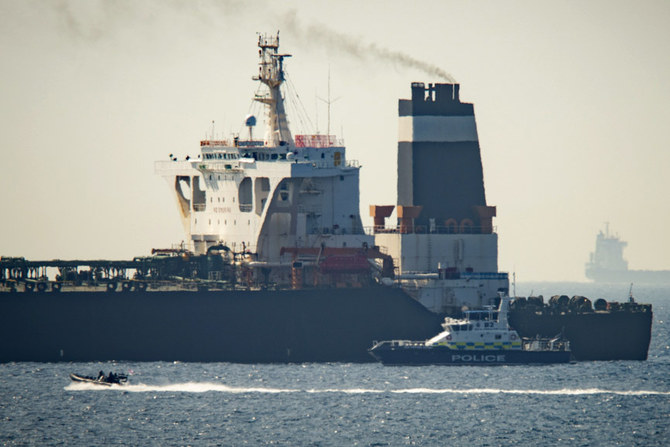
A view of the Grace 1 super tanker near a Royal Marine patrol vessel in the British territory of Gibraltar, Thursday, July 4, 2019. (AP)
2 / 3
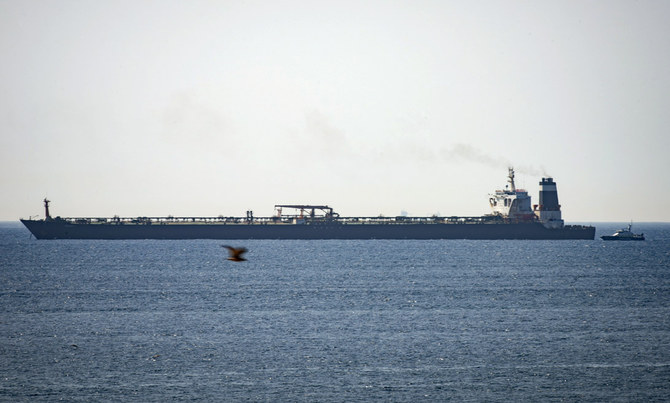
Grace 1 super tanker is anchored near a Royal Marine patrol vessel in the British territory of Gibraltar, Thursday, July 4, 2019. (AP)
3 / 3
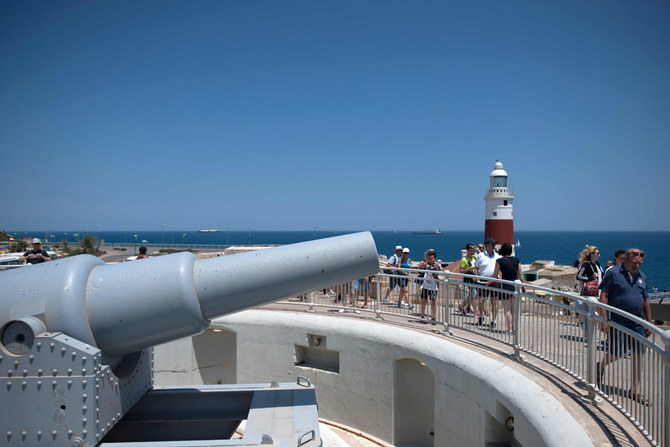
People walk on a seaside promenade as supertanker Grace 1 (rear C) suspected of carrying crude oil to Syria in violation of EU sanctions appears in the background after it was detained off the coast of Gibraltar on July 4, 2019. (AFP / JORGE GUERRERO)
Updated 06 July 2019
Follow

Britain seizes Iranian oil tanker in Gibraltar over Syria sanctions

  • Tehran summons UK envoy to voice ‘its very strong objection to the unacceptable seizure’
  • The Grace 1 vessel was halted in the early hours of Thursday by Gibraltar police and customs agencies

MADRID/LONDON/DUBAI: British Royal Marines seized a giant Iranian oil tanker in Gibraltar on Thursday for trying to take oil to Syria in violation of EU sanctions, a dramatic step that drew Tehran’s fury and could escalate its confrontation with the West.

The Grace 1 tanker was impounded in the British territory on the southern tip of Spain after sailing around Africa, the long route from the Middle East to the mouth of the Mediterranean.

“We have reason to believe that the ‘Grace 1’ was carrying its shipment of crude oil to the Banyas Refinery in Syria,” Picardo said in a statement. “That refinery is the property of an entity that is subject to European Union sanctions against Syria.”

The Grace 1 is a Panamanian-flagged tanker, according to the shipping trade publication Lloyd’s List.

“We have detained the vessel and its cargo,” Picardo said.

Spain's caretaker foreign minister Josep Borrell said the tanker was stopped by British authorities after a request from the United States.

The EU and others have imposed sanctions on Assad's government over its continued crackdown against civilians. They currently target 270 people and 70 entities.


'Unacceptable seizure'

Iran’s Foreign Ministry summoned the British ambassador to voice “its very strong objection to the illegal and unacceptable seizure” of its ship. 

The diplomatic gesture lifted any doubt over Iran’s ownership of the vessel, which flies a Panama flag and is listed as managed by a company in Singapore.

Shipping data reviewed by Reuters suggests the tanker was carrying Iranian oil loaded off the coast of Iran, although its documents say the oil is from neighboring Iraq.

While Europe has banned oil shipments to Syria since 2011, it had never seized a tanker at sea. Unlike the US, Europe does not have broad sanctions against Iran.

The EU has imposed sanctions on 277 Syrian officials including government ministers over their role in the “violent repression” of civilians.

It has frozen the assets of some 72 entities and introduced an embargo on Syrian oil, investment restrictions and a freeze on Syrian central bank assets within the European Union.

“This is the first time that the EU has done something so public and so aggressive. I imagine it was also coordinated in some manner with the US given that NATO member forces have been involved,” said Matthew Oresman, a partner with law firm Pillsbury Winthrop Shaw Pittman who advises firms on sanctions.

“This is likely to have been meant as a signal to Syria and Iran — as well as the US — that Europe takes sanctions enforcement seriously and that the EU can also respond to Iranian brinkmanship related to ongoing nuclear negotiations.”


Caught by its own admission

Authorities in Gibraltar made no reference to the source of the oil or the ownership of the ship when they seized it.

But Iran’s acknowledgment that it owned the ship, and the likelihood that its cargo was also Iranian, drew a link between the incident and a new US effort to halt all global sales of Iranian crude. Iran describes that as an illegal “economic war.”

Iran has long been supplying its allies in Syria with oil despite sanctions against Syria. What is new are US sanctions on Iran itself, imposed last year when President Donald Trump pulled out of an agreement that had guaranteed Tehran access to world trade in return for curbs on its nuclear program.

A spokesman for British Prime Minister Theresa May welcomed Gibraltar’s move.

Spain, which challenges British ownership of Gibraltar, said the action was prompted by a US request to Britain and appeared to have taken place in Spanish waters.

Gibraltar is a British overseas territory, a small rocky outcrop on Spain’s southern tip.


Jordan condemns Israel’s seizure of planning powers at Ibrahimi Mosque

Updated 9 sec ago
Follow

Jordan condemns Israel’s seizure of planning powers at Ibrahimi Mosque

  • Announcement on Wednesday by Israeli Civil Administration said it had transferred planning powers from Palestinian Authority-run Hebron Municipality to its own Supreme Planning Council

AMMAN: Jordan’s Ministry of Foreign and Expatriates Affairs on Friday strongly condemned Israel’s decision to revoke the planning and construction authorities of the Hebron Municipality at the Ibrahimi Mosque, the Jordan News Agency reported.

The ministry described the move as a blatant violation of international law and the historical and legal status quo at the holy site, JNA added.

The condemnation follows an announcement on Wednesday by the Israeli Civil Administration the body overseeing the occupied West Bank, that it had transferred planning powers from the Palestinian Authority-run Hebron Municipality to its own Supreme Planning Council.

The decision was accompanied by approval for a project to construct a roof over the mosque’s internal courtyard, a move that has drawn fierce Palestinian opposition.

The Hebron Municipality also condemned the Israeli decision, describing it as a “serious and illegal violation” and part of a systematic effort to alter the status quo at the mosque and weaken the authority of Palestinian institutions responsible for its management.

In a statement, the Jordanian ministry said Israel, as the occupying power, was acting unlawfully by unilaterally approving construction works at the Ibrahimi Mosque and stripping Palestinian authorities of their administrative powers, warning that the measures undermine the Islamic administration of the site.

The ministry’s official spokesperson, Fouad Al-Majali, affirmed Jordan’s “absolute rejection and severe condemnation” of Israel’s continued illegal unilateral measures in the occupied West Bank, most recently those targeting the Ibrahimi Mosque in Hebron.

Al-Majali added that the actions constituted clear violations of international law and international humanitarian law, including the 1954 Hague Convention for the Protection of Cultural Property in the Event of Armed Conflict, as well as relevant United Nations resolutions.

He also pointed to UNESCO’s 2017 decision to inscribe Hebron’s Old City and the Ibrahimi Mosque on the List of World Heritage in Danger.

He called on the international community to shoulder its “legal and moral responsibilities” by compelling Israel to halt its illegal measures in the occupied Palestinian territory, protect the cultural and religious heritage of the Ibrahimi Mosque, and preserve its outstanding universal value, which he said is under increasing threat due to Israeli actions.

Al-Majali further emphasized that achieving security and a just and comprehensive peace would remain impossible without fulfilling the legitimate rights of the Palestinian people to self-determination, including the establishment of an independent, sovereign Palestinian state on 1967 lines, with East Jerusalem as its capital.