ISLAMABAD: The United States on Tuesday declared Pakistan’s separatist group, the Balochistan Liberation Army (BLA), as a terror outfit, accusing it of “targetting Chinese engineers in Balochistan” and Gwadar terrorist attack.
“BLA has carried out several terrorist attacks in the past year, including a suicide attack in August 2018 that targeted Chinese engineers in Balochistan, a November 2018 attack on the Chinese consulate in Karachi, and a May 2019 attack against a luxury hotel in Gwadar, Balochistan,” a statement released by the US State Department on Tuesday read.
Reacting to the development, Pakistan’s Foreign Office (FO) said on Tuesday: “We have taken note of the designation by the US Administration of the Balochistan Liberation Army (BLA) as Specially Designated Global Terrorist (SDGT).”
The statement by the FO added that the BLA remains a proscribed entity in Pakistan since 2006 and in recent times has carried out several terrorist attacks in the country.
“It is hoped that this designation will ensure that the BLA’s space to operate is minimized,” the statement said, adding that it is important for the perpetrators, organizers, financers and external sponsors, including those glorifying these acts of terror against Pakistan, to be held accountable and brought to justice.

US designates Pakistan’s Baloch separatist outfit a terrorist group
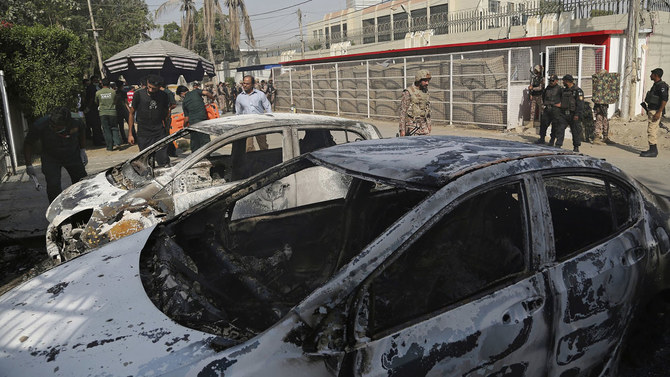
- BLA has been banned in Pakistan since 2006
- New listing will put sanctions on the funding and movement of BLA members
Pakistan urges developed nations, global institutions to expand role in climate financing
- Pakistan is recognized among countries worldwide most affected by climate-induced disasters
- Planning minister stresses redesigning global financial system on principles of responsibility, equity
ISLAMABAD: Pakistan’s Planning Minister Ahsan Iqbal this week called on developed nations and international financial institutions to play a greater role in helping developing countries adopt green technologies at lower costs, state-run media reported.
Pakistan has suffered frequent climate change-induced disasters over the past couple of years, ranging from floods, droughts, heatwaves, cyclones and other irregular weather patterns.
This year the South Asian country reported over 1,000 deaths from floods and landslides triggered by heavy rains and the melting of glaciers.
“He [Iqbal] said Pakistan has urged developed countries and international financial institutions to expand their role in climate financing to enable developing nations to adopt green technologies at lower costs,” state-run Associated Press of Pakistan (APP) reported on Saturday.
The minister was speaking at the Second Asia Energy Transition Summit held at Pakistani university LUMS on Saturday.
Iqbal warned that climate change is intensifying emergencies and increasing economic burdens on vulnerable countries, adding that financial incentives and concessional financing have become indispensable for sustainable climate action.
“He further emphasized the need to redesign the global financial system based on the principles of collective responsibility and equity,” APP said.
The minister noted that Pakistan has been introducing comprehensive reforms in its development agenda to promote renewable energy, solar power and green technological solutions.
The country, he said, possesses “strong solar potential,” a robust renewable energy market, a wide talent pool in engineering and science and an enabling environment for green innovation.
Pakistan has regularly urged developed countries to fulfill past pledges and provide easy access to climate funding without attaching conditions, especially at Conference of Parties (COP30) climate summits.
Islamabad was instrumental in getting the Fund for Responding to Loss and Damage (FRLD) established at the COP27 climate summit in Egypt in 2022. The Loss and Damage Fund aims to help developing and least developed countries cope with both economic and non-economic impacts of climate change, such as extreme weather events and slow-onset crises like sea-level rise and droughts.


