France returns looted relics to Pakistan

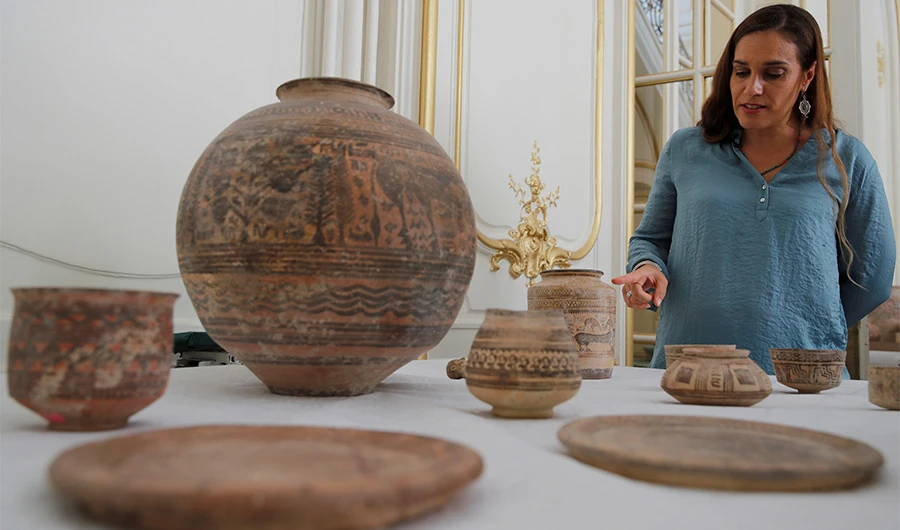
Archaeologist Aurore Didier points to some artifacts amongst the 445 from the 2nd and 3rd millennium BC which were seized by French customs between 2006 and 2007, during a ceremony at the Embassy of Pakistan in Paris (Reuters)
Updated 03 July 2019
Follow

France returns looted relics to Pakistan

  • Some relics dating as far back as 4,000 BC, with an estimated value of $157,000
  • 445 objects would be shipped back to Pakistan “within a few weeks”

Paris: France on Tuesday handed over to Pakistan nearly 450 ancient relics, some dating as far back as 4,000 BC, seized by French customs agents over a decade ago.
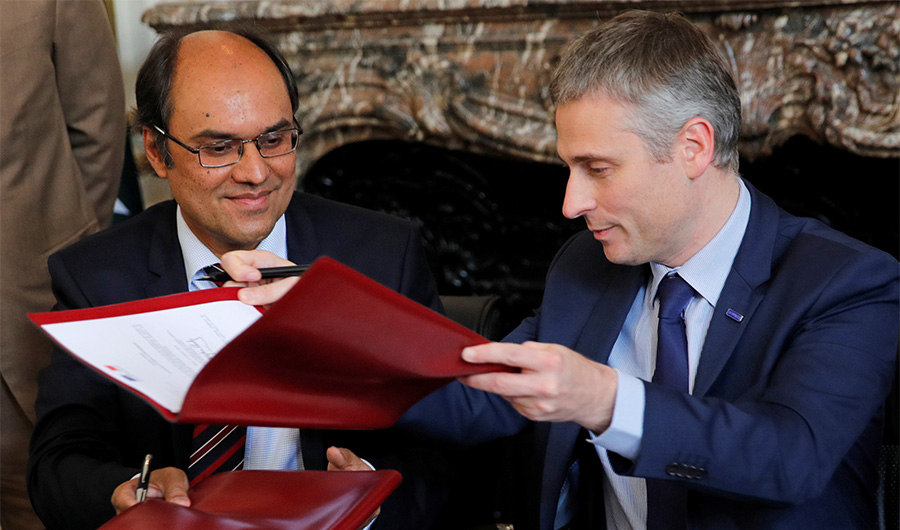


Rodolphe Gintz, head of French customs, and Muhammad Amjad Aziz Qazi, Deputy Head of Mission at the Embassy of Pakistan in Paris, sign official documents during a ceremony at the Embassy in Paris (Reuters)

Customs agents at Paris’ Charles de Gaulle airport in 2006 intercepted a parcel from Pakistan containing 17 terracotta pots addressed to a museum in the city, claiming they were more than 100 years old.
But an expert who examined them concluded they were artefacts dating back to the second or third millennium BC which had likely been stolen from burial sites in Baluchistan, a province in southwest Pakistan.
Following an extensive investigation which lasted almost a year and involved a raid on the Paris gallery, investigators found a total of 445 items, some dating as far back as 4,000 BC, with an estimated value of 139,000 euros ($157,000).
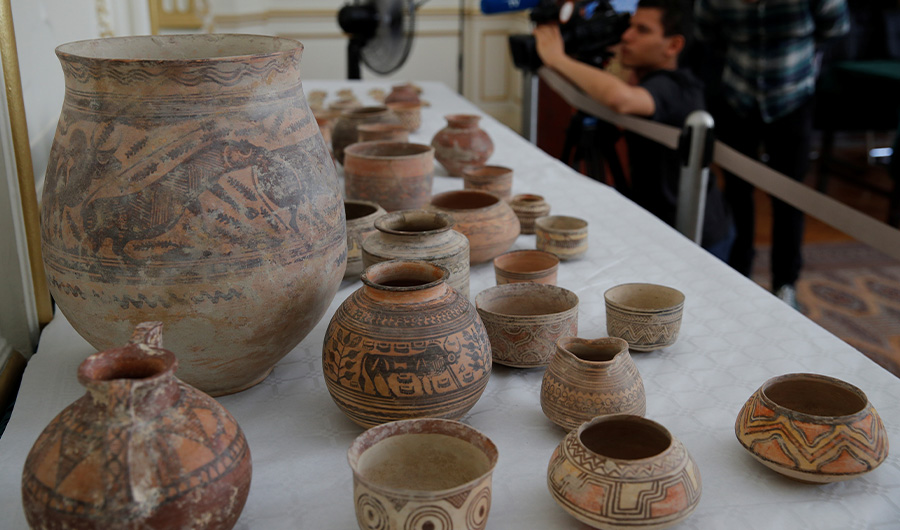


A cameraman films some artifacts amongst the 445 from the 2nd and 3rd millennium BC which were seized by French customs between 2006 and 2007, during a ceremony at the Embassy of Pakistan in Paris (Reuters)

Among the items on display at the embassy to mark the handover were a series of beautifully-decorated pots, vases and jars, all painstakingly adorned with small, stylized motifs of animals, plants and trees.
There were also about 100 tiny ceramic figurines, as well as plates, bowls, and goblets, all of which had been illegally shipped out of Pakistan for sale to dealers abroad.
“This is very, very important for us,” said Abbas Sarwar Qureshi, head of chancery at the Pakistani embassy where France’s top customs official attended a formal handover ceremony.
“Some of the items are 6,000 years old from the Mehrgarh civilization,” he told AFP, referring to an era that predates the Indus Valley civilization which flourished around 3,000 BC before mysteriously disappearing.
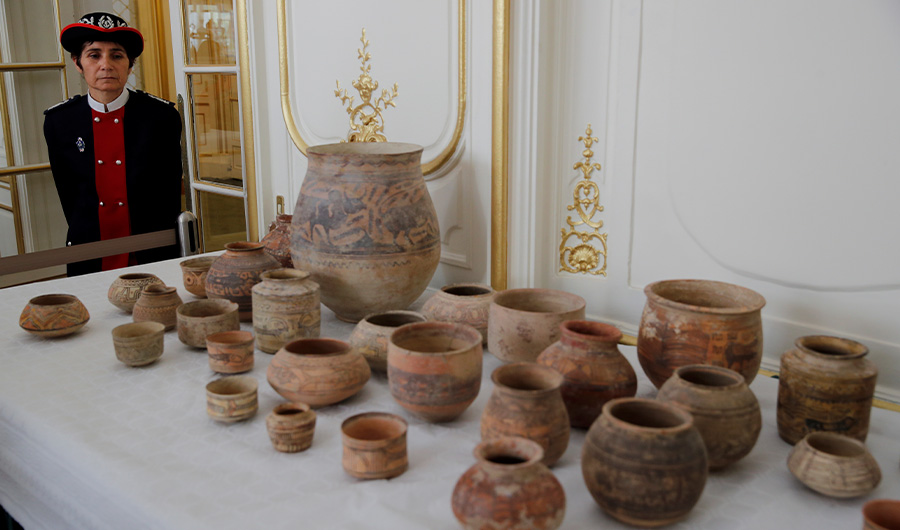


Evelyne Sarti, deputy to the inter-regional director of Paris airport customs, looks at some artifacts which were seized by French customs between 2006 and 2007, during a ceremony at the Embassy of Pakistan in Paris (Reuters)

Aurore Didier, head of France’s archaeological mission in the Indus basin, said the ceramics came from illegally-excavated graveyards and were examples of two different cultures: the Nal (3100-2700 BC), and the Kulli (2600-1900 BC).
“For this period, very few sites have been documented and archaeologists stopped their work in Baluchistan in 2007 due to political issues in the area,” she told AFP.
Although not new or unique, they provided valuable evidence of a period where most of the remaining graves had been destroyed.
“For archaeologists, it’s very important because it’s the only evidence of funerary material from this period,” she said.
Qureshi said the 445 objects would be shipped back to Pakistan “within a few weeks,” although it was not immediately clear where they would be exhibited.
Pakistan to launch AI screening in January to target fake visas, agent networks

Updated 5 sec ago
Follow

Pakistan to launch AI screening in January to target fake visas, agent networks

  • New system to flag forged-document travelers before boarding and pre-verify eligibility
  • Move comes amid increasing concern over fake visas, fraudulent agents, forged papers

ISLAMABAD: Pakistan will roll out an AI-based immigration screening system in Islamabad from January to detect forged documents and prevent illegal overseas travel, the government said on Thursday. 

The move comes amid increasing concern over fake visas, fraudulent agents and forged papers, with officials warning that such activity has contributed to deportations, human smuggling and reputational damage abroad. Pakistan has also faced scrutiny over irregular migration flows and labor-market vulnerability, particularly in the Gulf region, prompting calls for more reliable pre-departure checks and digital verification.

The reforms include plans to make the protector-stamp system — the clearance required for Pakistani citizens seeking overseas employment — “foolproof”, tighten labor-visa documentation, and cancel the passports of deportees to prevent them from securing visas again. The government has sought final recommendations within seven days, signalling a rapid enforcement timeline.

“To stop illegal immigration, an AI-based app pilot project is being launched in Islamabad from January,” Interior Minister Mohsin Naqvi said following a high-level meeting chaired by him and Minister for Overseas Pakistanis Chaudhry Salik Hussain.

Naqvi said the new screening technology is intended to determine travelers’ eligibility in advance, reducing airport off-loads and closing loopholes exploited by traffickers and unregistered agents.

The interior minister added that Pakistan remains in contact with foreign governments to improve the global perception and ranking of the green passport, while a uniform international driving license will be issued through the National Police Bureau.

The meeting also approved zero-tolerance measures against fraudulent visa brokers, while the Overseas Pakistanis Ministry pledged full cooperation to streamline the emigration workflow. Minister Hussain said transparency in the protector process has become a “basic requirement,” particularly for labor-migration cases.

Pakistan’s current immigration system has long struggled with document fraud, with repeated cases of passengers grounded at airports due to forged papers or agent-facilitated travel. The launch of an AI screening layer, if implemented effectively, could shift the burden from manual counters to pre-flight verification, allowing authorities to identify risk profiles before departure rather than after arrival abroad.

The reforms also come at a moment when labor mobility is tightening globally. Gulf states have begun demanding greater documentation assurance for imported labor, while European and Asian destinations have increased scrutiny following trafficking arrests and irregular-entry routes from South Asia. For Pakistan, preventing fraudulent departures is increasingly linked to protecting genuine workers, reducing deportation cycles and stabilizing the country’s overseas employment footprint.